
The next stop on our tour finds us at Sophia’s Dairy. No, this does not involve cows. Rather, the name refers to one of the first fine homes built in the county, by the daughter of a wealthy landholder.
Sophia White Hall was the daughter of Col. Thomas White who came to America from England in 1720, at age 15, and became a surveyor. That trade served him well. In 1777, he owned 7772 acres according to a tax assessment. However, some of this acreage was inherited in 1737 from his wife Sophia Hall White’s father, John Hall of Cranberry, who was given a 1500 acre tract of land along the Bush River in 1673.
Hall’s vast land holdings included part of Constant Friendship, as well as the oddly-named Ah Ah the Cow Pasture. According to legend, a headless horseman would terrorize riders attempting to ford the stream, known as the Ha Ha Branch, near Abingdon. The ghost purportedly would issue, “blood curdling taunts of, ‘Ha Ha!’” according to C. Milton Wright’s, Our Harford Heritage.
Find out what's happening in Aberdeenfor free with the latest updates from Patch.
When Sophia White married Aquilla Hall, her first cousin, they built the 64’x54’ “Dairy House,” in 1768, on land which was once owned by their mutual grandfather, and had been in their family for three generations, since 1718. To see a photo of the property please click here.
The design of this house represented a departure from earlier, more functional styles. It was described as, “Simple to the point of severity on the exterior, the house’s interior explodes in a glorious array of fashionably carved wood: Doric cornices, fluted pilasters, modillioned cornices, and cossetted window and door trim, in An Architectural History of Harford County, Maryland, by Christopher Weeks.
Find out what's happening in Aberdeenfor free with the latest updates from Patch.
In addition, a two-sided staircase rose from the foyer wall to meet in the middle with a short flight to the landing of the second floor. It was quite the masterpiece of its time and place. To see a photo of the staircase click here.
According to the Maryland Historical Trust (MHT), the house was built by five, “redemptionists.” This brings up an interesting historical point about the settlers who came to this country in the 18th century.
Redemptioners were immigrants who, in exchange for their passage on a ship, either had that fee paid by family members upon arrival in America, or they contracted their own indentured servitude. Their terms of service generally lasted about 7 years, and after they had, “redeemed,” themselves, they were given their freedom.
Obviously, the redemptioners who worked on Sophia’s Dairy were master craftsmen. It’s a shame their names have been lost to the ages.
However, the name of Aquilla Hall has echoed through the years. He was politically active in the county and his efforts had national impact. Hall was born in 1727 and, in1762, he was sheriff of Baltimore County (which included what would become Harford County). The following year he served in the Maryland House of Delegates.
Ten years later, in 1773, Hall became one of seven commissioners in the brand new county of Harford and the first court held in Bush (the fifth county seat was called Harford Town at the time) was held at a house he owned, according to the MHT.
In 1775, Hall’s name is the first of the 22 signers of the Bush Declaration, which pre-dated the Declaration of Independence by 14 months. (More about that interesting story another week.) He became Colonel of the Militia in 1776, and was made Lord Justice of the Court at Bush in 1779. Hall died that year.
This family’s contributions to America don’t end there. Sophia’s father remarried following her mother’s death and he had more children. One of these was William White. According to an account by Weeks, he was a rather capricious sort and he and Benjamin Franklin aided in an elopement in 1765, and in 1770 William White counted among his English friends such literary luminaries of the time as Samuel Johnson and Oliver Goldsmith.
William White’s interests in the secular life gave way to the theological and, in 1782, he became the first Bishop of the Protestant Episcopal Church in America. He served the faithful in Philadelphia.
There is yet one more notable member of the White family, and that would be Sophia’s sister Mary’s husband, Robert Morris. Morris came to be known as the, “Financier of the American Revolution.” He was also a signer of the Declaration of Independence.
In 1782, Morris, “opened the Bank of North America in Philadelphia, the first financial institution charted by the United States,” according to an article, “The Men Behind the American Revolution: Robert Morris,” by Rick Brainard.
Sophia’s Dairy remained in the hands of various descendants until it was bought in 1934 by Bata Shoe Company. According to MHT, the house was, “carefully restored for their executive, Victor Schmidt.” In addition, “Bata planned a large city for their workers on this land, but found instead that American workers expect to commute long distances to work.”
Sophia’s Dairy is currently a private residence.
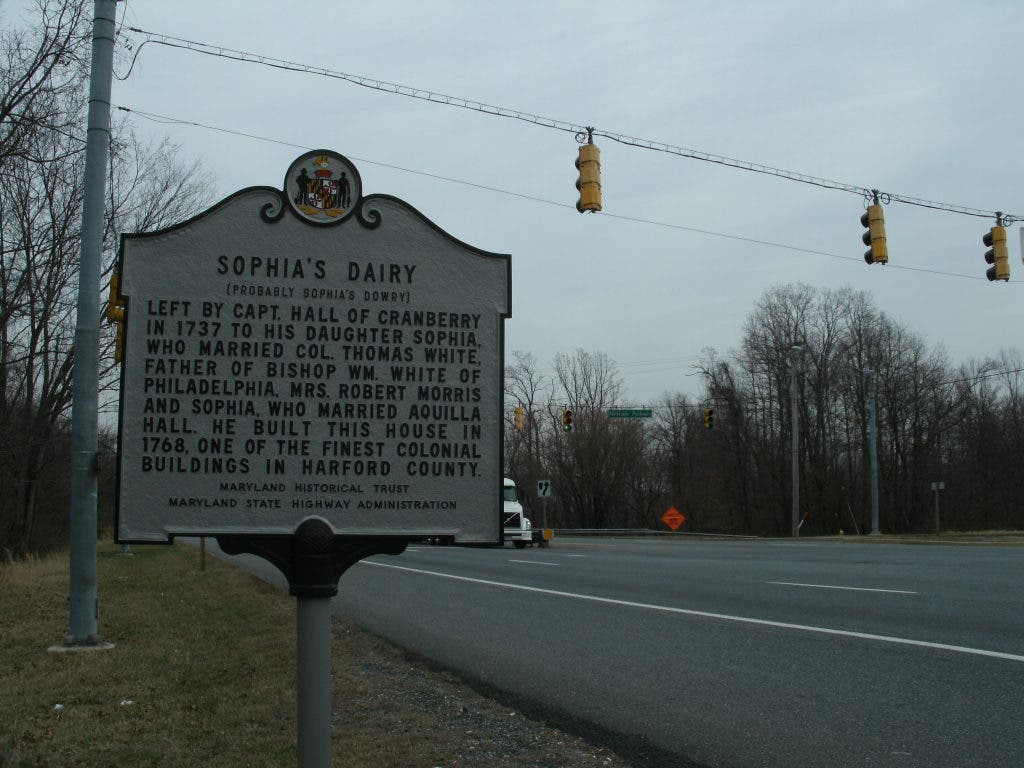
This sign is located on Rte. 40, near the intersection of Rte. 543, in Belcamp, and it was erected by the Maryland Historical Trust and the Maryland State Highway Administration.