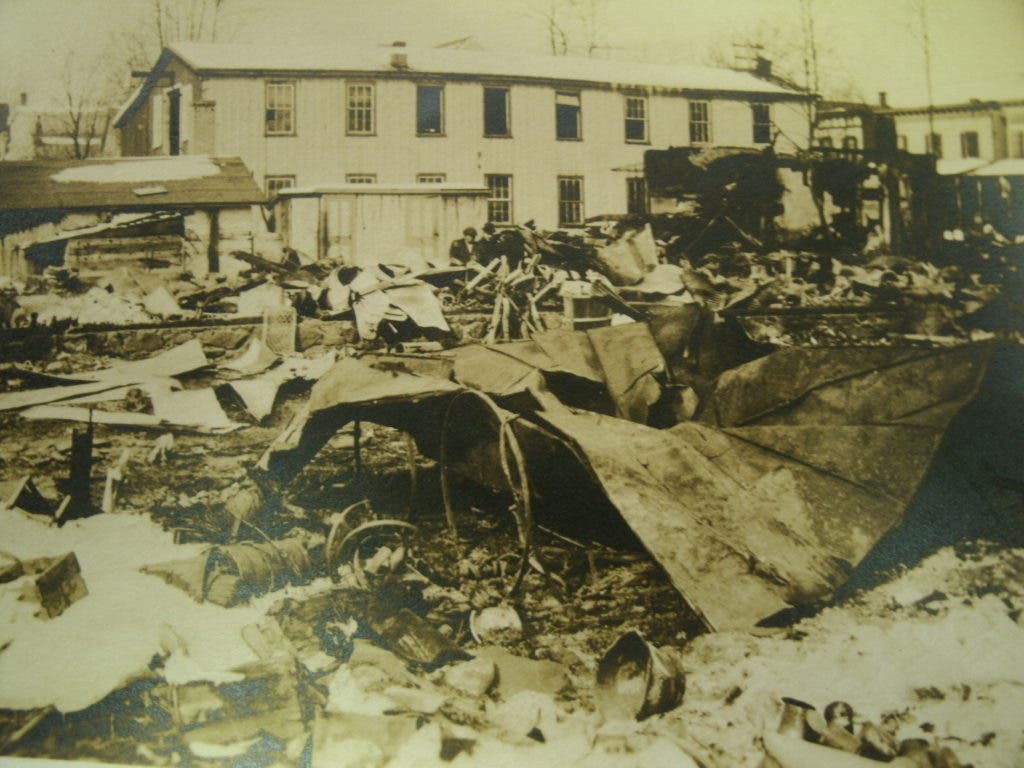


When fire broke out downtown on West Bel Air Avenue in the frigid early morning hours of February 5, 1918, it wasn’t the first fire Aberdeen saw, nor would it be the last, but the destruction was far greater than it had to be, as written in documents found at .
According to a news report in The Harford Democrat, the fire started when an oil stove exploded. It had been left burning to prevent the water pipes from freezing at the Adams & Co. meat shop.
The store was located on the west side of the street, a couple of blocks from what was then called Front Street. We know it now as Route 40.
Find out what's happening in Aberdeenfor free with the latest updates from Patch.
Public water flowed through the town courtesy of a standpipe, which was created in 1897 and held 100,000 gallons of water, and it was filled by gasoline driven pumps.
With many of the town’s water plugs frozen, the winds spread
the flames without much resistance. At some point, sent crews to help fight the fire.
Find out what's happening in Aberdeenfor free with the latest updates from Patch.
One of the businesses consumed by the blaze was that of Henry Tarring & Son. Their hardware store stocked dynamite and the, “terrific explosion spread the flames to other buildings."
Tarring’s loss amounted to $75,000. The store was not insured.
Other businesses that were destroyed included Slade’s Harness Shop, Harry Ivin's drugstore, Henry Amos Osborn’s office, Fyle’s Store, Hanway & Gibson’s Mercantile and William Silver & Co.
The fire was so intense that the safe at Silver & Co. exploded.
The Odd Fellows building was destroyed along with the Masonic Temple and the Post Office, which was on the ground floor.
The most needless loss occurred at Hanway & Gibson’s Mercantile, located across the street from the Odd Fellows building.
The fire started in the eaves and on a shed. The flame was small and men threw ice and snow and water from the gutters on the flames.
With the fire plugs frozen, the two fire companies of Aberdeen tried starting fires to thaw them. One usable plug was found across the Pennsylvania Railroad tracks.
According to documents from a subsequent lawsuit, the firemen stretched the hose across the tracks to Hanway’s store, “and were about to turn the water on the small blaze, then on the store” when a train ran over the hose.
This happened despite the fact that the railroad had been advised of the situation.
Undaunted, “the firemen spliced the hose and were able to turn it again on the small fire,” and then, “a second train cut the hose again.” That delay made it impossible to save the store.
Hanway reportedly suffered a loss of $30,000. It isn’t recorded whether or not the mercantile was insured, but given the lawsuit which ensued the following year, it seems safe to assume it was not.
Harford Mutual Insurance was relatively unscathed by the damages and only had to pay out $9,000, according to the account in the Harford Democrat.
When the smoke cleared, the buildings from the corner of Route 40 to the modern post office were destroyed. Hanway’s store was the only loss on the other side of the street.
The next installment of The Wayback Machine will recount the almost comical trial in which the Pennsylvania Railroad attempted to defend its actions, or lack thereof, during the fire.