Politics & Government
A Decade After Settlement, Medical Care Still Falls Short At Baltimore Jail
Decade-old settlement over medical access at Baltimore jail extended for the third time.
August 17, 2026
A decade-old settlement requiring the state to improve medical care at a Baltimore jail was extended for the third time this June after the federal court found the state remained partially or fully noncompliant with several requirements.
Find out what's happening in Across Marylandfor free with the latest updates from Patch.

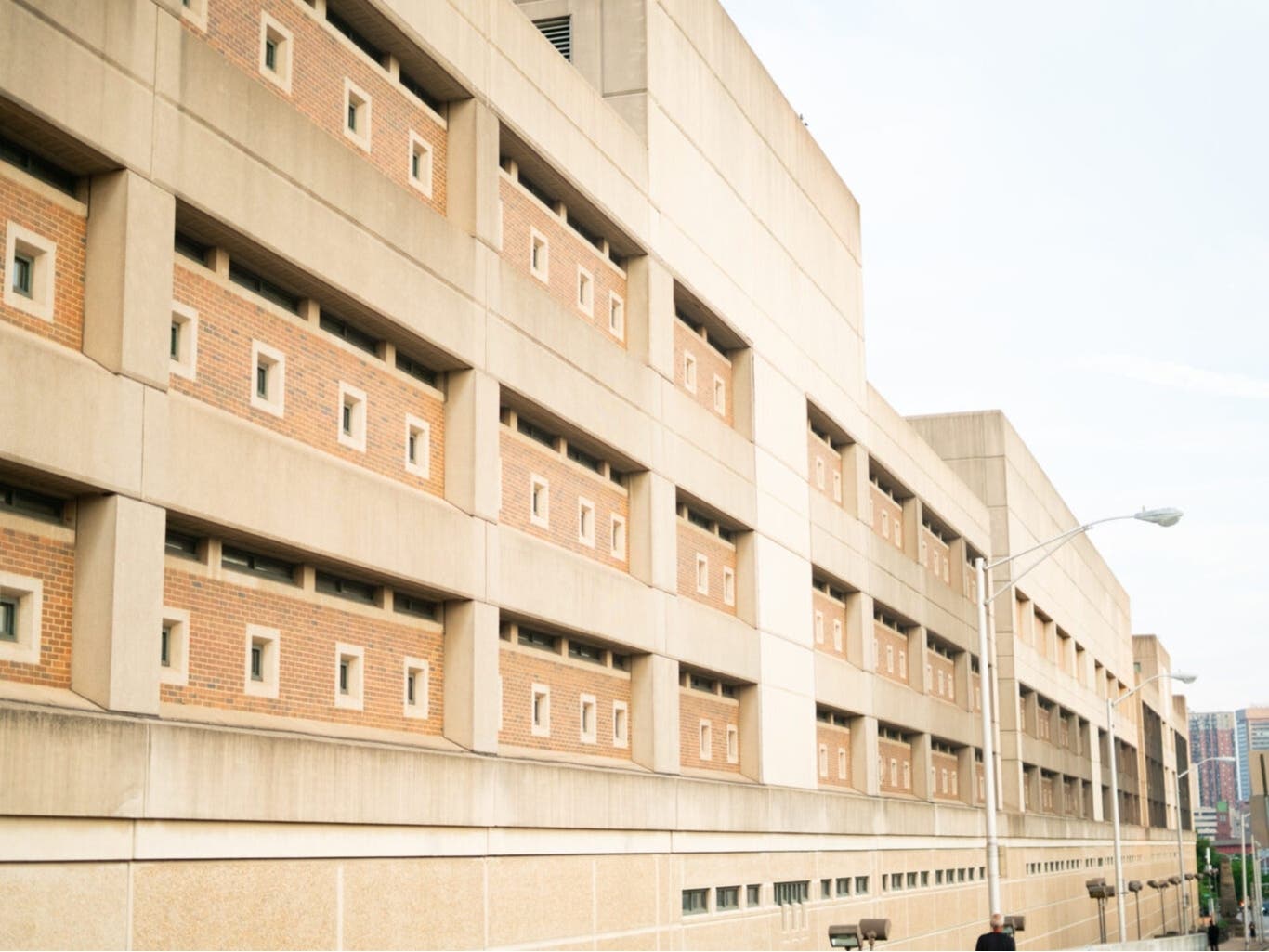
The 2016 settlement of Duvall v. Moore established a consent decree requiring the Department of Public Safety and Correctional Services to comply with a list of provisions related to facility maintenance and medical and mental health care for inmates at the Baltimore Central Booking and Intake Center. The department must submit regular reports to the court and is subject to oversight from court-appointed monitors.
Find out what's happening in Across Marylandfor free with the latest updates from Patch.
The original lawsuit was actually brought to federal court by inmates at the Baltimore jail in 1976, and consolidated five years later with a class-action suit that entailed a decree setting standards of confinement in the facility, including medical care. Over the following decades, the case was revised, settled and revived multiple times, including in the years leading up to the 2016 settlement that established the current decree.
Opening her June 2016 opinion, U.S. District Judge Ellen Lipton Hollander wrote, “This litigation is now in its fifth decade. Hopefully, the case is drawing to an end.”
But a decade later, that settlement’s third extension was extended again by U.S. District Judge Matthew J. Maddox, to Dec. 31, 2027.
“It’s frustrating that you know it was supposed to be in compliance fully six years ago, and again here we are,” said Corene Kendrick, deputy director of the American Civil Liberties Union National Prison Project, which represents the detainees. “It’s dragged on way too long.”
There has been some progress. The last of the 2016 provisions related to issues with the physical facility of Central Booking itself, such as heat injury risk, poor hygiene and sanitation, vermin infestations and utility maintenance, were dropped in 2018 after a medical monitor determined the state reached compliance.
Another milestone came this June.
Since the Moore Administration took office, it has worked diligently to ensure that the conditions of that settlement are finally met,” said Yianni Varonis, communications director for the Department of Public Safety and Correctional Services.
“As a result of this Administration’s efforts, the Court has agreed that BCBIC is now substantially compliant on the condition of mental health requirements—a significant victory since this case is nearly half a century old,” Varonis said.
The parties stipulated in December 2025 that the State was compliant with mental health provisions after a report by Dr. Jeffrey Metzner, who served as the court-appointed mental health monitor.
“I don’t in any way think that it’s perfect,” Kendrick said, “But it’s improved enough so that he just decided that it was good enough.”
Still, intake, management and testing of medication, medical records and plan of care, specialty care, disability accommodation and interaction between custody and medical staff remain partially or fully noncompliant, according to a July report by Dr. Muthusamy Anandkumar, who was appointed by the court in December 2024.
“DPSCS also strongly believes it meets or exceeds the requirements of both the Constitution and the Settlement Agreement regarding medical services,” Varonis said. “DPSCS is confident that the Court will recognize the substantial work of this Administration to meet each of its obligations.”
While those efforts continue, Central Booking faces litigation over other issues, including a 2022 lawsuit alleging the department routinely detained people beyond their release at the jail.
A federal judge ruled in June that the problem of over-detention persists and the lawsuit is eligible for class action litigation, the Baltimore Sun reported.
“For a jail that has had ongoing issues with things like releasing people in a timely way, it’s honestly not surprising that they’re failing to get people their medications and their healthcare treatment in a timely way,” said Wanda Bertram, communications strategist for the Prison Policy Initiative.
“All of the issues that I saw in the write-up of the Duvall-Moore case are ones that ring a bell for me,” Bertram said, noting that untimely responses to medical requests and poor intake screening are problems in jails nationwide. “One widespread issue seems to be that jails don’t want to spend the money to obtain the medications that people need most often.”
Kendrick said the department’s use of contractors for medical care has complicated efforts to improve conditions.
“Unfortunately, one of the things that we have seen across the country is this growth of the private companies that are for-profit that go around and tell jurisdictions, ‘Oh, we can provide healthcare more cheaply than if you do it yourself,’” she said.
“The problem is they always say it’s going to save the state or the county money but then ultimately, it doesn’t really, because you’re including a profit motive,” Kendrick said, noting that her organization is involved with similar litigation across the country.
The department’s Virginia-based medical care service provider, Centurion Health, has yet to reach the required staffing threshold, and medical complaints did not receive timely or any response in some cases, according to a February report by the Department of Legislative Services Office of Policy Analysis.
The report cited Centurion with $11.8 million in damages from February to June 2025, mostly “related to staffing levels.” From February to August that year, $109,150 in damages was levied for complaints without timely responses.
Before Centurion signed its five-year contract in 2024, worth $1.2 billion for correctional facilities and $490 million for pretrial detention facilities like Central Booking, the company handled mental health care while a Tennessee-based company, at the time called Corizon Health, handled medical care.
In 2023, Corizon entered into bankruptcy as a result of litigation from inmates across the country. It restructured and continued business under the name of YesCare until that company filed bankruptcy, too, in May. It reported liabilities of $100 million to $500 million and began shuttering its headquarters on June 22, according to Behavioral Health Business.
Neither Centurion Health nor YesCare responded to requests for comment.
“All of the major healthcare contractors, you know – Wellpath, YesCare, Centurion, Armor, NaphCare – they’re all deluged with lawsuits,” Bertram said. “It doesn’t work for a county or a state prison system to just hop from one provider to the next and say that’s going to fix the problem.”
In a June hearing granting the settlement’s latest extension, the court ordered the department to submit a report detailing its plans to become compliant with the Duvall decree by the new deadline.
“I’m hopeful that this will force them to really kind of focus,” Kendrick said.
She added that a similar report was required in 2022, but “that kind of fell by the wayside” after Corizon’s contract ended. “That’s been part of the problem and cause of the delay, I think, is just the turnover in the companies,” she said.
Betram noted that regardless of who’s providing the healthcare to inmates, administrators of correctional facilities don’t see those services as part of their job. She said there’s a tension underlying American jails and prisons between that punitive mentality and the laws and rulings that require proper medical care for inmates.
Sending inmates to state hospitals or retaining their access to Medicare could go a long way toward improving healthcare in correctional facilities, Bertram said. She also suggested bail reform as a potential solution, given that facilities like Central Booking hold pretrial detainees who often would have been released if only they could afford bail.
“The bigger issue here is the fiscal austerity that counties treat jail healthcare with, and privatizing that care is often just like a symptom of that,” Bertram said. “As long as a jail is prioritizing security at all costs over healthcare, the healthcare is just not going to be very good.”
Maryland Matters is part of States Newsroom, a network of news bureaus supported by grants and a coalition of donors as a 501(c)(3) public charity. Maryland Matters maintains editorial independence. Contact Editor Steve Crane for questions: scrane@marylandmatters.org. Follow Maryland Matters on Facebook and Twitter.