Politics & Government
Ed Hale's Money-Making Proposal For The Governor's Mansion
Airbnb, weddings and bar mitzvahs for rent at Government House; GOP candidate for governor says it's no joke.
May 14, 2026
Travelers to Annapolis have always been able to stay in a historic property, but not the likes of the property Ed Hale Sr. has in mind.
Find out what's happening in Across Marylandfor free with the latest updates from Patch.
Hale, a Republican candidate for governor, said that instead of raising taxes — the Baltimore businessman is firmly anti-tax — he wants to turn the governor’s mansion into a moneymaker, renting it out for events, overnight stays and the like.
“I’m a single man, and living in that mansion, I don’t want to do that,” Hale said. “That, to me, should be turned from an expense into some sort of revenue source.”
Find out what's happening in Across Marylandfor free with the latest updates from Patch.
He swears he’s not joking.
The comments came at a recent campaign stop outside a vehicle emissions test station in Hyattsville that was meant to highlight concerns about VEIP.
“This is a grab for money that really is not necessary,” Hale said, adding that he supports eliminating the test and making changes to the state’s gas tax.

Ed Hale Sr., a Republican candidate for governor, said he wants to end the vehicle emissions test and automatic gas tax increases, and wants to turn the governor’s mansion into a moneymaker. (Photo by Bryan P. Sears/Maryland Matters)
But he also used the 20-minute stop for an off-the-cuff tangent on the official residence of Maryland’s chief executive.
“I don’t want to live there,” Hale said outside the inspection station.
Hale, a newly minted Republican, not only criticized fees and taxes, like the sales tax on IT services, he said the governor’s mansion could be used to raise money.
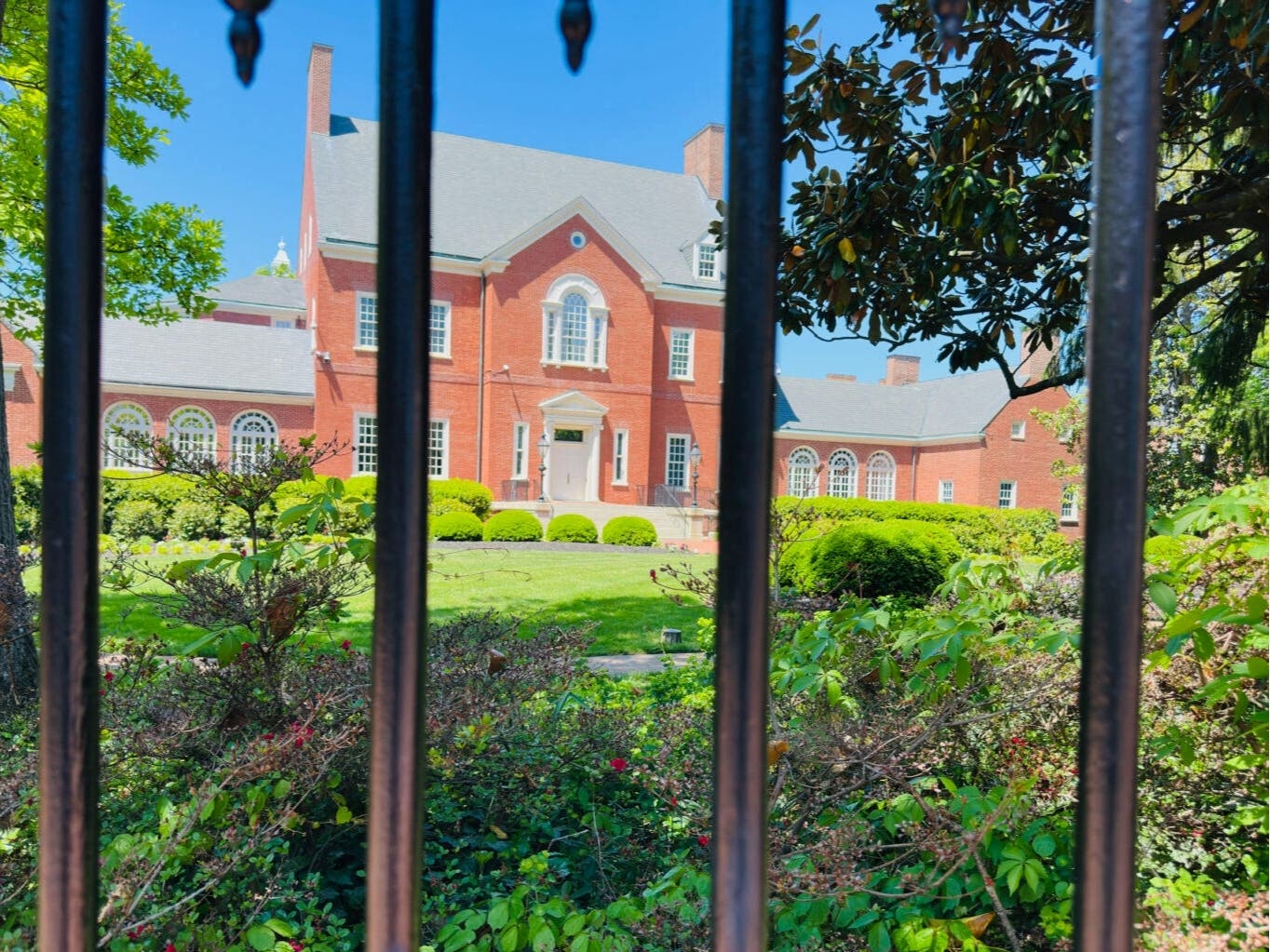
The mansion — officially known as Government House — sits across the street from the State House and is the official residence of the governor. Maryland’s Constitution requires the governor to live in Annapolis — though some, such as former Gov. Parris N. Glendening, have managed to bend that requirement to some degree.
While the language does not specifically mandate living in the mansion, that has become the tradition and expectation. Currently, the mansion is home to Gov. Wes Moore, his wife and their two children. Moore is seeking re-election.
Hale told reporters he would not hold an inauguration party if he won, calling such events a “waste of time and money.” As for living in the mansion, “I would rather commute to my farm or commute up to Baltimore to my home up there.”
‘Everybody thinks it’s a joke, but it’s not’
Hale, one of nine seeking the GOP nomination in June, does not want to see the mansion sit empty.
“People think I’m joking about it, that I don’t know what to do with it because I don’t know what the rules are,” he said. “But we should make it an Airbnb or do weddings and bar mitzvahs there. So, everybody thinks it’s a joke, but it’s not.”
The idea has the virtue of having never been previously proposed.
Some experts said doing as Hale proposes is complicated, if not impossible.
The mansion has been the home of the chief executive of the state for more than 150 years. The property is overseen by the Government House Trust.

General Services Secretary Atif Chaudhry. (File photo Bryan P. Sears/Maryland Matters)
“In addition to the obvious public safety risk that would be raised in and around the Capitol complex, commercializing Government House would be limited under State law … which assigns operational control of state property, which includes Government House as a state-owned residence, to the Maryland Department of General Services,” according to a statement from that department.
“Department of General Services Secretary Atif Chaudhry is the chair of the Government House Trust with authority over renovations, furnishings, and preservation of State rooms,” the statement said.
‘It would cause such a kerfuffle’
Such a proposal likely comes with a price tag.
First — and assuming renting it out would pass legal muster — there is the cost of upkeep for the historic house.
Second, there is the cost of security. Details of security for the governor and other officials are not made public.
In the last several years, the state has added additional cameras to the property, and the iron fencing around was raised to a new height in the last year. That change came soon after the firebombing last year of the Pennsylvania Governor’s Residence where Gov. Josh Shapiro and his family were observing the second night of Passover. The family escaped unharmed.
The Maryland Constitution says the governor “shall reside at the seat of government.” And while some governors have, at times, tested the meaning of that phrase, it has come to be understood as living at the mansion.
In addition to hosting formal and ceremonial events, the home is a museum of sorts.
Seven rooms — the Entrance Hall, the Victorian Parlor, the Federal Reception Room, the Empire Parlor, the Conservatory, the Drawing Room and the State Dining Room — are public. The home features portraits of many first ladies and other art such as the bust of Harriet Tubman, displayed in the Conservatory on a pedestal made of wood from the historic Wye Oak.
“I understand Marvin Mandel did move out of the governor’s mansion for a period of time, but he was staying on the state yacht, which was tied up in Annapolis, so he didn’t officially leave the city," said former Lt. Gov. Boyd Rutherford, who also served as General Services secretary under then-Gov. Robert Ehrlich.
“I think it would cause [longtime Senate President] Mike Miller to come back from his grave if they tried to hold wedding receptions and bar mitzvahs that are not related to the governor at Government House,” Rutherford said. “I think it would cause such a kerfuffle that the legislature would pass something.”
‘Money grab’ motor vehicle test
Hale’s side comments about Government House came as he expressed his opposition to the state’s vehicle emissions testing program.
As part of a deal to help close a budget gap last year, lawmakers raised VEIP charges from from $14 to $30, raising an additional $20 million a year. Future increases are tied to the consumer price index.
Bills to repeal the program failed this year. Besides costing the state nearly $50 million in revenue next year, analysts raised concerns that repealing VEIP would incur federal penalties including the withholding of federal aid.

The vehicle emissions testing facility in Hyattsville. (Photo Bryan P. Sears/Maryland Matters)
Hale also called for ending automatic, inflation-linked increases in the state’s gas tax. The automatic increase was imposed more than a decade ago as part of a modernization of the tax.
Democratic lawmakers have resisted calls to decouple the inflationary index, despite calls from Republican lawmakers, Gov. Larry Hogan (R), and even Gov. Wes Moore. Hale believes he could bring the legislature to heel where others have failed.
“You have me coming in, who’s unafraid to do this, and I’m going to talk about the fact that you don’t want to decouple it, and you want to go back, and you’re going to have another increase on your tax, and you got to go back into your neighborhood and see your constituents,” Hale said. “To me, that’s a deterrent for them.”
Hale said he believes lawmakers should have to cast a vote any time they want to increase the surcharge.
In 2013, lawmakers voted to couple the gasoline tax to inflation. The rate can go up, but never decreases. Annual increases are capped at 8%.
Last year, inflation rose by 2.7%. But the nine-tenths of a penny increase was offset by a drop in the pre-tax price of gasoline. leading to a net gas tax decrease of 0.1%. It was the fourth time the state gas tax decreased since 2013, all because of lower wholesale fuel prices.
The tax pays for transportation programs including transit and road projects. Hale proposed budget cuts to ensure transportation projects lose funding.
“Oh yeah, I have a lot of them,” Hale said, declining to offer specifics. “I can’t today but they involve some transportation components.”
Maryland Matters is part of States Newsroom, a network of news bureaus supported by grants and a coalition of donors as a 501(c)(3) public charity. Maryland Matters maintains editorial independence. Contact Editor Steve Crane for questions: scrane@marylandmatters.org. Follow Maryland Matters on Facebook and Twitter.