Politics & Government
Maryland Bill On Chicken House Permit Draws Environmentalists' Concern
The bill comes after Maryland failed to issue a general permit on time.
ebruary 13, 2026
Maryland Department of the Environment Secretary Serena McIlwain admits that her agency “did lapse” in failing to re-issue a critical permit for chicken houses on time.
Find out what's happening in Annapolisfor free with the latest updates from Patch.
In response, the agency is backing an emergency bill in the General Assembly that would allow construction to start on new chicken houses before the new permit is released for the industry.
The bill has vociferous support from chicken farmers, who argue they have lost time and money waiting for Maryland officials to allow them to build new poultry houses.
Find out what's happening in Annapolisfor free with the latest updates from Patch.
In testimony before House and Senate environmental committees in Annapolis this week, McIlwain argued that the legislation would not jeopardize any environmental protections, and the agency would retain its power of oversight.
“You can build a house, but you can’t move in until you get the permits,” McIlwain said. “So they’re building the houses, but the chickens can’t live there.”
Still, environmental and community groups are pushing back. They argue that allowing farmers to construct new chicken houses before permitting sets a bad precedent, and could make it more difficult for communities to provide input. After houses are built, it would be more difficult to get changes because of environmental concerns, they say.
And, as introduced, the bill wouldn’t sunset.
“This is a temporary problem that can be solved without permanently weakening oversight,” said Patti Anderson, an assistant public health professor and policy director for the Johns Hopkins University Center for a Livable Future.

Del. Regina Boyce (D- Baltimore City) sponsored a bill that would allow new chicken houses to be built in Maryland even though the state has faced delays in issuing a new permit for concentrated animal feeding operations. (Photo by Christine Condon/ Maryland Matters)
Chickens raised in the state’s poultry houses, which dot Maryland’s Eastern Shore, produce manure that can pollute waterways if it is discharged or spread on land. Chicken litter also generates airborne ammonia emissions, which can aggravate respiratory issues for people in surrounding communities. This ammonia breaks down into nitrogen, a harmful pollutant for waterways.
The state’s Department of the Environment (MDE) is in charge of issuing a general permit, which broadly covers concentrated animal feeding operations, also known as CAFOs. This permit technically lapsed in 2025, but it was administratively extended, a fairly common practice at the agency that keeps the permit in place while a new one — potentially with new requirements — is drafted.
For chicken houses and other livestock operations that were already operating in Maryland, this didn’t cause an issue. But individuals looking to build new facilities hit a roadblock, thanks to a 2019 law change, said Rick Kessler, director of the department’s Land and Materials Administration, during a January hearing in Annapolis.
“We’ve had a number of CAFO permits, and all, to my knowledge, have been administratively extended without issue to date,” Kessler said. “There were changes made in 2019 in the law that made it more difficult for us to exercise our regulatory discretion to allow for construction to proceed during the period between permits. And I think that is the source of this problem.”
Kessler said on Wednesday that the proposed legislation would give state officials the leeway to green-light construction activities.
“With our flexibility restored, we can enter into consent orders with the individual farmers and work through these things in a way we have been advised by counsel that we cannot right now,” Kessler said.
On the Senate side, the bill was sponsored by a cohort of Republican senators, including Sen. Mary Carozza (R-Eastern Shore), but on the House side it is backed by a bipartisan group, led by Del. Regina Boyce (D-Baltimore City), who sits on the House Environment and Transportation Committee, and said she backed the bill in support of farmers who have faced financial losses because of the permit delay.
“This bill is not intended to have any effect on water or air quality, nor does it eliminate a permit, weaken protections or allow unregulated CAFOs to operate,” Boyce said. “A CAFO, as you know, cannot legally house birds or generate manure without coverage under a general CAFO permit. This bill does not change that.”
Queen Anne’s County grain farmer Jason Cronshaw, who backs the bill, said during Wednesday’s hearing that he was unable to secure bank loans for a new poultry house on his farm because he was not covered under the CAFO permit. Cronshaw said he’s been stuck in the same place in the process since the summertime.
Asif Khan, who said he is trying to start a chicken house in Dorchester County after previously operating one in Delaware, said that the delayed permit has been a painful hurdle, which the bill would address.

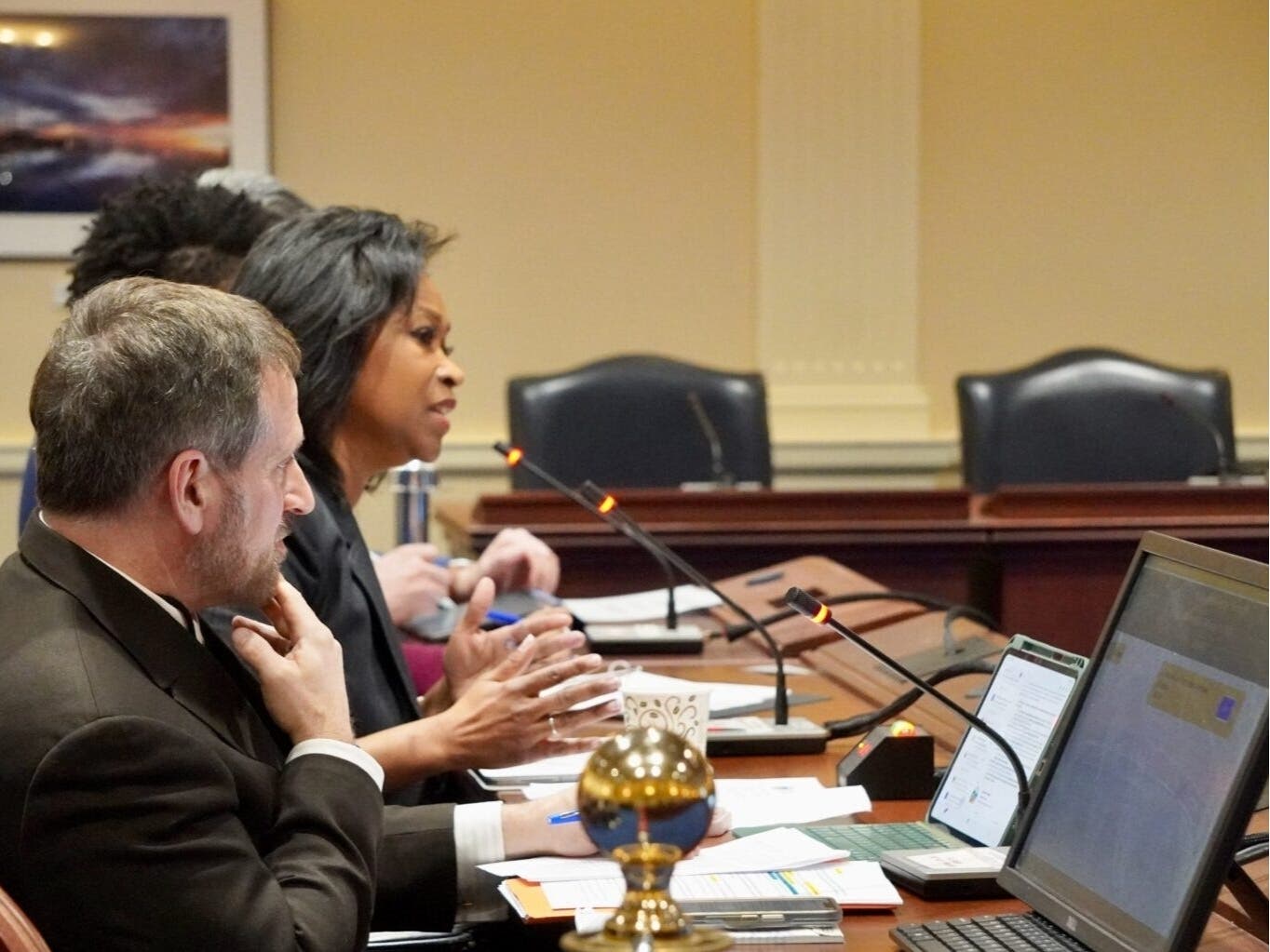
Queen Anne’s County resident Jason Cronshaw testifies in support of a bill that would allow him to begin constructing a poultry house on his farm. Cronshaw said that a delayed permit from the Maryland Department of the Environment has prevented him from moving forward. (Photo by Christine Condon/ Maryland Matters)
“It is extremely frustrating to be told that we cannot go forward with starting our farm and expanding our family’s dream, not because of anything we did, just because of an administrative error,” Khan said.
In written testimony, Jeremy D. Baker, MDE’s director of government relations, said chicken growers will still be required to obtain construction permits before they break ground, and MDE would still perform pre-construction inspections, and require builders to publicly issue information about their facilities.
He added that any farmer who decides to build before a new permit is issued would not be guaranteed a permit to actually operate, and would still be subject to enforcement actions if it violates any permit conditions.
Environmental groups, including the Chesapeake Bay Foundation, ShoreRivers and others, fear that those protections are insufficient.
Michael Payan of nonprofit Sentinels for Eastern Shore Health said it is “shameful” that the chicken industry is using a lapsed permit to make a permanent change to the law, which he said would curtail opportunities for public input.
“We cannot afford to take away an opportunity for community engagement that should come before construction of a facility, and just place it after the facility is built, so that it becomes a meaningless checkbox that needs to be ticked,” Payan said.
Payan says he worries about what would happen if a facility is built, but then community members notice problems, or the site is out of compliance with the permit later issued by MDE.
“Who’s going to fix that problem? Will the community be burned with the consequences of what could have been fixed with input prior to construction?” Payan said. “Will the lender shell out more money to make changes to the facility?”
But McIlwain argued that chicken farmers should be able to take the risk of having to make future changes to their construction.
“This is just allowing them to construct. They still have to go through the CAFO permit. And so it is a risk for them, but I think if they’re willing to take it, they should,” McIlwain said.
Annie Richards, Chester Riverkeeper at ShoreRivers, said she feels that the appropriate fix for the issue faced by chicken farmers would be to pass legislation that compels the agency to issue its permit in a timely fashion.
“We feel the emphasis of this legislation, therefore should be targeting accountability for the Maryland Department of the Environment,” Richards said. “Instead, we are discussing a retreat from the Clean Water Act that will set a precedent for a build first, permit later standard.”
Committee members in the House seemed open to some potential amendments. Del. Marc Korman (D- Montgomery), who chairs the House Environment and Transportation committee, asked some panelists about the possibility of restricting the bill to only apply if MDE’s permit lapses. Korman also expressed interest in Richards’ suggestion.
“That might be a good add-on to the bill, regardless of what happens,” Korman told Richards.