Community Corner
Baltimore Cracks Top 20 Most Populous Metros
Despite the Baltimore region growing, census data shows Baltimore was the second biggest loser of residents in the U.S.


BALTIMORE, MD — New census data reveals Baltimore was the second biggest loser in terms of population from 2016 to 2017 among cities and counties nationwide. That said, the greater Baltimore metro region moved up comparatively and is now listed among the top 20 largest metro areas in the country. Its previous spot on the list was 21st.
According to U.S. Census Bureau population estimates released this week, Baltimore City was among the U.S. jurisdictions with the greatest population loss from 2016 to 2017.
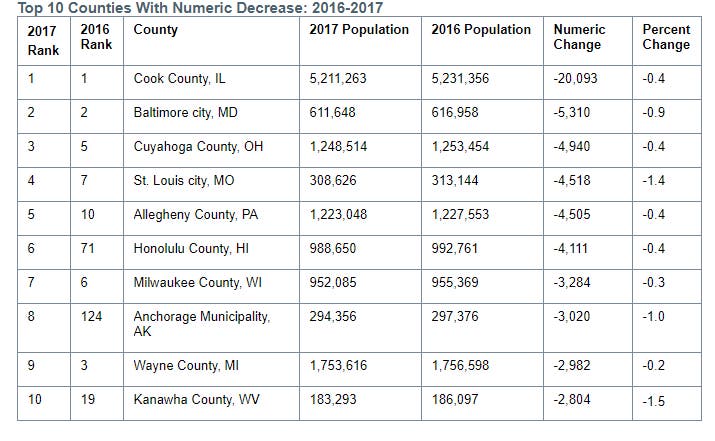
Charm City had the second largest population decrease by the numbers, the data shows. Baltimore had 611,648 residents in 2017, compared with 616,958 in 2016, meaning the city lost a total of 5,310 people.
Find out what's happening in Baltimorefor free with the latest updates from Patch.
In sheer numbers, Baltimore was eclipsed only by Cook County, Illinois, where Chicago is located; Cook County lost 20,093 people, according to the new estimates from July 1, 2017.
The table below is provided by the U.S. Census Bureau. It shows that while Baltimore's population went down, the overall percentage of loss was not as high as, say, St. Louis, Missouri; Kanawha County, West Virginia; or Anchorage, Alaska.
Find out what's happening in Baltimorefor free with the latest updates from Patch.
Despite the number of people leaving, Baltimore moved up in terms of metropolitan areas in America. It is now among the top 20 most populous metropolitan areas in the U.S. Previously, Baltimore had been No. 21 in terms of size, but it switched spots with St. Louis based on the latest estimates.
The Baltimore metropolitan area includes Anne Arundel County, Baltimore City, Baltimore County, Carroll County, Harford County, Howard County and Queen Anne's County. The metropolitan area is a region determined by the census bureau to be linked by economic and social ties.
The metro areas that saw the most growth in the U.S. between 2016 and 2017 were in the south and the west, with the Dallas area topping the list, according to the U.S. Census Bureau.
“Historically, the Dallas metro area attracts large numbers from both international and domestic migration. Many of the other largest metro areas in the country rely mostly on international migration and natural increase for growth,” Census Bureau Demographer Molly Cromwell said in a statement.
Baltimore's population has been declining for decades. At its peak, Charm City had nearly 950,000 residents in the 1950 census. By 1970 the population was down to around 905,000; the population in the 1990 census was about 736,000; and by 2010, Baltimore was down to a little more than 620,000 people.
Photo of Baltimore City waterfront off Boston Street by Elizabeth Janney.
Get more local news delivered straight to your inbox. Sign up for free Patch newsletters and alerts.