Health & Fitness
Most In MD Will Get COVID-19 Vaccine But Skeptics Remain: Survey
Nearly 3,700 took the Maryland Patch survey on the coronavirus vaccine. Here's what they said.


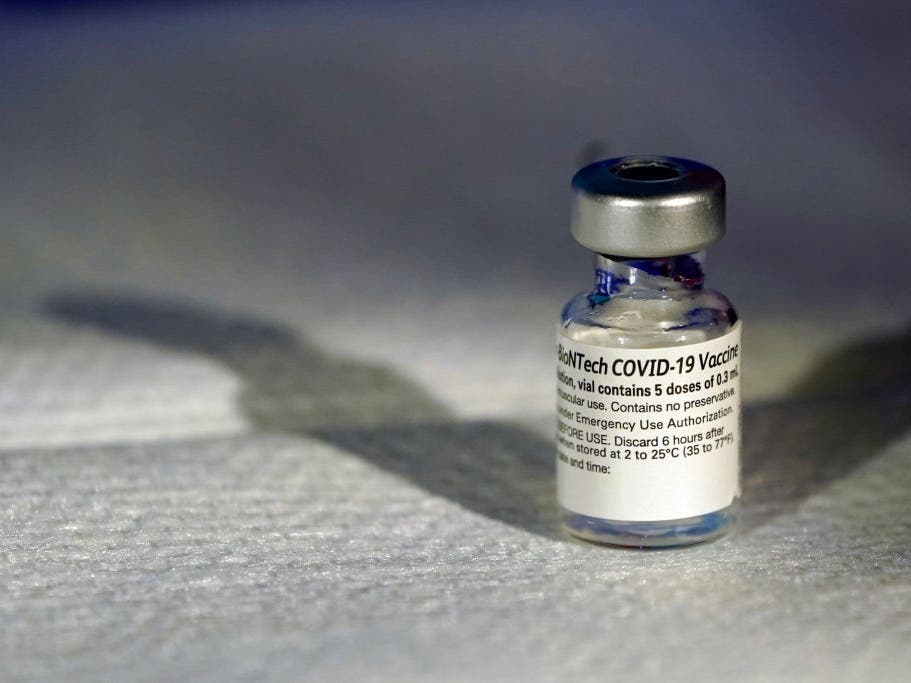
MARYLAND — With the release of a coronavirus vaccine beginning this month in Maryland, the majority of the nearly 3,700 readers who took Patch's survey say they intend to get vaccinated against the disease. However, others said they were concerned production of the vaccine was rushed.
Just a year after the emergence of the coronavirus — which has since killed more than 5,000 in Maryland — two vaccines are expected to become available in the United States this month.
In Maryland, officials are estimating the state will receive 50,000 doses of the Pfizer vaccine and 104,000 doses of the Moderna vaccine in its first allocation.
Find out what's happening in Baltimorefor free with the latest updates from Patch.
Front-line health care workers, people living and working in nursing homes and first responders are among the first to receive the vaccination.
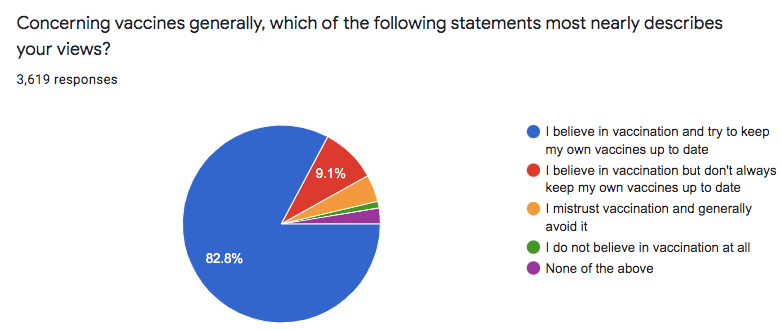
An overwhelming number of Maryland Patch readers who responded to the survey — nearly 83 percent — say they believe in vaccination and try to stay up to date on their own shots, with a small minority (about 1 percent) saying they don't believe in vaccination at all. Another 9 percent said they believe in vaccination but don't always keep their own shots up to date, and more than 4 percent said they mistrust vaccination and generally avoid it.
Find out what's happening in Baltimorefor free with the latest updates from Patch.
More than 86 percent of those who took Patch's survey said they already got a flu shot this year or intended to get one.
As for whether they intend to get vaccinated against the COVID-19 virus, 65.9 percent of respondents said they will get a vaccine at the earliest opportunity.
Others were more cautious, with 22.5 percent saying they will get one, but only after it's been in use long enough to make sure it is safe and effective. More than 9 percent said they will not get one at all, and the remaining 2.4 percent of those who responded said they are not sure.
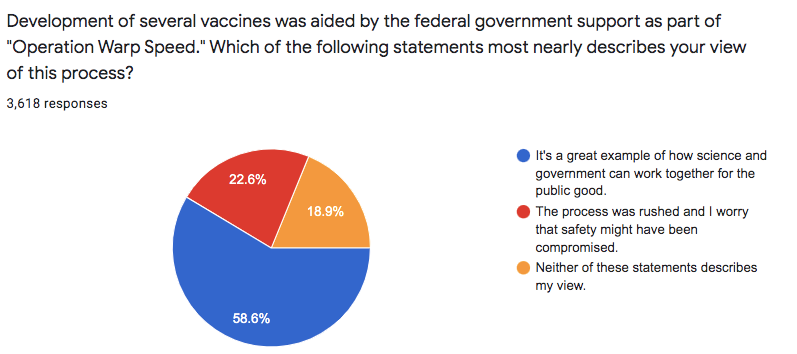
Meanwhile, 58.6 percent of Patch readers were pleased with the way the government and researchers worked together as part of Operation Warp Speed to develop several vaccines against the virus.
But 22.6 percent said they felt the project was rushed and are worried the safety of the vaccines may be compromised.
For perspective, it has been just about a year since the first cases of the coronavirus were detected in December 2019, as a cluster of pneumonia cases of unknown origin were diagnosed in Wuhan, China. On Jan. 12, Chinese authorities noted a novel coronavirus termed severe acute respiratory syndrome coronavirus 2 (SARS-CoV-2). Community spread of the coronavirus was first detected in the United States in February, and by mid-March, all 50 states had confirmed cases of the virus.
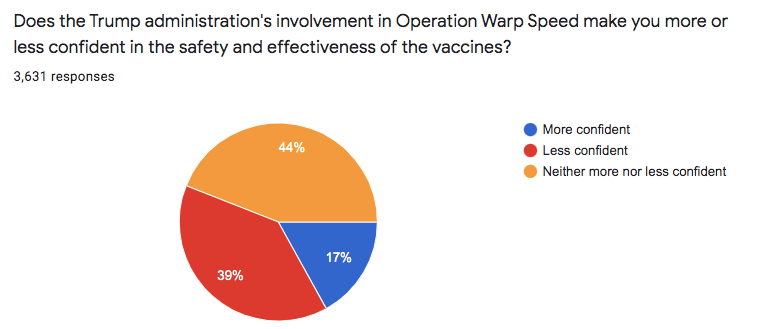
Forty-four percent of readers who responded said the Trump administration's involvement in the project did not impact their confidence in the project.
But for 39 percent, the administration's involvement makes them less confident in the vaccines. For 17 percent, it made them more confident.
One respondent said: "I don't like it when political questions are mixed with medical science."
Dr. Anthony Fauci, director of the National Institute of Allergy and Infectious Diseases, was identified as the source of trusted information for 67 percent of respondents in the Maryland Patch vaccine survey.
"As a preschool teacher, I am ready to get my vaccine so that I can feel safe at school and not worry about bringing it home," one respondent said. "If Fauci or other experts like him say 'Yes,' I'm in."
Patch readers were also given the opportunity to leave comments regarding their thoughts on the coronavirus vaccines in general. Many said they trust those behind the development of the vaccines and that they will get vaccinated regardless of which vaccine they receive, but some were skeptical.
"I am a nurse. Either you get the vaccine or you get the virus. The virus is 100% more of a risk!" one respondent said.
"Refusing vaccination falls somewhere between reckless endangerment and assault with a deadly weapon," another wrote. "There needs to be negative consequences."
Some remain skeptical, however.
"I don't want to be experimented on," wrote one person, who identified as a senior. " With these new vaccines, it usually takes about a year before side effects come out. I'm a senior and can't afford it. Besides, they haven't proved the interaction between all the medications we take!"
One person was reportedly ineligible for the vaccine because of liver problems, while another said she would not take the vaccine because she was concerned about pregnancy.
"My biggest concern with the vaccine is the impact [on] fertility long term," the respondent said. "I would most likely not take it until done with child bearing. That being said, I’m also concerned with the impact the virus could have on fertility, but I’m trying my very best to stay safe!"
According to the Centers for Disease Control and Prevention, there is no data on pregnancy and the Pfizer vaccine as of Dec. 12, while COVID-19 may put pregnant women at increased risk of severe illness, including ICU admission, mechanical ventilation and death, and there may be a risk of preterm birth.
Another person suggested going back to the basics of healthy habits.
"The government needs to promote how people can naturally boost their immune system without drugs or vaccines," one respondent said. "That is the cheapest and safest option with no side effects."
Here are ways to help control the spread of the virus, according to state leaders
- Wear a mask over your mouth and nose — don't pull it down to speak.
- Practice physical distancing, keeping at least 6 feet of distance between people.
- Wash hands frequently.
- Avoid traveling to states with coronavirus positivity rates of at least 10 percent.
- Telework when possible.
Note: Patch's survey on the coronavirus vaccine was not meant to be a scientific poll, with random sampling and margins of error, but meant only to gauge the sentiments of our readers in an informal way.
With reporting by Shannon Antinori and Kara Seymour of Patch.
Get more local news delivered straight to your inbox. Sign up for free Patch newsletters and alerts.