Weather
Full Buck Moon To Shine Over Maryland: When To Watch
Skies over Maryland will be illuminated Friday by July's full moon. Plus, planets and meteors may be visible overhead.


MARYLAND — The July full buck moon, so named because it comes at the time of year when male deer begin to grow velvety antlers, reaches 100 percent fullness at 10:37 p.m. Friday.
It will appear full from Thursday night until Sunday morning, according to NASA.
July's full moon is sometimes called the full hay moon since it occurs about the time farmers put hay up in their barns, or the full thunder moon because of the prevalence of thunderstorms in July.
Find out what's happening in Bel Airfor free with the latest updates from Patch.
Particles in the atmosphere from wildfires in the west may cause the moon to appear orange.
Planets are also part of the show this weekend.
Find out what's happening in Bel Airfor free with the latest updates from Patch.
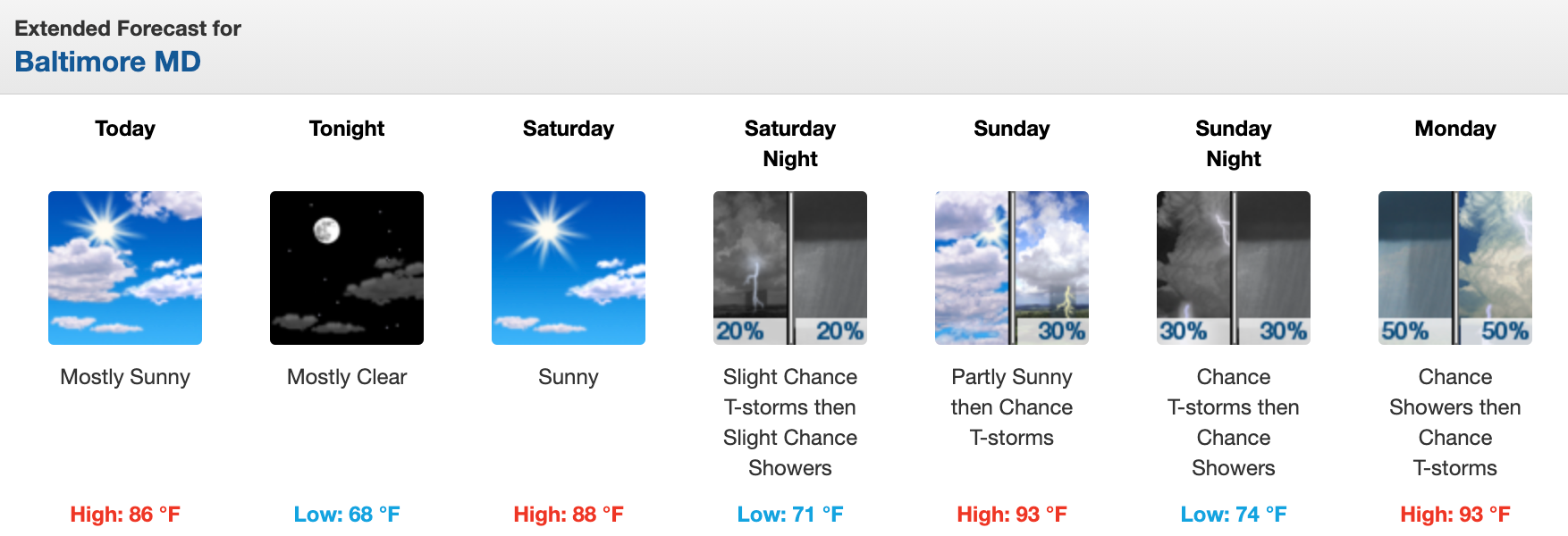
Friday looks to provide the best night for skywatching of the weekend in Maryland. Temperatures will be in the mid to upper 80s Friday, dropping to the high 60s overnight. It is supposed to be mostly clear in central Maryland Friday evening, according to the National Weather Service.
The forecast for Saturday shows increasing clouds as the day progresses, with daytime temperatures nearing 90 degrees and dipping to the low 70s in the evening, with a chance of rain.
In addition to the lunar and planetary activity overhead, the Delta Aquariids meteor shower is underway, running from July 12 to Aug. 23. Produced by debris left behind by the Marsden and Kracht comets, the Aquariids shower is known for producing fireballs.
It peaks July 29 and will produce about 10 to 20 shooting stars an hour.
Harsh light from a waning gibbous moon will likely wash out a good number of the meteors, which are faint to begin with because the shower favors the Southern Hemisphere, according to Earthsky.org.
To see the Delta Aquariids, it’s best to head outside between midnight and dawn, regardless of where you live.
Meteors from the Delta Aquariids will continue to fire through about Aug. 23, intersecting with the Perseids, often regarded as the best meteor shower of the year.
The Perseid meteor shower runs from July 17 to Aug. 24.
Because the bright moon will wane during the first week of August, viewing conditions should be ideal for the Perseid peak, which is slated for Aug. 11 to 12.
Skywatchers will be able to see about 100 shooting stars an hour during the Perseid shower if skies are clear, NASA meteor expert Bill Cooke told Space.com. Under typical conditions, he said, people should be able to see one meteor every minute.
He expects 2021 to be a stellar year for the Perseids.
“The Perseids are rich in fireballs, so they’ll be bright,” Cooke said.
Cooke, who leads the Meteoroid Environment Office at NASA’s Marshall Space Flight Center in Huntsville, Alabama, said meteor shower watching requires an investment in time and preparation.
Here are some tips:
- Get as far away from city lights as possible.
- Give your eyes about 30 to 45 minutes to adapt to the darkness.
- Take in as much of the sky as possible; take along a reclining lawn chair or a blanket and lie flat on your back.
- It can be helpful to find the radiant point (for the Perseids, that’s the prominent constellation of Perseus; for the Delta Aquariids, it’s the constellation Aquarius the Water Bearer). But avoid staring directly at it. The longer streaks are visible farther away from the radiant point.
Also, Cooke told Space.com, ditch the cell phone.
“The bright screen can throw a wrench in your efforts to adjust your night vision,” he said. “My suggestion to my friends who want to observe meteors is, leave your phone inside.”
So, if you see a meteor in July and August, how do you determine whether the shooting star is a Delta Aquariid or a Perseid?
If you really want to distinguish a Delta Aquariid from a Perseid meteor, the short answer is that the former appear to fly from the south and the Perseids from the north-northeast.
Full Moon Schedule For The Rest Of 2021
After the buck moon, five more full moons remain for 2021. Here's a little bit about each.
Aug. 22, full moon, seasonal blue moon: Also known as the full sturgeon moon, the green corn moon and the grain moon, the August full moon is a blue moon under the earliest definition of the phrase because it's the third of four full moons between the summer solstice and autumnal equinox.
Sept. 20, full moon: Also known as the full harvest moon because it occurs close to the fall equinox, but also known as the corn moon.
Oct. 20, full moon: Also known as the full hunters moon, the travel moon and the blood moon.
Nov. 19, full moon: Also known as the full beaver moon, the frosty moon and the dark moon.
Dec. 19, full moon: Also known as the full cold moon, the long nights moon and the moon before Yule.
— By Beth Dalbey and Elizabeth Janney
Get more local news delivered straight to your inbox. Sign up for free Patch newsletters and alerts.