Politics & Government
Purple Line May Be Derailed By Judge’s Ruling
A federal judge says Maryland officials need to consider Metro repairs and its declining ridership in the plans for the MTA's Purple Line.



BETHESDA, MD — The $5.6 billion Purple Line light-rail project to connect Montgomery and Prince George’s counties may have derailed Wednesday when a federal judge canceled government approval of the project.
In March, state officials selected the firm to build the long-awaited Purple Line light rail, which will run 16.2 miles from New Carrollton to Bethesda. When in operation, the Purple Line will provide a direct connection to the Metrorail Red, Green and Orange Lines at Bethesda, Silver Spring, College Park and New Carrollton.
Ground was scheduled to be broken for the rail route by the end of 2016, state leaders said, with plans for Purple Line service to begin in 2022.
Find out what's happening in Bethesda-Chevy Chasefor free with the latest updates from Patch.
But the ruling by U.S. District Judge Richard J. Leon chided the Maryland Transit Authority for not studying whether the “seemingly endless Metrorail breakdowns and safety issues” and the seven-year decline in Metro ridership will have an affect on Purple Line usage. Leon ordered the state agency to do another study of possible ridership that takes Metro’s issues into account. (See the full ruling below.)
Maryland Secretary of Transportation Pete K. Rahn told WTOP that the state will seek to quickly overturn Leon’s ruling at the court of appeals.
Find out what's happening in Bethesda-Chevy Chasefor free with the latest updates from Patch.
Sen. Jim Rosapepe, D-College Park, and chairman of the Prince George's County Senate Delegation, said in a statement that the judge's decision "is absurd."
"Everyone who lives in the Washington suburbs knows that traffic, particularly between Montgomery and Prince George's Counties, is getting worse, which reinforces the evidence that we need to build the Purple Line sooner rather than later," Rosapepe said. "We can only hope that the U.S. Court of Appeals will overrule this decision promptly."
John M. Fitzgerald, a Chevy Chase lawyer representing the Friends of the Capital Crescent Trail and others that sued over environmental concerns, told The Washington Post he was “heartened” by the judge’s decision that more study is needed. Fitzgerald said he hopes state and federal officials will consider cheaper options, such as a rapid bus system, and wait to build the Purple Line until this year’s massive repair work to Metro is done.
Leon wrote in his ruling that putting the brakes on the Purple Line for the study isn’t ideal but noted that $900 million of the project’s $5.6 billion budget is supposed to come from a federal grant.
The Purple Line will connect to four Metro stations, and 27 percent of the Purple Line’s riders are expected to be Metro passengers feeding into the light-rail system, says The Washington Post.
At a June 15 hearing in the case, attorneys for the MTA and the federal government said re-figuring the ridership forecasts could delay the project by six months and unravel its public-private partnership.
SEE ALSO:
- Purple Line Construction 'Going to Ruin Everything': Resident
- 'Now I Don't Have Anything': Purple Line Resident
- Purple Line: Rail Project Seen As Boon for Jobs, Setback for Some
- Business Down, Owners Stuck Waiting on Purple Line
The Coalition for Smarter Growth, which promotes walkable and transit-oriented communities in the Washington, D.C., region, called the judge’s decision an error that jeopardizes the project because it could mean higher construction costs that undo the financing.
Purple Line ridership forecasts are for 2040, said Stewart Schwartz, executive director of the Coalition for Smarter Growth, by which time the Metro system will have completed major rehabilitation. Population growth in the area will boost ridership "many years before 2040,” Schwartz said in a news release. “Yet it seems that the judge is presuming that Metrorail is in permanent and irreversible decline."
The environment will be improved by the Purple Line, he said, as it shifts traffic from cars to the less-polluting light rail system.
“Perhaps most unfortunate here, is that wealthy residents of one community continue to stand in the way of a transit project which would provide significant economic and social benefits to lower income residents in dozens of communities to the east,” Schwartz said.
The Purple Line would also connect to MARC, Amtrak and local bus services. Twenty-one stations are planned.
The Purple Line would run through Silver Spring and College Park and would include five stops on or near the University of Maryland’s campus that would be free for students.
Stations for the Purple Line LPA would be at these locations:
Bethesda
Connecticut Avenue
Lyttonsville
Woodside/16th Street
Silver Spring Transit Center
Silver Spring Library
Dale Drive
Manchester Place
Long Branch
Piney Branch Road
Takoma/Langley Transit Center
Riggs Road
Adelphi Road/West Campus
Campus Center
East Campus
College Park Metro
M Square
Riverdale Park
Beacon Heights
Annapolis Road/Glenridge
New Carrollton
Purple Line Transit Partners, which was chosen as the project’s contractor, offered a “competitive price and maximum value,” Gov. Larry Hogan said in March. The agreement achieved $550 million in savings for the state over the contract’s lifetime, he said.
The 36-year P3 agreement — including a six-year design and construction period and a 30-year operating period — with the Maryland Department of Transportation, the Maryland Transit Administration and the Transit Partners would be performance-based.
“This will act as an economic development catalyst to connect residents with jobs,” Hogan said in the spring. “It’s another sign of our shared commitment to fiscal responsibility and sound stewardship of taxpayer dollars. It’s a giant step forward.”
“People will understand why transportation is so important,” said Comptroller Peter Franchot, a long-time Montgomery County resident and Purple Line supporter, who noted that areas such as College Park will benefit greatly from the light-rail system.
Critics of the Purple Line are skeptical of the noise disruption construction and operation will cause. Franchot noted another potential challenge could come from enforcing riders to pay to ride the light rail, as Purple Line stations won’t have turnstiles.
“(Having fare enforcement officers) doesn’t really work,” Franchot said. “People are going to be jumping on these things left and right – and we want them to use it – but we also want them to pay.”
Purple Line Now President Ralph Bennett said the next steps are closing the contract and getting the Federal Transit Administration to certify a “full funding grant agreement,” which will lock in federal contributions of around $2 billion to the project. Officials said $990 million of federal reserves would come in the form of direct payments, while the remaining money would be Transportation Infrastructure Finance and Innovation Act loans, he said.
To supplement state funding, more than $330 million in cash and contributions will come from Montgomery and Prince George’s counties: Montgomery pledged to pay $210 million, and Prince George’s County agreed to contribute $120 million to the project.
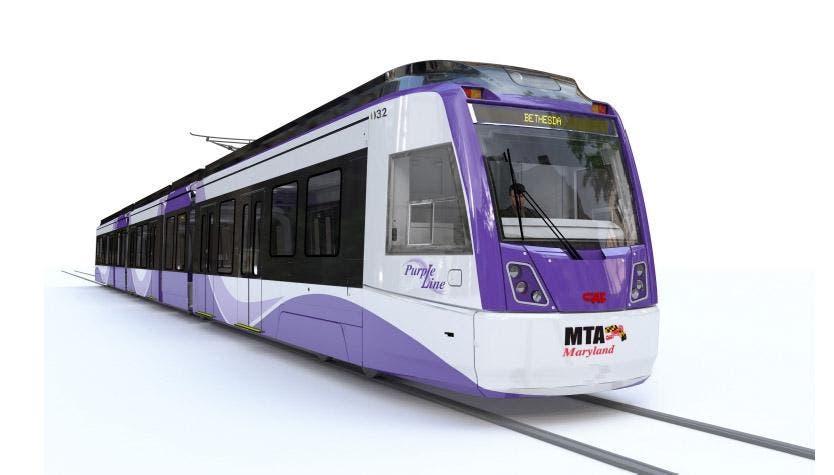
»Map of Purple Line route and drawing of Purple Line rail car, from the Maryland Transit Administration website
Judge's ruling on Purple Line by Deb Eatock Belt on Scribd
Get more local news delivered straight to your inbox. Sign up for free Patch newsletters and alerts.