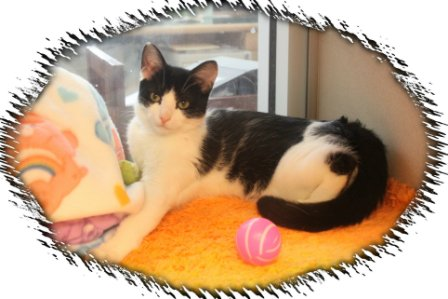


Daisy is a very affectionate little girt. She has “Cerebellar Hypoplasia” also known as "Spastic Cat Syndrome" or "Wobbly Cat Syndrome" but that does not stop her from wanting to snuggle with her human companion and playing with her toys
Daisy came in as a stray and has just captured our hearts with her loving demeanor. Because of her neurological condition, she doesn’t like tile floors. She is most comfortable on carpeting
NAME: “Daisy"
COUNTY ID#: A390111
AGE: 9 Months
GENDER: Female
BREED: Domestic Shorthair
WEIGHT: Just a wee little bit
COLOR: Black
HOBBIES: Batting at my squiggly toys and napping on a human’s. If you or anyone you know is interested in adopting the wonderful pet featured this week, please call the Prince George's Animals Management Facility in Upper Marlboro at 301-780-7201 to check on the availability. You may also visit www.pgamd.petfinder.com or www.petharbor.com to see many more precious pets that are available for adoption.
ASK FOR DAISY #390111
TIP OF THE WEEK
"Spastic Cat Syndrome”
"Wobbly Cat Syndrome”
The cat with cerebellar hypoplasia is abnormal from birth, though it may not be clear that something is wrong until the kittens are toddling around with some coordination. The cat with this disease clearly has balance issues: he walks with his legs widely placed for fear of falling and places his feet clumsily. He often leans against walls for support. Sitting still, he may look like a fairly normal cat but once focused on a toy, food bowl or friendly hand, tremors begin getting more severe as concentration becomes more intense. Still, despite the obvious impairment, cats with this condition are happy, able to feed themselves and use a litter box, and are felt to have good life quality.
YOUR CAT’S CEREBELLUM AND THE FELINE DISTEMPER VIRUS
The cerebellum is obviously a complex piece of equipment. During development before birth, the cerebellum is maturing up until the last few days before birth. Having a long period of development leaves the cerebellum especially vulnerable to an assortment of toxins for a long period of time. In the case of cerebellar hypoplasia the culprit is the feline distemper virus. Growing nerves in the cerebellum are destroyed ultimately yielding a tiny improperly developed cerebellum and a disability in the kitten. The mother cat need not be actually infected during pregnancy to create this syndrome; she can simply be vaccinated with a modified live distemper vaccine, the most basic of all cat vaccines.
Kittens infected with distemper under age 2 weeks may also experience enough cerebellar damage to suffer cerebellar hypoplasia.
This means that mother cats due for vaccines should not be vaccinated<
during pregnancy nor in the first 2 weeks following kitten delivery.
DIAGNOSIS
While special imaging such as CT scanning or MRI can be used to confirm the underdeveloped tiny cerebellum, the diagnosis of this condition is usually obvious because of the following features:
The condition is non-progressive (it doesn’t get worse). The cat is not weak, just not coordinated.
“Intention tremors” are evident when the cat is focused but the cat looks largely normal if still.
Walking is incoordinated with a wide stance, often using the wall for support
PREVENTION
This syndrome is easily prevented by vaccinating female cats for feline distemper when they are not pregnant. This means that regular vaccination will prevent cerebellar hypoplasia in kittens. If a cat is pregnant, vaccination should be withheld during pregnancy and for a good 2-3 weeks after the kittens are born