Health & Fitness
Does Your Dog Sleep Naked? Should he?
Is a 'Naked Dog' the right dog for you? For your lifestyle?

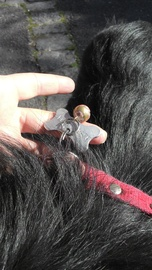


EverythingDogBlog #62: Does your dog sleep naked? Should he?
By Skye Anderson, MS
The Naked Dog, part two of two
Find out what's happening in Columbiafor free with the latest updates from Patch.
Does your dog sleep naked?
It may be a good idea to remove your dog’s collar at night, thus allowing his neck to ‘breathe’ and his fur to recover from being flattened (so he will look prettier! fluffier!)
Find out what's happening in Columbiafor free with the latest updates from Patch.
Do your dog a favor and massage his neck lovingly after removing his collar – he will love that.
Just remember to ‘dress’ your dog again in the morning!
What is the purpose of a collar, anyway?
I tell my dog training clients that the purpose of a collar is to hold dog tags. Period. Not to attach the leash.
I encourage using a front-attach harness for dogs who pull (harnesses that attach to the leash on the dog’s upper side or back encourage pulling – look at sled dogs. In addition, flexi-leads also encourage pulling and are not recommended for other reasons as well.)
Nowadays, many dogs are microchipped for more secure, quick and permanent identification but a dog should also have a tag - at least one that indicates he is microchipped plus his rabies tag, of course, and perhaps his license and a cell phone number but no names – especially his.
What about being collarless inside the house?
If your dog rushes the door when someone comes to visit and you have to pull him away by grabbing his collar so he won’t run out when your visitor enters, you may want to collar him when he’s inside. That way, you won’t forget his collar when he goes out for a jaunt!
On the other hand, a good positive-reinforcement, reward-based trainer can help you train your dog to not rush the door but to go to his crate instead, e.g., when he hears the doorbell or a knock.
And, finally, on a lighter note, when I first became certified in canine massage, I made business cards that said, “Naked Massage. Your Dog (Collarless), Not You.” Ten years later, I still have a whole slew of them. Let me know if you want one!
Finally
If you read my last blog, part one, I hope you are convinced that all dog collars should be break-away collars. For more information, here is a great clip - http://www.youtube.com/watch?v=U92rSks9j3U
Addendum: More and more dogs every day are using harnesses to attach their leashes to rather than collars - a great idea, especially if a front-attach harness is used which prevents pulling on leash.
Using a front-attach harness is one way to get loose-leash walking (LLW). I call it J-Walking because the leash is never taut, but, instead, has a dip in it and instead of looking like a straight line, it looks like a J. (Yuk, yuk. Get it? Jay walking!) Maybe I should term it, dip-walking, or C-walking, or bridge walking, or jump rope, or . . . .
(For more tips on walking your dog, see my article Six Tips to Put More Fun into Fido’s Walk on the KONG website at http://www.kongcompany.com/2013/07/12/6-tips-to-put-more-fun-in-fidos-walk/)
And, please, never leave a choke chain on a dog unattended (or even attended, for that matter). There is a reason they used to be called ‘training collars’ (to be used only when actively training). Fortunately we now know a better way to train our best friend through positive reinforcement reward-based training.
Thanks!