Community Corner
How To Prevent Christmas Tree Fires: Howard County Officials
It doesn't take long for a live Christmas tree to catch fire and burn. Fire officials are offering helpful tips to prevent such a tragedy.


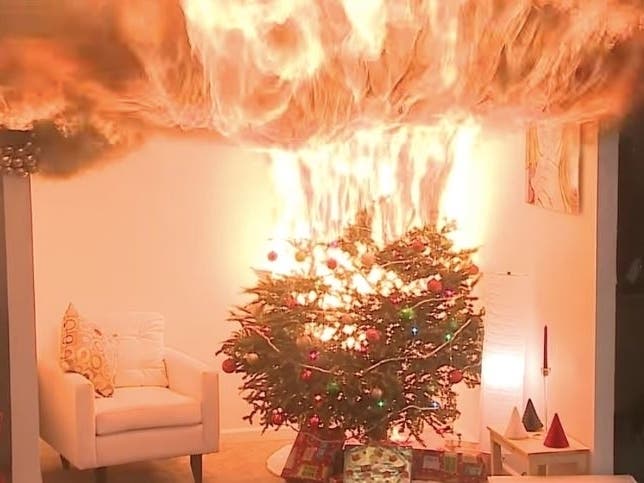
HOWARD COUNTY, MD — The fresh scent of pine filling your house may not be worth the price of a cut Christmas tree if you don’t take proper precautions to make sure extension cords and lighting equipment are in good shape, the National Fire Protection Association warns. Christmas tree fires sparked 160 home fires in a recent four-year period, and 44 percent of them were fueled by electrical problems.
According to the Maryland state fire marshal's office, it's best to select a Christmas tree with fresh, green needles that do not fall off when touched. Be sure to cut the tree two inches from the base of the trunk before placing the Christmas tree in a stand with water.
Place the tree three feet away from any heat source such as a fireplace, radiator, candles, heat vents or indoor lighting. Be sure to water the tree daily. Use lights on your tree that have a label with a recognized testing laboratory on it and replace any string lights that have worn or broken cords and loose bulb connections. Always turn off the Christmas tree lights before leaving the house or going to bed.
Find out what's happening in Columbiafor free with the latest updates from Patch.
As soon as the tree dries out, dispose of it before it can become a fire hazard. Do not leave it in the home or garage, but instead, place it outside and check your local community for any recycling programs specifically for trees.
The Howard County Department of Fire & Rescue emphasized the importance of testing smoke alarms and carbon monoxide detectors every month in the event that something does occur.
Find out what's happening in Columbiafor free with the latest updates from Patch.
About 19 million of the 95 million Americans who will decorate Christmas trees this season will cut them down themselves or buy them pre-cut at lots, according to national statistics. That requires extra care to keep the trees from drying out and becoming fuel for a deadly house fire.
The U.S. Consumer Product Safety Commission conducted a live Christmas tree burn to demonstrate how quickly Christmas tree fires ignite when needles become brittle do to under-watering.
Trees can become fully engulfed in a matter of seconds, then ignite everything in the path of the flames. In comparison, an electrical fire sparked for the demonstration on a well-watered tree didn’t spread at all.
From 2013 to 2017, the most recent years for which data is available, 160 home fires started with Christmas trees, according to the National Fire Protection Association.
A closer look at the data show that, overall, Christmas tree fires are responsible for an average of three deaths, 15 injuries and more than $10 million in property damage every year.
For perspective, one of every 52 reported home fires that began with a Christmas tree ended with a death. That compares to one death per 135 total reported home fires due to other causes.
Though electrical problems are the source of the majority of Christmas tree fires, the fire protection group also reports that from 2013 to 2017:
- A heat source, whether from a candle or heating equipment, too close to the tree caused 25 percent of home Christmas tree fires;
- One-fifth of Christmas tree fires were intentionally set;
- Three-fourths of Christmas tree fires occurred in December or January;
- Two of every five home Christmas tree fires started in the living room.
Fires resulting from candles are also a big problem. The data show candles were responsible for an average of 22 home fires every day from 2013 to 2017. In 60 percent of the fires, the candle was placed too close to a flammable object, such as furniture, mattresses or bedding, curtains, or holiday decorations.
Christmas Eve and Christmas Day are the peak times for home fires caused by candles. The fire protection group said 18 percent of December candle fires occurred in the living room and 8 percent started in the dining room, compared to14 percent and 3 percent for those areas during the rest of the year.
Thanksgiving is the peak day for home cooking fires, followed by Christmas Day and Christmas Eve. Also, according to the data, cooking equipment was involved in one of every five home decoration fires. This can happen when a decoration is left on or too close to a stove or other cooking equipment.
Get more local news delivered straight to your inbox. Sign up for free Patch newsletters and alerts.