Schools
Guide Dog Helps Holabird Students Learn About Senses
Holabird Academy ESOL teacher Leanne Riordan brought in local visitors from Guiding Eyes for the Blind to help her first- and second-grade students learn about the senses.

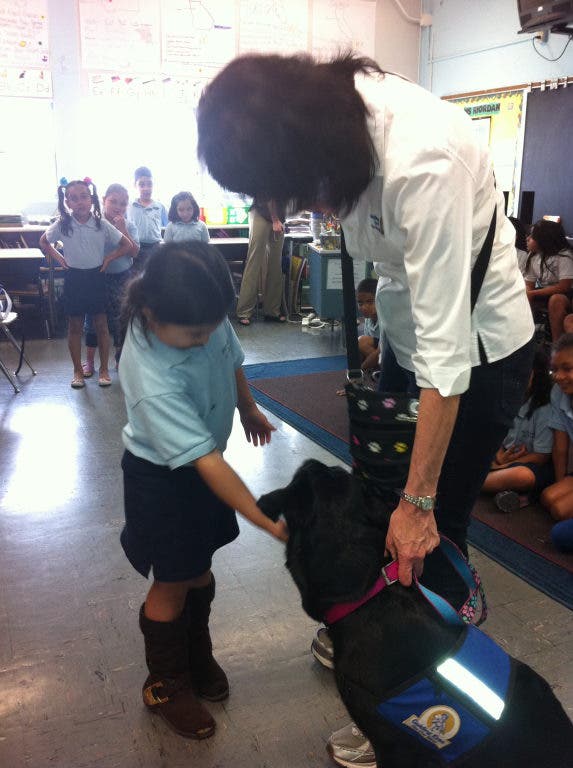


Leanne Riordan teaches first and second grade ESOL students at Holabird Academy, a pre-K-8 school in O'Donnell Heights, and last week she brought in a unique visitor to underscore recent lessons on the senses.
Her name was Arlene. And she’s a 10-month-old Labrador.
Arlene came to class with Linda Steiner and Barbara Katz, of Guiding Eyes for the Blind Maryland. Katz is in the process of training Arlene, who she’ll eventually return to the Guiding Eyes for the Blind facility in New York for final training and placement with a sight-impaired individual.
Find out what's happening in Dundalkfor free with the latest updates from Patch.
“When we started learning about the senses, we imagined what it would be like if you couldn’t hear, imagined what it would be like if you couldn’t see—and I thought bringing in a guide dog would help us,” said Riordan. “It also connects the kids to people in the community who are active and doing good things.”
As part of the recent lessons, Riordan also used visual aids and videos to instruct the students in her ESOL classes in basic sign language.
Find out what's happening in Dundalkfor free with the latest updates from Patch.
“May I please pet the dog?” was the first question from students after a presentation about how guide dogs are trained and placed—and how children should approach all dogs—which is slowly, and only after asking permission from the dog’s owner first.
Katz also read a short story to children called Through Otis’ Eyes: Lessons For A Guide Dog Puppy.
Guiding Eyes for the Blind has been placing trained guide dogs with sight-impaired men and women since 1954 and graduate about 200 pairs of dogs and owners each year.
Katz explained that puppies go through several levels of early training, including early socialization, home socialization, puppy testing, puppy raising and in-facility training.
“The puppies spend some time in a classroom, just like here today,” she told the kids. She added, however, it’s not all career training for the pups.
“It’s not all work and no play,” Katz said. “When the puppy doesn’t have his [guide dog] jacket on, he’s just my puppy at home.”
Katz, answering children’s questions, also said it’s difficult to give up a puppy after spending 15-16 months together. She tries to keep in mind it’s for a larger purpose.
“Finding a purpose beyond myself makes life fulfilling,” Katz said. “Helping others gives life meaning.”
Riordan noted that along with lessons about blindness and helping others in the community, she hoped that Katz’s message of still being able to love Arlene—while not being physically with her down the road—would resonate with students. Many of her students, she explained, have relatives, grandparents, for example, living in other countries who they may not see often or at all.
After Katz’s presentation, the students got a chance to ask questions and pet Arlene, if they wished, which, of course, most did.
“My sister’s name is Arlene,” one student said.
“What does Arlene eat?” asked another student.
“Will she have babies someday?” asked a student.
“Did you have to teach her to go to the bathroom outside?”
Several students said they had seen photographs of guide dogs, and one student said he’s seen a guide dog in his neighborhood.
“He helped a man in the street walking,” said Bryan Cedillo, 7.
“Arlene is a great dog, and she did everything great,” said Marjorie Cedeno-Leon, 7. “I think I want a dog.”
Get more local news delivered straight to your inbox. Sign up for free Patch newsletters and alerts.