Health & Fitness
Annapolis High School Rain Gardens Get a Makeover
Teamed up with the South River Federation, Annapolis High School students weeded, mulched, and planted the school's four bio-retention areas.
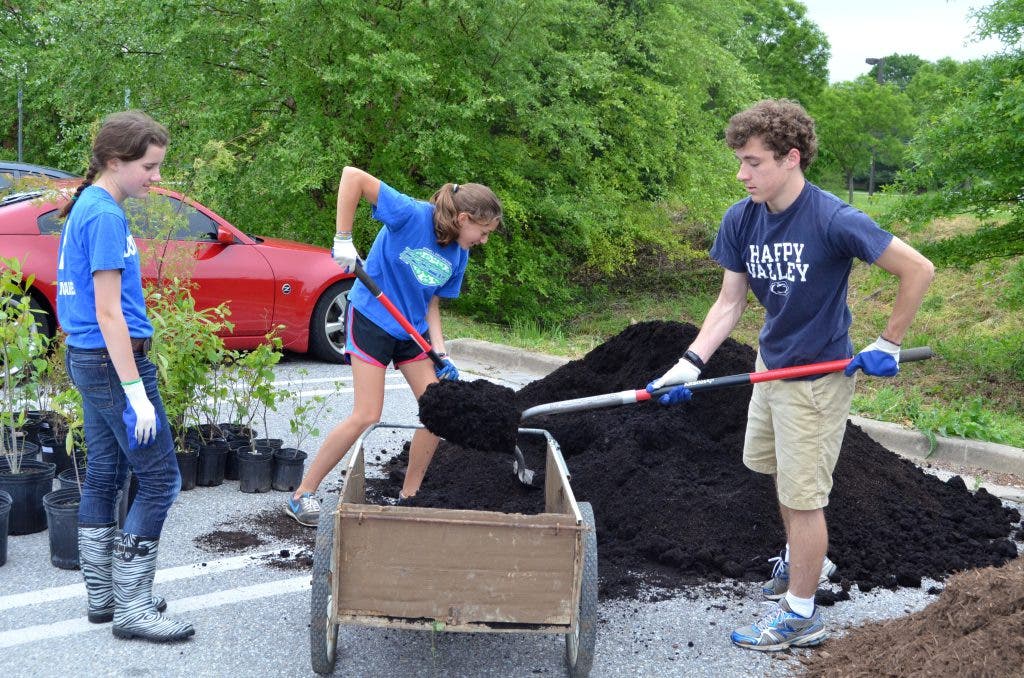


May must be the month for maintaining rain gardens! After the Key School did an excellent job with the Hillsmere Community rain gardens, we tackled the rain garden bio retention areas at Annapolis High School. Seven years ago, four separate bio-retention areas similar to rain gardens were installed at the high school by the Department of Public Works. The purpose of these bio-retention areas is to capture and filter the polluted stormwater run-off from the school’s parking lot.
Like all other BMPs (Best Management Practices), it is very important for these bio-retention areas to be properly maintained so they continue to work efficiently. However, maintenance, costs money and takes lots of hard work. Luckily, we had both for this project! The Scenic Rivers Land Trust (SRLT) was awarded a grant for a project in the South River Watershed. After teaming up with SRLT and the Watershed Stewards Academy (WSA), we decided to combine our forces and give the Annapolis High School bio-retention areas some well deserved TLC. The hard work needed for this project came from a great group of volunteers and the students at Annapolis High School.
We divided our efforts into three stages: preparation, heavy lifting, and educational. To prepare for such an undertaking, Ciminelli’s Landscape Services removed eight invasive callery pears (Pyrus calleryana) and delivered mulch and biosoil before the volunteers arrived. Removing the pear trees was important because they are invasive, have poor root structure due to a small root ball, split easily, and are less effective at removing nutrients.
Find out what's happening in Edgewater-Davidsonvillefor free with the latest updates from Patch.
On Sunday, May 6th, armed with our team of volunteers, we dug in, literally. Stormwater enters each bio-retention area via stormwater curb cuts. A curb cut is an open area that drains into a rock lined swale entering the garden. Over time, debris and sediment build up at these entrances and fill all the empty space in the rock swales. As the debris builds up, less water enters the bio-retention areas and decreases its overall effectiveness. Volunteers removed the rocks from the areas and then dug out all the debris and sediment before replacing the rocks. This type of maintenance needs to be performed on a regular basis to ensure that the curb cuts are allowing as much water as possible into the bio-retention areas.
Next, volunteers spread about 5 tons of bio-soil and 20 tons of mulch in each of the 4 bio-retention areas. Because these gardens are collecting and filtering polluted stormwater runoff, the addition of bio-soil and mulch helps to maintain an environment where the plants continue to thrive. After all that shoveling, volunteers re-energized with a pizza lunch generously donated by Vocelli Pizza of Edgewater. To finish off the day, volunteers planted new trees and shrubs, but the plantings are far from over.
Find out what's happening in Edgewater-Davidsonvillefor free with the latest updates from Patch.
On May 24th and 25th, Federation staff will be going back to Annapolis High School to work with three biology classes. Restoration Project Manager for the South River Federation, Kirk Mantay, will begin each class with a lesson on the importance of native plants. Afterwards, the students will plant the remaining native shrubs, grasses, and trees. The students will also be able to continue weeding the gardens and remove additional invasive plants. A special thank you goes to biology teacher Judy Lukacs for all her help coordinating this project with the school and students.