Health & Fitness
BLOG: Chain Pickerel, South River's Prehistoric Predator
The chain pickerel may in fact be the South River's original apex predator. Learn more about this living fossil.
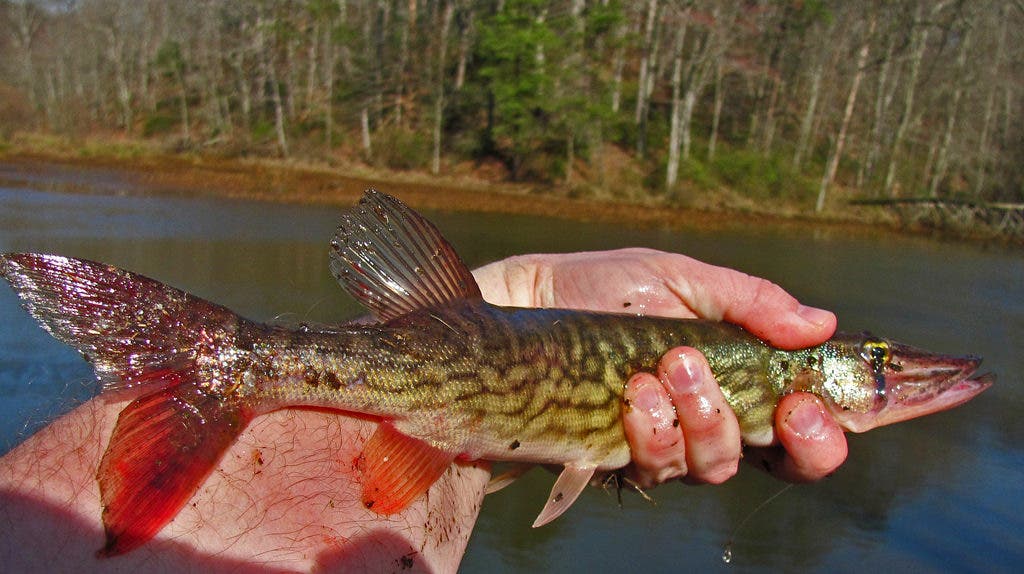

Blog and Photographs by Kirk Mantay, Restoration Project Manager for the South River Federation.
Recently on the headwaters of Broad Creek, I came face to face with a living fossil of sorts—the chain pickerel.
It was early March and he had probably just completed spawning, and was extremely hungry as a result. His toothy ancestors—pikes—first arrived on the Maryland coast around 30 million years ago, right around the time that the Chesapeake Bay was formed into its current shape. By comparison, American bass, perch and sunfish species are said to have differentiated from each other just during the last 15 or 16 million years.
Find out what's happening in Edgewater-Davidsonvillefor free with the latest updates from Patch.
The chain pickerel may in fact be the South River's original apex predator. So what do chain pickerel do, and why does it matter?
Chain pickerel are closer relatives to the pikes (northern pike, muskellunge) than they are other "pickerels." Their flat, wide head is a very ancient design for catching large prey in shallow water, and in fact, there are very few species of the pike/chain pickerel genus still in existence throughout the world. Luckily, the chain pickerel is well designed to hunt and survive in our waters.
Find out what's happening in Edgewater-Davidsonvillefor free with the latest updates from Patch.
They are fairly tolerant of pollution and are stealthy hunters—but aggressive killers who will leave the shadows just long enough to inhale injured fish, swimming frogs, and water-treading mice.
The chain pickerel prefers shallow, vegetated beds of tidal rivers and small stormwater ponds that have shallow, flooded zones full of fallen trees or living vegetation. Chain pickerel are happiest in water bodies with a minimal amount of flow, which means they are frequent visitors to flooded wetlands, beaver dam impoundments and man-made lakes and ponds.
As South River populations of other large predators (striped bass, largemouth bass) continue to be suppressed due to persistent water pollution issues, the chain pickerel may continue to grow in range and population. Look for them in vegetated heads of creeks, small natural and man-made impoundments like beaver swamps and stormwater ponds, and even larger impoundments like Annapolis Waterworks Park.
The chain pickerel isn't going anywhere, and it has a will to survive—nothing but ospreys or bald eagles will pursue the adult fish. But that doesn't mean they aren't worth targeting on a fishing outing—the voracious predators are very difficult to hook and at 18-20 inches, they are sure a handful.
Recommended lures are inline spinners, rubber grubs, spoons and honestly, anything you'd use to catch their close relative the Northern Pike, or alternately, a lot of the lures you might use to catch one of the South River's few largemouth bass.
Good luck tangling with this dinosaur!
(Note: The fish in the images above was released immediately after being photographed)