Health & Fitness
BLOG: Which Came First: The Paper or the Rug?
A brief history in wallcoverings. How did they come about? Why not just paint? A little input from a professional interior designer.
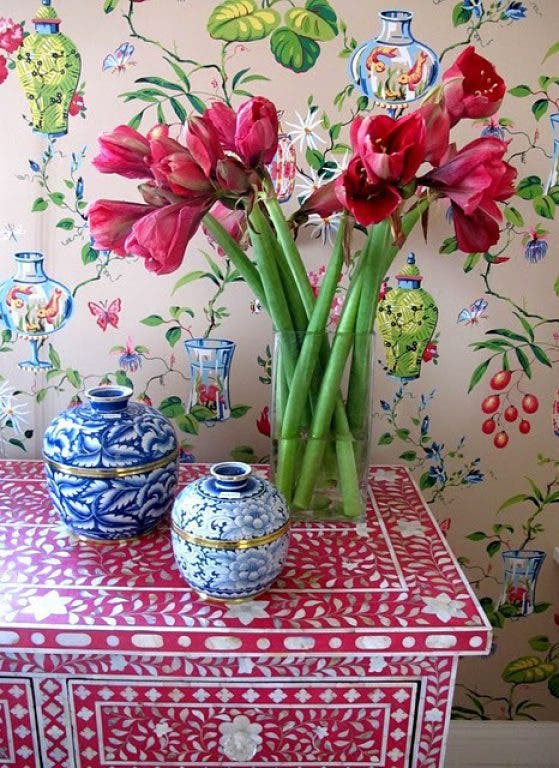
Flocked, gilded, jungle themed, endless fields of petite flowers. Yes, wallpaper!
Or, wall coverings as they are now referred to as they have undoubtedly resurfaced a few years ago as classy and chic ways to add interest to a room as subtle backdrops to both modern and traditional interiors. But how did wall coverings come about in the first place? Isn't paint enough? And why is it sooo hard to remove?
During the middle ages, home design choices were often made to include necessities more than for appearance alone. Many people lived in small hut-type homes that provided shelter from the elements and wildlife. But not much more. There had been several trade routes to the east Asian countries which brought an influx of area rugs as well as introducing a new type of weaving.
Find out what's happening in Edgewater-Davidsonvillefor free with the latest updates from Patch.
These area rugs were a hot commodity because they were versatile- floor to wall, then wall to floor- to help bring comfort to drafty, cold rooms. As luxury set in, the area rugs on the walls were replaced with tapestries and paintings.
Wallpaper first appeared in the 16th century, in the form of hand-blocked prints. A very popular choice for adding details to walls that were now made of plaster, and rather boring because the paint roller had not been introduced. So to answer your dying question, the rug came first! And now we have tapestries to remind us of poor humble beginnings when we had to use function as fashion (and vice versa) in order to survive.
Find out what's happening in Edgewater-Davidsonvillefor free with the latest updates from Patch.
I guess that means interior design has actually saved lives???
In the Victorian age, the look of the home was far more important to those who lived in the space. Interior design choices were often representative of the class, or status, of the homeowner. For instance, the more money the homeowner earned, the more luxurious the interior design choices were expected to be.
The Victorian home was one of the first to incorporate powerful works of art in home décor, particularly in rooms that were spacious and richly decorated. This time is also when mass production of goods came into full swing and all of the sudden interior goods were available to a much wider array of people.
Isn't paint enough? Sometimes. Wallpaper is well capable of hiding imperfections in your walls, especially on uneven unsightly walls where you will need to spend on priming and smoothing out as in the case with paint. Fine details and crisp, repetitive patterns are a main strength of wallpaper, as trying to achieve these looks are extremely difficult with paint.
Ok, so why is it so hard to remove? Because of how it was put up. Just like painting a surface, you need to start with the correct materials and to prep the surface. The surface should be relatively smooth, cleaned and sized.
Wallpaperers treat or coat the walls with a watered down or diluted wallpaper wheat paste prior to a papering project. Older wallpaper hangers use this practice and the term sizing, which is, in effect, a form of priming. What kind of paper do you have?
- If the whole thing peels away in one piece, you have strippable wallpaper. A bottle of champagne is in order!
- If, much like that cheap champagne label, only the surface layer peels away, leaving a papery bottom layer, your wallpaper has a peelable top layer. This isn’t as easy to remove as strippable wallpaper, but you should still consider yourself lucky that you don’t have the traditional kind.
- If you cannot peel your wallpaper away from your wall by hand (or can only peel a thin strip away at a time), you have traditional wall paper. You will have to remove it either with stripping solution or a wallpaper steamer.
So the lesson of today is to hire an electrician to do an electricians job just the same as you would hire a professional to help you with your wallcovering selections and installation!
And always remember to shop local first! We are not restricted to one set of retail goods.