Health & Fitness
Move Over Mower; Making Room for a Meadow
What can you do about that difficult to mow area in your yard? Turn it into a meadow!


South River Federation's Go Green Project of the Month
We all seem to have that part of our yard. You know what I’m talking about: the section we hate to mow partly because it’s a difficult area and partly because we never use it. Master Watershed Steward Candidate Ted Hall and his wife Caryn Jackson were no exception to this. While they have a beautiful forested lot in Davidsonville, they had an awkward steep slope in front of their yard. The area was too steep for the kids to play on and not an ideal location to mow. So what to do?
While in the Master Watershed Stewards course, Ted learned about various best management practices homeowners could use to reduce runoff from their land. These practices included rain gardens, rain barrels, and other bio-retention plantings. When it came time to do his Capstone project, Ted Hall knew he wanted to do something to improve the ability of his yard to capture runoff as well as create new habitat for native fauna. He also wanted to do something that would serve as a model for others in his community.
Find out what's happening in Edgewater-Davidsonvillefor free with the latest updates from Patch.
The solution? A residential meadow! Now, get that image of the overgrown highway meadows overrun with invasive plants out of your mind. Instead, think beautifully landscaped native plants like black-eyed Susans and native shrubs such as lowbush blueberry and dwarf red twig dogwood. Plants ranged from trees like a red bud all the way down to tiny plugs. Beyond a carefully selected plant list, the plants were arranged nicely and the area mulched, giving the final project a very finished garden appearance. Luckily, through the Watershed Steward Academy (WSA), Ted and Caryn got connected with Jodie Shivery of Ecologically Sound Landscapes and had careful guidance throughout the entire design process.
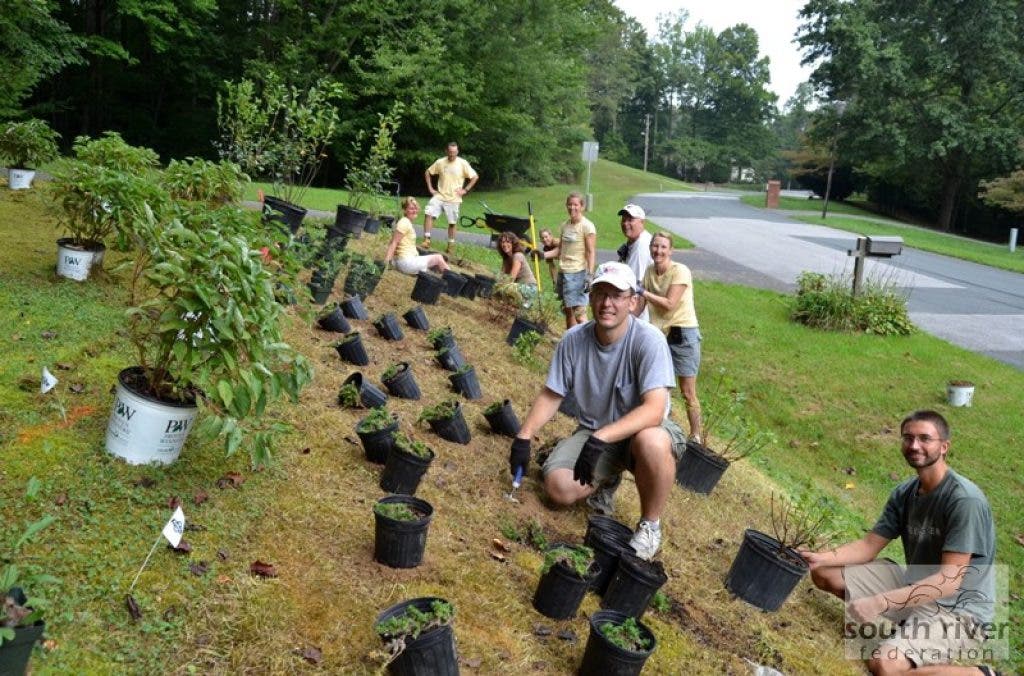
Sounds like a big project, right? You bet! In total, almost 1,000 plants were planted. Ted and Caryn were not alone in their planting efforts. With help from WSA and the South River Federation, they turned the planting into a community event. Over 30 neighbors and friends came out on a beautiful Saturday morning, planted almost 1,000 plants, and enjoyed a picnic lunch courtesy of Ted and Caryn. There were even crafts for the kids!
Find out what's happening in Edgewater-Davidsonvillefor free with the latest updates from Patch.
If you are a homeowner and are thinking about removing some of your lawn to replace it with native plants, here is some advice:
First, determine how the area will be used and the purpose of the planting. The selected area was on a steep slope and was not used for recreational purposes. They did want to slow down the water because the water coming off of the slope was going directly into a culvert leading to a storm drain down the street. So, when planting on a slope, look for native plants that will easily soak up water but do not require that they be in a moist environment.
Ted strongly advises to “plant native plants because they will require less maintenance and will not take over. Our slope is mostly sunny but parts of it were shady. So we needed to find plants that would survive best in each area.”
Ask for help! Ted and Caryn consulted with Jodie Shivery from Ecologically Sound Landscapes and Lara Mulvaney of the Watershed Stewards Academy. “Without the advice and help of these two very knowledgeable and helpful people this project would have been much more difficult. I would advise anybody choosing to do a project like this to seek the help of professionals like Jodie and Lara.”
Finally, and very importantly, get a feel for how the community is going to react to a meadow. Ted explained, “If you live in a community like ours where many of the lawns are manicured and cared for throughout the year, you will want to carefully word how you talk about your project.” Calling your new planting a meadow initially may bring negative images to people’s minds. Instead, let your neighbors now that you will be landscaping your yard to better fit into the natural surroundings of the neighborhood. And once the project is done, show them how beautiful a landscaped meadow can look!
Enjoy the pictures of their lawn being converted to a meadow!