Community Corner
Are Howard County and South Carolina Identical Geographical Twins?
Newsflash from a cartophile's diary: a revelation that Howard County and South Carolina share a similar shape. This leads to a quest to determine what else they have in common.
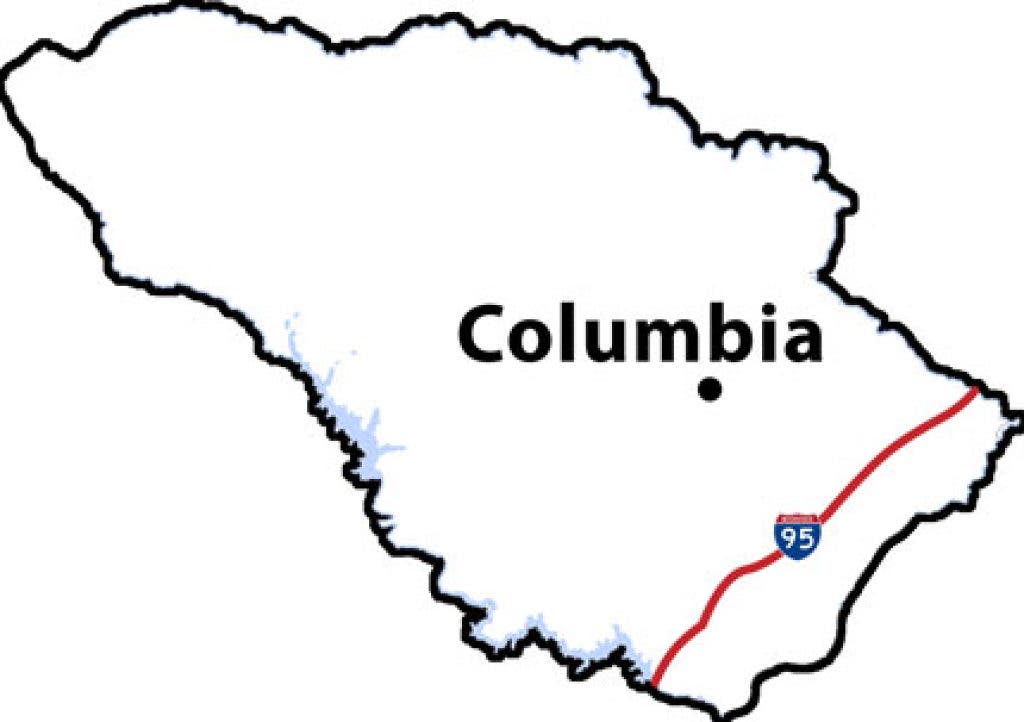


Unless you're a cartophile like me—a map lover—you probably never noticed that the footprints of Howard County and South Carolina have a similar shape.
What's more: Interstate 95 crosses both Howard County and South Carolina in approximately the same place. And Columbia, the name of the largest city in each, is located in roughly the same position within them.
I was studying a South Carolina map several months ago when I suddenly was struck by how familiar it seemed.
Find out what's happening in Ellicott Cityfor free with the latest updates from Patch.
It took a few minutes before I knew why.
In addition their shapes, they both have towns named Florence, Simpsonville and Waterloo, as well as reservoirs along their southwest borders.
Find out what's happening in Ellicott Cityfor free with the latest updates from Patch.
"Those things are kind of cool," said Christo Cambetes, a friend of a friend and, more importantly, a highly educated cartographer with more than 29 years of experience at the National Oceanographic and Atmospheric Administration. I called him to share my discovery.
"It's interesting that the roads, boundaries and towns kind of match," Cambetes said. "You might want to follow up with the University of Wisconsin at Madison —they have a big cartography department out there."
Referred to Wisconsin? I guess Cambetes was busy.
I didn't call Wisconsin. Undaunted, I instead contacted David White, a weekend resident of Columbia, SC, who commutes to Marine Corps Base Quantico in Quantico, VA.
During the week he serves as editor of the Quantico Sentry, a weekly military newspaper. I knew I could count on White to tell it like it is.
I first admitted to him that you wouldn't normally compare Columbia, MD, to Columbia, SC for any reason other than their names. But, with my curiosity piqued, I decided to see what else they share in common.
The answer: Not much, really. Although Columbia, SC (pop. 118,000) and Columbia, MD (pop. 98,000) are very similar in size and have grown at about the same rate since 2000, that's about all the two cities appear to have in common.
In fact, the rest of this tale is a startling example of "haves" versus "have-nots" in a city and a town that are separated by much more than the 515 miles between them.
"The South Carolina unemployment rate is highest in the nation, but Columbia is a little better insulated from [the recession] because of its proximity to Fort Jackson, state government and the University of South Carolina," White told me.
Nonetheless, Columbia, the state's capital, appears beset with poverty.
"Columbia has several personalities," White continued. "It's part academicians at the university and part heavy-duty redneck."
Although the Palmetto State skews very Republican, Columbia "is very mixed blue/red and sits apart from the rest of the state," White said. "We just elected our first black mayor. Actually, Columbia is very progressive, given the state's history of racism."
Columbia, SC, founded in 1805, is much less densely populated than Columbia, MD, with some farmland within its borders. Its people tend to be younger and less educated.
By comparison, Columbia, MD, is a wealthy suburb with an average household income two-and-a-half times that of the other Columbia, an unemployment rate nearly one-fifth of the South Carolina city, and a poverty rate approximately one-sixth of the other Columbia.
At the risk of sounding rude, I had to ask Dave why he lives there if he has to drive to Northern Virginia to find work.
"Columbia is a fascinating place," he responded. "It's two hours from the beach in one direction and two hours from the mountains in the other, hot as hell in August and September, and wonderful the rest of the year.
"You can be outside on your deck having a beer with your friends in January," he said. "You can't do that here!"
And then Christo Cambetes, our busy cartographer friend, sent an e-mail.
He asked if I had noticed that Columbia's People Tree resembles the tree on the South Carolina flag.
"This thing is the talk of the office," Cambetes said. "People at NOAA are really into it!"
Maybe I should call those experts in Wisconsin.