Neighbor News
A Cash Cow Made of Concrete? An HOA "Micro-Charges" Homeowners
The predatory HOA industry suddenly thought your sidewalk and steps were pure gold. Not so fast. (Ch. XXII, "Living on Cuckoo Court")



[ UPDATE 7/18/2024]. It is not at all clear that the HOA is backing away from this predatory tool, and ones like it. This alleged "violation" is not an error. It follows the HOA business model of micro-charging. Our current property management company is also a debt collection company. We continue to monitor the situation.--SL]
[UPDATE 11/15/2021: Some residents reports that the HOA has backed off this "track" of property "violations" for "concrete this and that." We continue to monitor the situation. --SL]
Old concrete. That’s the new revenue generator for the predatory HOA industry. After years of fining people for minor flaws in their fences, slipping slats in their shutters, and rust on their metal chimneys, our property management company has discovered a real cash cow. Deputized by the Quail Valley HOA, an inspector sallies forth to fine residents for minor flaws in their concrete walkways, steps, and stoops. Or the inspector, who has no expertise in concrete construction or engineering, just makes stuff up, and fines residents for that. Yes, concrete is the new gold.
Find out what's happening in Gaithersburgfor free with the latest updates from Patch.
This is big money folks. Consider three pandemic-era examples from Quail Valley, Maryland.
(1) FINING A FAMILY FOR AN HOA-GENERATED LANDSCAPE PROBLEM.
(UPDATE, Dec. 2021: The residents, who are renters, say that the HOA has apparently backed off from imposing a violation; I have not spoken with the landlord/property owner).
In a summer downpour, thousands of gallons of rainwater flow off an acre of land (owned by the Quail Valley HOA) and funnel into a muddy gully, eroding the ground around the posts holding up the backyard fence at the northern corner of Bluebird Terrace in Montgomery County, Maryland. (See photo 3, above, showing fence and nearby trees.) But that’s not all. Runoff gathers from four backyards in this row of townhomes and conveys across this same backyard—the one at the lowest point along the hillside. The downpour creates a temporary stream two inches deep, which then joins the rivulet already moving along this end-unit’s fence line. Topsoil washes away. The subsoil clay is exposed, along with the tops of the concrete footings that hold the wooden fence posts in place.
Find out what's happening in Gaithersburgfor free with the latest updates from Patch.
So what was the QV HOA’s response to this situation? It cites the family for allowing the concrete footings to show above ground. It hassles them for months. It gives them a deadline to solve “the problem” and threatens them with fines if they do not somehow cover up these concrete fence post footings.
What nobody in the discussion seems to realize is that the exposed concrete is merely a symptom of the bigger problem: severe erosion cause by runoff from the HOA’s commonly owned land. It threatens the stability of the homeowner’s fence. It destabilizes the trees nearby. It deposits mud on the sidewalk below. The runoff and erosion are not the resident’s problem. They are the HOA’s problem.
(2). FINING A FAMILY FOR A MINOR FLAW. (Steve Lapham speaking from his townhome on Purple Martin Lane). Our family received an HOA violation notice in June 2020, during the first major COVID wave: “Your walkway is slanted.” Well, yes, it had been leaning a bit since we moved in, 19 years ago. There was no issue of safety or maintenance. It was just an old sidewalk, listing slightly to the right. Why was it suddenly “a problem” during a pandemic? Wishing to avoid HOA fines, we hired a contractor to demolish & haul away the old, and then pour new concrete over a foundation of bluestone. Our family could afford the $3,000 to replace the concrete walkway, steps, and stoop, but how many families can pay that kind of cash under a 2-month deadline? During a pandemic? I began asking around. (One neighbor recently pointed out to me that if the walkway had this look in the for-sale photos when we bought the house, it must be “grandfathered in,” and no fine would be legal.) I learned that at least a dozen families in Quail Valley have been surprised to find that their long-standing walkways and steps, after decades of not being cited, are suddenly “a problem” for the HOA. Here come the fines. Late fees. Liens placed against homes. Houses flipped. It’s a vein of pure gold for the property manager, the debt collector, and the house flippers.
(3) FINING A FAMILY FOR MADE-UP STUFF. [UPDATE: I have a verbal report from a homeowner, 9/26/2021, that some of these "violation notices" have been cancelled; evaporated as it were, perhaps in response to these critiques? We hope to verify this good news with several residents.]
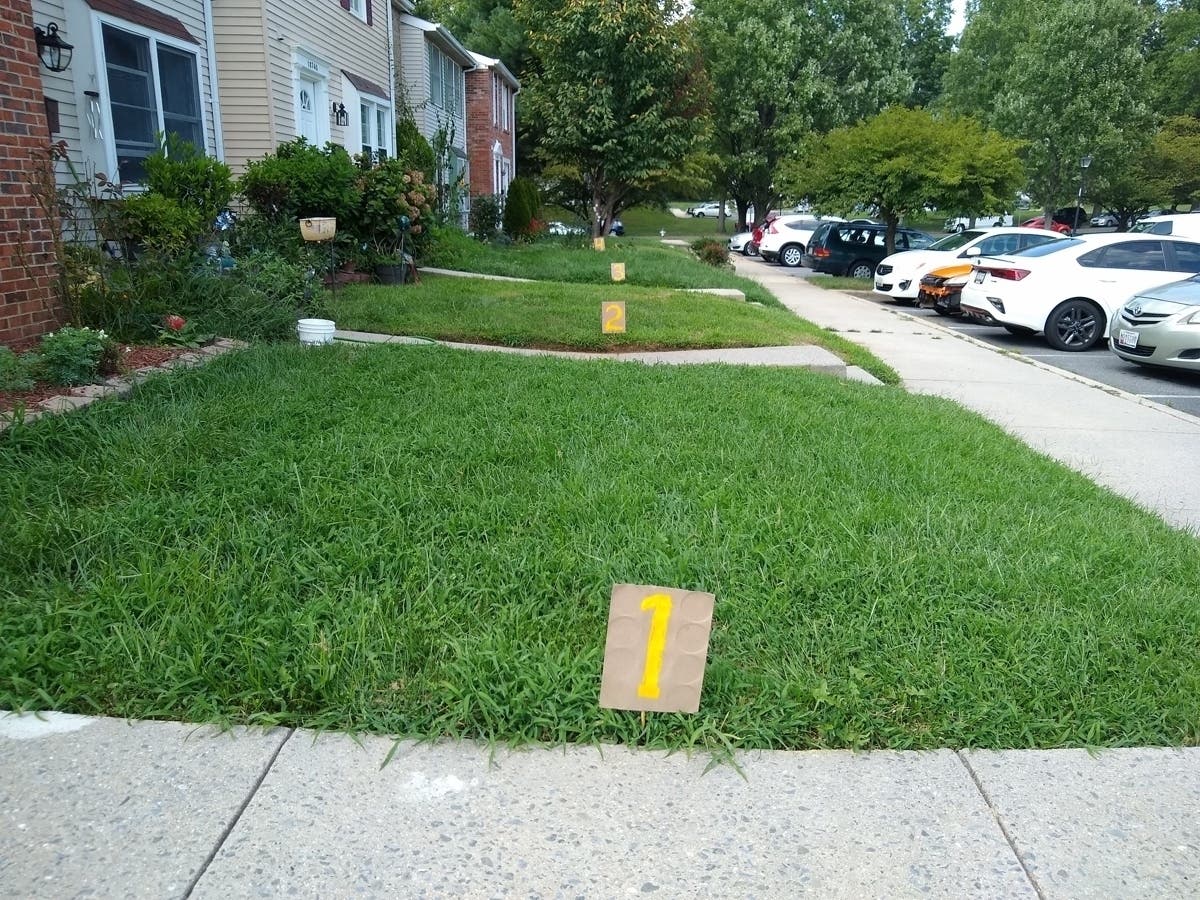
From March 2020 until recently, the inspector seemed to be developing a new habit: citing homeowners for a “dip in their sidewalk.” If you look at the walkways in photo 1, you do see two slabs that form a slight V-shaped dip, there in each sidewalk. Five sidewalks in a row. You also see this configuration on other walkways at other townhomes around Quail Valley. (photo 2) “Why is that?” I wondered. Did the original builder skimp on the foundation right at the middle of everybody's walkway? Or something? So I went looking for someone who might know the answer.
I found a contractor, a Quail Valley neighbor in fact, who constructs concrete driveways and foundations for buildings in Montgomery County and Washington, DC. He explains: “What the HOA is calling a 'dip' is part of the original design of these walkways, which are very firmly constructed. There is a good foundation here. None of the underlying bluestone is showing or has washed away. There is nothing wrong here. It would be a crime to demolish these well-constructed concrete walks.”
This expert emphasizes, “The dip is NOT the result of ground settling or eroding under the walkway. The shape has a function: the slabs are inclined to convey water off the walkway and into the grass.”
The inspector said that this dip was caused by undermining, by soil erosion? Really? That is not correct,” he asserts. “There is no safety or maintenance issue here. I see no evidence of the ground shifting or eroding. This particular pattern for laying the slabs is not the current practice or code, but features like this must be grandfathered in. It is not a flaw. The slope is part of the original design. And it works as intended.”
The property manager for Quail Valley HOA, “explained” at the August HOA meeting that concrete walkways age over time, etc. We’ll take more photos, they said, at our public meetings, "to clarify matters." Meanwhile, the violation stands. At the September community meeting, the issue was still unresolved.
This is novel stuff, folks. Homeowners cannot recall being cited for concrete before the year 2020. The pandemic has put the HOA industry into a creative frenzy. Many families report being surprised by the volume of violations that have hit their door in 2020 and 2021. Concrete "flaws" are the new fad. It's the latest tool in the toolbox of extortion.
This year we witnessed an apartment building collapse in Florida. One failure in the chain of events leading up to the disaster was an association (a volunteer board of directors) who did not understand or attend to an engineer's warnings about problems developing in a concrete slab. Perhaps this disaster has inspired amateurs in Maryland to falsely claim they are experts in concrete? The timing is weird.
Looking at the five walkways (photo 1) before him, the contractor explained, “Sidewalks have to shed rainwater. Thus, they should not be perfectly level. (Note 1) There should be a slight slope to the finished walkway.” Does that engineering fact, and the grandfather clause for the original design, matter to the Quail Valley HOA board of directors? If the homeowner does not comply by spending thousands of dollars, the HOA is empowered to hand their file over to the debt collector, stoking up the fining machine. They would be riding high on power, astride a great cash cow made of concrete. Let's not go there.
NOTES
1) "Not level" is a problem, according to the QV Home Maintenance Checklist, under "Stairs/ Walkways/" etc. That guideline is vague, arbitrary, and technically incorrect; to shed rain, the structure should not be perfectly level.
This (good and wise) sentence is at the top of the checklist: "We encourage you to consult with professional contractors if you have questions regarding the proper maintenance of your property." What's good for the goose is good for the gander. The HOA, itself, should check with a professional before giving any inspector the green light to cite anyone with a violation for the condition of their concrete walkway, steps, or stoop. How often would "concrete" be contemplated as an HOA citation addressed to any homeowner? It seems that would be a very rare occurrence, and the damage to the concrete rather severe, before such a letter is written.
** **** ** **** ** **** ** **** **
Read various Chapters of "Living on Cuckoo Court" at tinyurl.com/CuckooCourt.
Read about condo and HOA "dysfunction, corruption, and abuse" all across America at IndependentAmericanCommunities.com.