Neighbor News
HOA Negligence? Self-Reliant Residents Fix a Tripping Hazard
If residents report a safety hazard, then create a service request; examine the scene; and make a repair. (Ch. 39) See the How-To video.



Here is the video that accompanies this article.
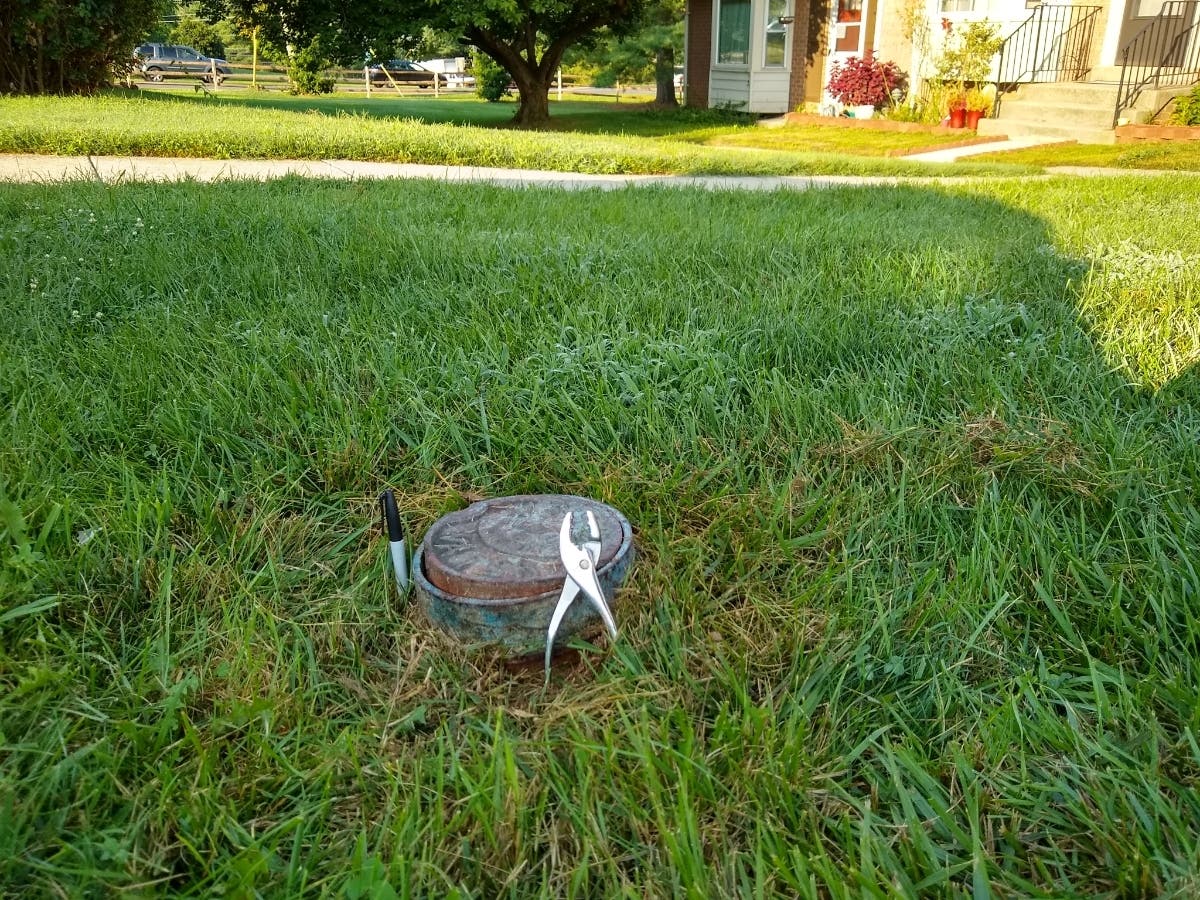
Back on August 24, 2021, we suggested that "the HOA should level the ground around this vertical cast-iron pipe and cap and plant some grass seed this fall." A resident had reported breaking her toe on the thing, and others had been injured as well, tripping over it in the dark. She reported the hazard to the HOA. This lawn on Hummingbird Terrace is adjacent to parking spaces, and there are other hazards nearby: sink holes that are hidden by the evenly-mowed grass, waiting to sprain your ankle.
Three months later, these hazards remain. So in the absence of a simple and inexpensive fix by the Quail Valley HOA, some residents have apparently taken spade in hand and, with a couple buckets of soil, leveled the ground around the cap to the WSSC water shutoff valve. Residents eliminated this hazard, but another hazard is just a few feet away: small sink holes. Will the HOA now please fix them ? (Update: 5/30/2022. Dear HOA, You are too late. One resident had some extra soil and used that to fill the remaining sinkholes.)
Find out what's happening in Gaithersburgfor free with the latest updates from Patch.
CITIZEN ACTION ON FILM
Why are Quail Valley residents paying $600,000 in HOA dues annually? Is there no money for a workman, a spade, and a couple buckets of dirt? And why does our neighborhood government, the HOA board, seem so unresponsive to residents' concerns about public safety?
The task here—leveling the turf— is not rocket science. A video (of how the work was done) has been posted here-and-there on the Internet. The authors of the film seem to be anonymous. (If their alleged Oscar nomination for best documentary moves forward, that could be a problem.)
Find out what's happening in Gaithersburgfor free with the latest updates from Patch.
Golly and gosh! Will the HOA now trace and fine these civic do-gooders for improving a bit of the commonly owned landscape and preventing injury? Will they receive a reprimand for their permission-less use of a sod-breaking spade? Heavens-to-Betsy, what is the world coming to, when people eliminate, at no cost, obvious hazards that might harm themselves and their neighbors?
TWO SUGGESTIONS FOR THE QUAIL VALLEY HOA
1) FILL IN THE REST OF THE DEPRESSIONS on this bit of lawn. The depressions--sink holes-- are tripping hazards. They are a liability for the HOA. Yet more people could get hurt from these sink holes. Why delay? A handyman with a spade and soil in a pickup truck (about 4 wheelbarrow loads) could do the trick. Cool weather is a good season to do this kind of work.
2) CREATE SERVICE REQUEST NUMBERS. Hire a property management company that creates a service request when any resident reports a problem on the common lawns or buildings. This is standard business procedure for property managers and, well, for any service industry and responsible government agency. How does that work?
If a resident calls in about a problem, the property management staffer creates a service request record and gives the resident the unique number of that record—which can be used later to track progress as the problem is verified, prioritized for work, and then fixed. (Note 1)
That's called accountability. Professionalism. Good government. The county's 311 provides you with a service request number when you make the call. Quail Valley residents don't get that kind of service. What we get this message from the HOA:"We reported [the problem] to the WSSC, but no telling when they will respond. It looks like the cap is lopsided, and [we] will try to have it placed flush." Then nothing happened. The hazard remained. That is not an example of responsible government.
The HOA can send a competent landscaper (or carpenter, or arborist) promptly onto the common property who can look at the pothole (or the clogged gutter, or the leaning tree), create a work order, and report back to the community that the work is done—or if not, why not. If problems on the landscape "get fixed occasionally," that's not good enough. Residents' concerns about the upkeep of the community ought to be the priority. That's why we have an HOA, right?
** ************ **
NOTE 1
A service request record begins as a form with a unique tracking number and relevant data fields such as the date, who was the source of the complaint, and a description of the problem, including its location. The record grows into a journal showing the institution's step-by-step response. Each staff person who takes action to fix this problem (including the intake clerk) enters their name, date, and describes the work they did. If they hand over the problem to someone else (with special skills, perhaps), that new participant enters their initials and the date they received the service request, accepting responsibility for its progress.
Thus, you create a clear record showing who did what, and when. Give the resident who calls in the service request tracking number before they hang up (or place it in the email reply). If a work order sits forgotten on someone's desk for 3 months, the record shows exactly who dropped the ball. Even better, if the work has not been completed in a week, the service request title can pop up in red ink on the supervisor's computer screen in the morning. That's accountability. Choose the software that fits your particular organizational or business needs, such as property management.
** ************ **
Steven Sellers Lapham is a 21-year resident of Quail Valley. He can be reached at MuskratMusic@gmail.com. The "Living on Cuckoo Court" collection of essays is on Patch.com. Read about the nationwide problem of "HOA corruption, dysfunction, and abuse" at Independent American Communities.