Neighbor News
Let's Do This Work: Correcting a Legacy of Dangerous Trees
Decades ago, we planted cute little white pines, which grew into huge hazards. Today, urgent HOA remedial action is needed. (Chapter XXXIV)

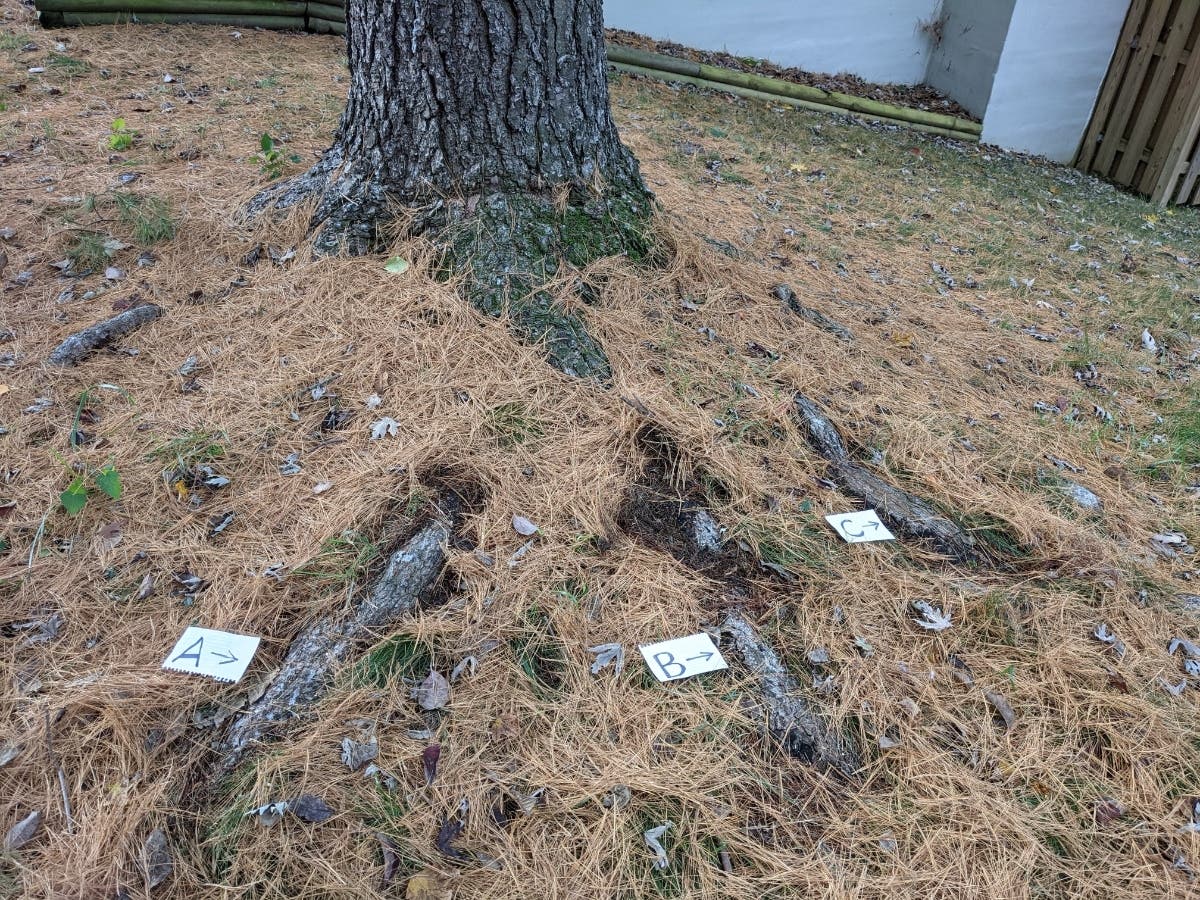


UPDATE 8/8/2022: The HOA has had a tree company survey all of the trees on the common-ownership property and identify hazardous trees that need removal. This looks like progress. We are hoping this new list of targeted trees overlaps 100% with the (shorter) list of trees that residents have expressed concerns about, such as those described here. Stay tuned. –S.L.
Decades ago, the Quail Valley HOA apparently made the mistake of not consulting with licensed tree experts (LTEs) before planting dozens of cute, inexpensive, white pine trees all around the community. Today, those trees have grown into dangerous behemoths that can--and have--crushed roofs with their limbs (when they break off, burdened with ice) or with the whole tree (when it uproots from the shallow, clay soil typical of the Maryland piedmont). See the examples in the photos above.
Today, the HOA board of directors is unhappily saddled with this legacy of hazardous trees. It will be a very expensive problem to correct. The problem is not their fault, but it is their responsibility to mitigate these hazards. (Note 1) Let's not make the same mistake of relying on salespersons, vendors, property managers, and other inexpert or potentially biased sources of information. (Note 2) We have wasted months (and some would say years) not doing the required work, relying instead on cosmetic trimming of trees. Here is what the Quail Valley HOA must do now.
(1) Hire an arborist to survey ALL of the trees in Quail Valley, produce a map showing where each hazardous tree is located, and share this map with all 592 property owners. Maryland State regulations require that any tree over 20 feet high be examined by an arborist (an LTE). Here is a useful flier for reference about the Maryland Tree Expert Licensing Law.
Find out what's happening in Gaithersburgfor free with the latest updates from Patch.
(2) Seek guidance on developing a plan to pay for the tens of thousands of dollars required to mitigate these hazards. Start immediately. (Note 3) The HOA should appeal for help from the University of Maryland Extension (UME), the Maryland Arborist Association (MAA), the county's Office of Common Ownership Communities (OCOC), and our county and state elected officials (MD District 39). For example, perhaps there are grants to which we could apply, but we will not discover them unless we ask. There ought to be public funds to help communities in this predicament.
(3) Advise any family that is in immediate danger of being crushed by a tree to live and sleep on the first floor, not on the second floor (directly under the roof) during severe weather. The HOA should work very closely with the arborist in this regard, and perhaps with a county social worker. We want to reduce the risk, but not raise fears unnecessarily.
Find out what's happening in Gaithersburgfor free with the latest updates from Patch.
(4) Report to the residents (by email, in the Quill newsletter, USPS letter) about which trees are slated to be removed or pollarded, and what the schedule is for the treatment. Give details. Keep residents updated with brief reports at the monthly board meeting -- as well as separate Zoom meetings on this topic, at least once a month, to delve into the details.
The urgent problem of dangerous trees is a matter of life and limb for the residents. The problem has been developing for decades, but time is up. The crisis is now. We are off to a rocky start. The HOA is discussing this matter, but it did not act quickly after warnings were sounded in April 2021, and even earlier by various residents. We can do better than this. Let's work together, and solve this problem as a community.
NOTES
(1) The HOA board must always "promote the health, safety, and welfare of the residents," per our HOA Covenant.
(2). "Let's not make the same mistake of relying on inexpert advice." Please note that I'm an amateur tree lover myself, and anything I say here about the correct management of trees should be verified by experts, by LTEs. Even then, the HOA may wish to seek second and third opinions if there are ambiguities in the diagnoses of problems. Wouldn't relying on the advice of an unlicensed person be malpractice by one party or the other? Let's not repeat that mistake.
(3) The Quail Valley HOA gathers about $600,000 from the 592 homeowners each year in HOA dues, the "HOA assessment." Taking down one 40-foot white pine tree near a house can cost $2,000 or $3,000. Pollarding it to a safe height might cost half that amount. --SL.
*** Steven Sellers Lapham is a 21-year resident of Quail Valley. ***