Neighbor News
MCPS Demolishes a Little Food Garden
Volunteers manage a small meadow with a few garden plots. Reduce costs. Capture carbon. Build community. So ... where's the problem?



How does Montgomery County Public Schools (MCPS) . . .
- Relate to adults who step forward to volunteer?
- Manage its green spaces–the grounds, trees, and creeks?
- Transition to a sustainable future and reduce carbon emissions?
- Enhance the security of the school and its human community?
The summer of 2022 was rough for planet Earth and her inhabitants. Headlines read, “Monarch Butterflies Endangered,” “Hot Weather Emergency,” “Climate Change,” and “Global Food Shortage." Health experts recommended that kids and adults seek outdoor recreation–for their physical and emotional wellbeing–during the summer’s resurgence of new COVID variants.
On a small plot of land next to Strawberry Knoll Elementary School in Montgomery County, Maryland, neighbors had been visiting the Three Sisters Garden and the Butterfly Patch. You could meander about the plants, and chat with the adult volunteer gardeners while maintaining a CDC-recommended safe personal distance. These informal projects, run safely by volunteers for two-and-a-half years, had improved a landscape that MCPS had long neglected.
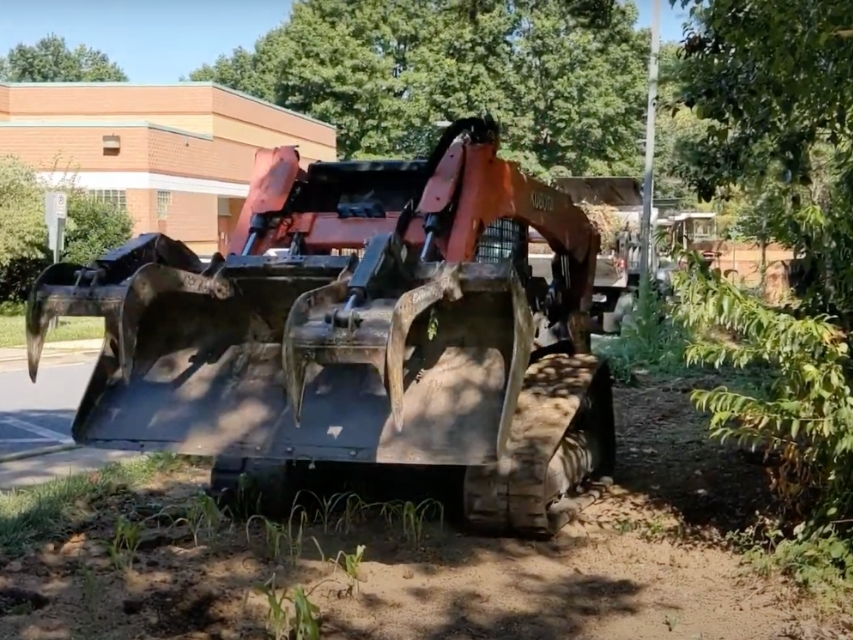
Then, on June 30, 2022, school district crews bulldozed the tomato plants, summer squash, okra, bean, and strawberry plants. They leveled the milkweed and goldenrod, removing signs: “Brer Rabbit’s Den,” “Please stay on the path,” and “No matter where you are from, we’re glad you’re our neighbor.”
Find out what's happening in Gaithersburgfor free with the latest updates from Patch.
That moment of destruction is not the end of the story. The community is petitioning, at Change.org, to bring the garden back. More than 135 people have signed at
tinyurl.com/3SistersPetition. This time we are hoping to form a collaboration with school district administrators and educators. Perhaps it was necessary to “clear the slate” so we could start again.
It Began with Strangled Trees
Honeysuckle vines and trumpet creeper had been strangling these trees for years. When overshadowed by invasive vines, treetops die, then rot, and then break and fall. Nobody seemed to notice, certainly not the school district, even as falling limbs damaged the neighbors’ fences. So when the COVID epidemic began in the spring of 2020, Steve began cutting down the vines as a form of exercise, applying his training from county’s volunteer Weed Warrior program. Struggling through the thicket of thorny bushes just to reach the trees, he came across rotting basketballs and footballs that kids couldn’t fetch over the years. So he began clearing away the multiflora rose and berry bushes to create paths across the plot. He also cleaned up trash, including quite a few beer bottles. The ground opened up, and a healthier mix of wild plants, pollinators such as goldenrod and foxglove, began to sprout.
Find out what's happening in Gaithersburgfor free with the latest updates from Patch.
Volunteers Turn a Wasteland into a Huerta
A week later, Nelson came out of the adjacent house, admired the progress Steve was making, and asked if he could join in the clean-up effort. He also wanted to plant a few vegetables in the newly opened spaces to make it interesting for the kids when schools reopened. Steve replied, “Let’s find out who the land actually belongs to. We can check with the school principal and the manager of the nearby county park. See how they react.” The principal responded (in emails) that it would be okay to plant garden crops and flowers, but please contact him if we wished to construct anything on this MCPS-owned land, across a driveway from the school.
So we planted few crops– some tomatoes, hot peppers, and sunflowers. Nelson researched the cultivation of the Three Sisters (corn, beans, and squash), a pre-Columbian method of sustainable farming still practiced today. The next year, 2021, the first COVID vaccine was produced. Ella joined the effort and planted our most successful crop of the season, five varieties of okra, along with Cherokee beans and other plants. Other neighbors contributed tomato plants, flowers, and squash. Ella began having conversations with teachers about possible interdisciplinary lessons that could be taught during a “field trip” on the sidewalk alongside this nascent school garden, La Huerta de las Tres Hermanas.
The volunteers began learning about successful community gardens. For example, the St. Michaels Community Center on the Eastern Shore runs a low-cost, one acre community garden. (See snapshot above, and their online photo gallery.)
One main service that the plot of land at Strawberry Knoll provides is sequestering rainwater. There is a large storm drain along the soccer field 1,000 feet downhill from the garden. The efforts of the gardeners–breaking up the clay, adding organic material–greatly increased the permeability of the soil and its capacity to hold runoff.
Warning Signals from MCPS
In late May 2022, we learned that the principal’s request to establish a school garden at this site was denied by district administrators, who emailed: “The garden was found to be: non-ADA compliant, contained trip hazards, and is considered a potential environment for rodent infestation. The existing metal shared-food donation bin is also a potential hazard for elementary school children with food allergies. The posting of ‘Forest Conservation Area’ signage on MCPS property by unauthorized agencies is also not permitted. Based on these findings, the garden is to be removed entirely from school property.”
Yipes! There was some good advice, but also a number of misunderstandings here. We appealed to administrators in emails. Steve wrote, “I'm sure we can make changes needed for safety and/or to meet code in the Three Sisters Garden. We would be glad to follow MCPS guidance in the project, and [we] have a record of doing so…”
In response to the list of problems, we quickly removed official-looking signs. (These were, we thought, obviously humorous: an acre with a few trees is not a “forest”). We removed the small metal box that housed fliers giving the addresses of nearby food banks. (Apparently, somebody had placed a jar of peanut butter in there, but this was never intended to be a little food pantry.) We began removing the pavers (trip hazards) that had defined the path winding between the garden plots. We could have been quicker removing the pavers and a few rebars that formed a trellis for cucumbers. Mea culpa. We could have taken down the ropes and stakes defining the different crop areas–if that was part of the “tripping hazard.” But was it? We asked for a conversation. We got a bulldozer.
Two Spurious Objections
Two complaints in the email were without merit. Do gardens attract rats? In 2021, Steve had, by chance, met the MCPS rodent control inspector, who explained his work, walking about the grounds. On that day, the inspector found no sign of rodents, and placed no traps (as we observed). Rat infestation can be a real challenge on school properties, but it is also a spurious accusation leveled against community gardens. The bushes and “forest path” managed by the volunteers was a habitat for rabbits and chipmunks. We knew them well. We harvested tomatoes as they ripened, and many of the crops (e.g., okra) grew on stems, up off the ground. There were no rats in the garden, as confirmed by the inspector. During the 2021 season, for good measure, Steve placed one A24 Rat Trap on private property near the garden. (GoodNature, $170). No rats were obtained by this concussive device, which has aided the recovery of native mammal and bird species in Hawaii by exterminating (exclusively) Norway rats.
Can school gardens comply with the technical requirements of the Americans with Disabilities Act (ACA)? The wheelchair-accessible sidewalk along a stretch of the southern edge of this garden meets the definition of an ADA-compliant pathway. Ella described how students could line up along the edge of the garden, “smell a mint leaf and watch a gardener harvest a potato” without any child actually entering the garden during a mini “field trip.” The ADA explicitly does not require that an entire playground (or an entire garden) be wheelchair accessible.
Please understand: this is not a garden alongside of a school, where students can casually walk out the door and into the plants. Instead, the plot is on the far side of a utility driveway where repair trucks and garbage trucks access the loading dock and dumpsters. It’s “across the driveway” from the school. It’s a space not used by students, teachers, or staff. After school hours and weekends, however, parents and children did visit the garden and walk through it. That is not unusual for all sorts of school properties, which are open campuses on the weekends.
Volunteers Enhance School Security
The value of the security (e.g., reporting trespassing and vandalism), informal education, and good community-school relations provided by adult volunteers who worked the land may be hard to measure, but it is very real. The gardeners worked within sight of K-5 students as they came to and went from the school. We worked on evenings and weekends, when staff are rarely present to keep an eye on the buildings. As the sun set, there were gardeners on the property, rather than solitary beer drinkers hiding behind a thorny thicket.
The garden was managed safely for two-and-a-half years, and the buildings and grounds were safer because of it. For example, Nelson has gently but assertively approached people pulling up with cars and trucks to illegally dump trash beside the school’s dumpsters. He can see it happening from his back yard. The volunteers erected a small “No Dumping” sign that deterred dumping … until the sign itself was removed by the demolition crew. Now attempts at illegal dumping have picked up. We report incidents to facilities management.
Nelson says, “I call the police when I see people up on the school’s flat roof.” Sometimes there are just up there “for a thrill,” but often they break the skylights or do other damage. Steve has encountered teenagers starting to climb up on the roof and deterred them from that. Instead, they got a tour of the garden, and a cherry tomato to eat.
Moving Forward from Here
Our informal garden was “untidy,” we the volunteers admit. The rebar trellis for cucumbers was not approved, we confess. We have a lot to learn about managing a school garden in collaboration with professional staff, we know.
Our online petition asks MCPS to work with the adult volunteers, school staff, and officials–as partners–to figure out a way “to establish a gardening project that would support the elementary curriculum, integrating math and literacy with lessons about where food comes from (science and history), while improving this plot of land and reducing carbon emissions.”
We are asking the school district to see volunteers not as problems, but as partners. If the administrators and safety engineers had engaged us in frank conversations, on site, during their spot inspections of the garden, we could be well into an interesting experiment in land-management, cost-savings, and school-community relations. Now that the land is cleared, might MCPS perceive this as an opportunity to start again? Our petition is addressed to the new superintendent, in hopes that a new path might be forged.
Cost Savings with Meadow Management
Small garden plots would cover just a fraction of this land. What about the rest of the one-acre plot? Facilities management could maintain the remaining ground as a meadow. The volunteers were, informally, doing that. By mowing the land only once a year in February, instead of 12 times or more a year (as a typical lawn requires in Maryland), MCPS would save on fuel, equipment, and staff hours.
Over the next few years, MCPS could upgrade its fleet of lawnmowers by purchasing battery-operated, sit-down lawnmowers. But that’s “greenwashing” the problem. What purpose do lawns serve? The better, low-energy, low-carbon-emissions, and sustainable solution is to convert lawns into meadows.
Montgomery County Parks manages many meadows and has a program encouraging property owners to convert their lawns into meadows. Scholars at the University of Maryland and the University of New Hampshire (among other east-coast research centers) promote the practice.
There are many models for a small-budget project at Strawberry Knoll. For example, the Town of Hillsboro, Maryland, has a meadows project on about one acre of land. At the Glenstone Museum's Environmental Center in Rockville, land managers can learn about regenerative landscape architecture, as practiced on this large campus.
This is a solved problem. And it is urgent that we enact the solution. A warming climate and rising fuel prices demand that school districts find better ways to manage the lands entrusted to them. There is also the preservation of birds, bees, and insects–which, scientists warn us, are needed for human survival. Mowed lawns just don’t cut it any more.
Potentially, hundreds of acres of MCPS-owned property could be managed as meadows, saving millions of dollars per year (on fuel, equipment, and staff hours), and greatly reducing MCPS’s carbon emissions. Of course, we can mow the playing fields for sports and school front yards, but let’s convert the rest to meadows and low-growing trees. Maybe have a school garden here and there, when volunteers step forward to do the work, in collaboration with MCPS management.
With a little work from volunteers (who can be advised by a horticulturist), any small meadow can become an attractive pollinator garden. Here on Strawberry Knoll, one of the first plants to spring back from the denuded soil, thus helping the land to recover from the bulldozers, is a variety of milkweed–whose leaves are the ONLY food that monarch caterpillars can eat. It grew to six inches before it was mowed down (again) last week. If left alone, it will sprout yet again.
The Urgent Choice
Will we give children yet another monochromatic lawn to gaze at? Or can we teach them where their food comes from with the sights, smells, sounds, and textures found in a small school garden? Will we plant and mow more grass, thus contributing to global warming? Or can we create a meadow to capture carbon from the air and create habitat for endangered monarch butterflies? Now is the time for Montgomery County Public Schools to choose.
** *** **
Steven Sellers Lapham is a PTA volunteer, Weed Warrior, member of the Maryland Sierra Club, and retired educational editor. The opinions expressed here are his own.