Neighbor News
Survey ALL of the HOA-Owned Trees. It's the Right Thing To Do.
The HOA can save money (and perhaps lives) in the long run (and maybe in the short run too) with an LTE's arboricultural survey. (Ch. 37)



UPDATE 8/8/2022: The HOA has had a tree company survey all of the trees on the common-ownership property and identify hazardous trees that need removal. This looks like progress. We are hoping this new list of targeted trees overlaps 100% with the (shorter) list of trees that residents have expressed concerns about, such as those described here. Stay tuned. –S.L.
"Most important is a tree replacement strategy—a 20-to-30-year cycle of adding, removing, and replacing trees." — UMD plant pathologist Dr. David L. Clement, quoted in The Washington Post (NOTE 1)
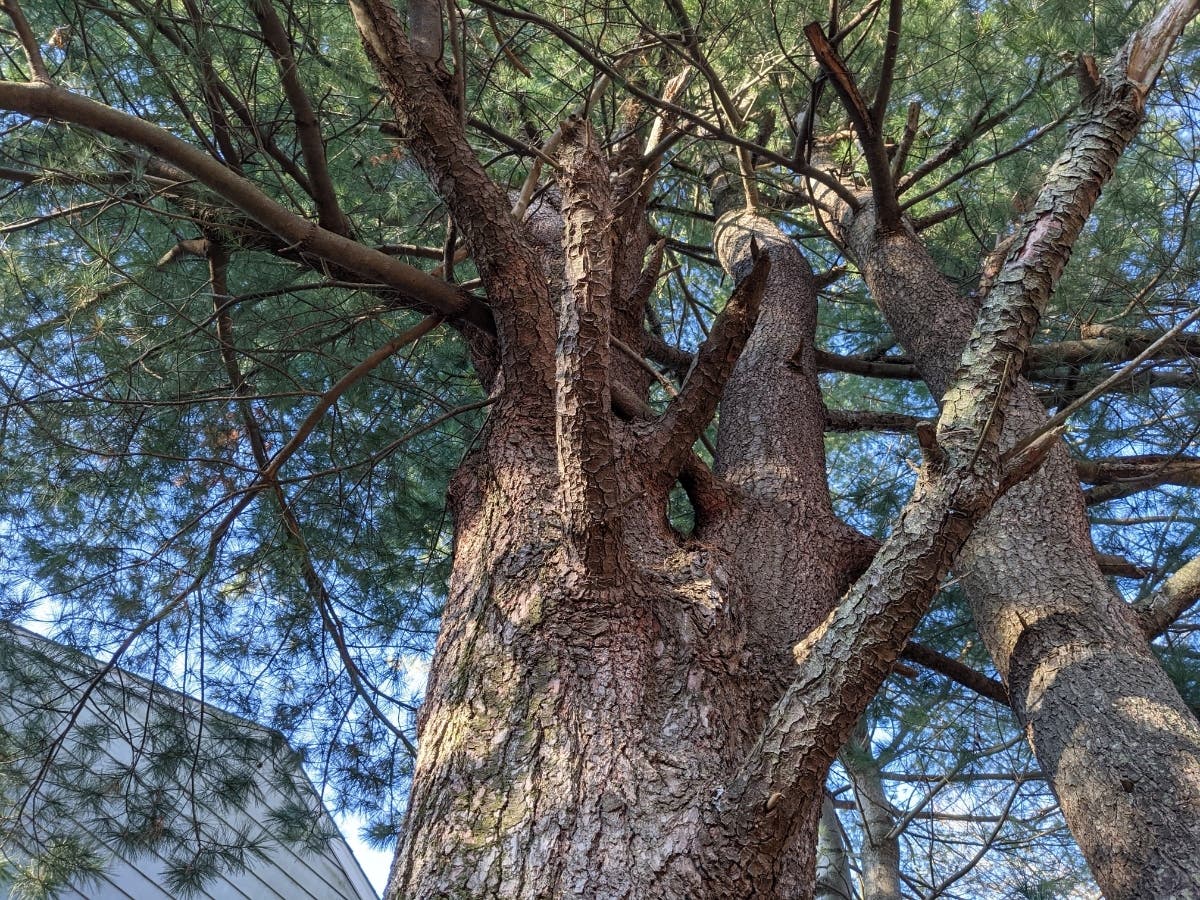
The Quail Valley HOA is spending $27,350 on tree pruning and removal. (See excerpt below from the September 2021 newsletter). This sounds like progress, but the HOA board is making some of the same mistakes that the board seems to have made 30 years ago. Back then, the HOA spent community funds to plant dozens of cute little white pine saplings, some of which have grown to be monstrous in size, looming over houses. The consequences of such mistakes are costly for the association, which means for all of us. For one, the board has created an HOA-resident conflict where there need not be one at all.
Today, the HOA's fundamental error is the same. The HOA has committed funds while failing to hire a Licensed Tree Expert (LTE) to first survey and assess the community's entire collection of large trees. The LTE could identify clearly trees that are hazardous and prioritize them for removal. That professional person could work with the HOA in developing a long-term plan for tree management.
Find out what's happening in Gaithersburgfor free with the latest updates from Patch.
Instead, the HOA surveyed the residents (!) on their opinions about potentially hazardous, huge pine trees (as described below). That is irresponsible. Most resident of Quail Valley are not qualified to evaluate the integrity of a power line, an airplane, a cliff face—or a tree. In fact, only a LTE can answer a question about the safety of a tree over 20 feet tall, per state code.
It's not a bad thing in itself–to distribute a questionnaire asking residents for their opinions. But let's avoid hubris. Does this board know when there's a need for a professional—a hydrologist, traffic engineer, building contractor, or arborist—to inspect a specific potential danger? In this case, the answer is clearly, "no." The board does not recognize its need for expert advice in managing the community's trees. That is frustrating (year after year), and dangerous, for the residents.
Find out what's happening in Gaithersburgfor free with the latest updates from Patch.
Another mistake: The HOA also focuses on one patch of trees, rather than committing to an arboricultural survey of all the commonly held land. These huge old pine trees are all over.
Another mistake: The HOA and its vendors seem to be relying on pruning a few branches big pine trees every now and then as a "silver bullet" to fix all problems. Indeed, that action can sometimes make problems worse. For example, the HOA spent thousands of dollars just a few years ago to prune branches on a row of huge pine trees between Sandpiper Lane and Nuthatcher Lane. Was that Band-Aid measure effective? The answer is here—
An item in the September 2021 QV HOA newsletter:
"Tree Removal/Pruning Proposals – Homeowner feedback solicited regarding whether to remove a row of pine trees between Sandpiper Lane and Nuthatcher Lane was mixed. Following discussion, [board members awarded a contract to a tree service] to remove the trees including a trunk, fallen limbs and remnants of evergreen trees in the area for a cost of $17,550.
A proposal from [the tree service] to remove a number of other dead trees in the community for a cost not to exceed $5,000 was discussed [and approved]. Proposals for pruning of several trees in the community were discussed [and a contract] of $4,800 [was approved]."
This is not all bad news. Some dangerous and/or diseased trees will be gone. We could let all of this pass by without comment except that other huge pine trees, probably hazardous to the humans living in the houses within their fall line, will NOT be covered by the work, which is costing $27,350.
Some potentially hazardous trees are not located between Sandpiper Lane and Nuthatcher Lane; they are not dead; and pruning a few branches from one side or the other will not minimize the gross damage caused by the whole top of the tree splitting away, or the whole trunk tipping over. (NOTE 2)
The focused removal of hazardous trees, as directed by an LTE, should be the priority for how this association spends $27,350. Sadly, that did not happen. We have pleaded for the HOA to hire an LTE to perform an arboricultural survey in earlier blogs (Chapters 31-35), calling out the central problem as early as April 12, 2021 (Chapter 2). And other residents have preceded us in this effort.
Once again, in the absence of HOA leadership on their behalf, residents alone must shoulder the responsibility of protecting themselves and their families. (NOTE 3) This is an inefficient and burdensome way to "manage" a community's tree canopy. The HOA places the residents in an antagonistic position, in opposition the HOA, as we try to solve this problem. The conflict is unnecessary. This conflict is a result of the HOA board of directors not listening to the needs of the community. So here we go ...
[Update, summer 2022: The following passage was wishful thinking. The county refuses to evaluate the hazard. Instead, the arborist leaves a card telling you that the tree belongs to your HOA. Well, thanks. We already knew that.] If you call 311 and say that you fear a tree nearby might be hazardous to your home, then Montgomery County will send an arborist, an LTE, to evaluate that tree. "In all cases, if a tree is found to be hazardous by a Maryland licensed tree expert (LTE) or certified arborist, the hazard may be removed as soon as possible by an LTE." The owner of a tree known to be hazardous would probably be liable for damage caused by that tree, as determined in a court of law.
It's been said that these essays on the topic of trees are "creating liability for the Quail Valley HOA." Well, if that is true, then so be it. Our HOA budget dollars are precious. Our safety matters. Please care about that.
** *** **
NOTE 1: U-Md plant pathologist Dr. David L. Clement, quoted in "Goodbye to an Old Friend: Oaks are Dying throughout Mid-Atlantic," by Alisa Tang, The Washington Post (November 25, 2021), B1-2.
NOTE 2: We've asked the HOA to provide a map, online, for all the residents to see—a map indicating which trees are targeted for removal. The HOA has not posted such a map, to my knowledge.
NOTE 3: The HOA must "promote the health, safety, and welfare of the residents." QV HOA Articles of Incorporation, "IV: Purpose and Powers," p. 9.
** *** **
Steven Sellers Lapham is a 21-year resident of Quail Valley. He is not an LTE. He can be reached at MuskratMusic@gmail.com. The "Living on Cuckoo Court" collection of essays is on Patch.com. Read about the nationwide problem of "HOA corruption, dysfunction, and abuse" at Independent American Communities.