Neighbor News
Trees Can Kill. SNAGS Can Saves Lives, and Budgets Too. (Exhibit A)
A snag is the trunk that remains after you cut off ALL the dead (and deadly) limbs. Woodpeckers love it. Humans are safer. [TREE IS FELLED!]



UPDATE, AUGUST 7, 2024: The county took down the tree today, before this big storm today. Hooray! Concerning snags, there's a neat 20-foot-high snag along N. Summit Avenue on the western side with the Asbury Community in the background. Covered with ivy. Managed by City of Gaithersburg. I'll take a photo & post it. The snag feeds the woodpeckers and looks like a green Greek column or something.
UPDATE: Here is an informative response from Councilmember Dawn Luedtke's chief of staff, July 16, 2024. . The dead tree still stands, but we hope it will come down soon. It's getting some attention. -SL
Dear Steve:
Find out what's happening in Gaithersburgfor free with the latest updates from Patch.
Thank you again for notifying us of these trees. MCDOT is planning to remove the trees at Nuthatcher Lane/Quail Valley Boulevard and Sandpiper Lane/Quail Valley Boulevard within the next few days. Some more information from MCDOT Division of Highway Services:
MCDOT strongly advocates for all the benefits that urban trees can provide to both people and wildlife. Occasionally, MCDOT’s arborists leave wildlife spars in wooded areas where there is little to no consequence if the remainder of the tree were to fail. However, in general, we don’t believe that the roadside is the best place for a spar to remain standing for any significant amount of time due to the extreme consequences that could result from it failing and striking property or worse.
Find out what's happening in Gaithersburgfor free with the latest updates from Patch.
For efficiency, our contractors do frequently remove trees in stages. First, they send a crew with a bucket truck to “top” a tree. A second crew then arrives shortly thereafter with a grapple truck to dismantle the trunk of the tree and haul it away. MCDOT appreciates the community’s feedback as we work to ensure the safety of roadways and sidewalks.
Aaron Kraut
Chief Of Staff - Councilmember Dawn Luedtke
100 Maryland Avenue, Rockville, MD 20850
240 777-7859
[End of the Update]
** ****************************************** **
"Woman Killed by Tree was Amazing: Sarah Noah, 35, had 'So Much Life,'" reads the METRO, p. 1 article on July 12, 2024 in the Washington Post. A large branch had fallen on her as she walked through Garfield Park in D.C.
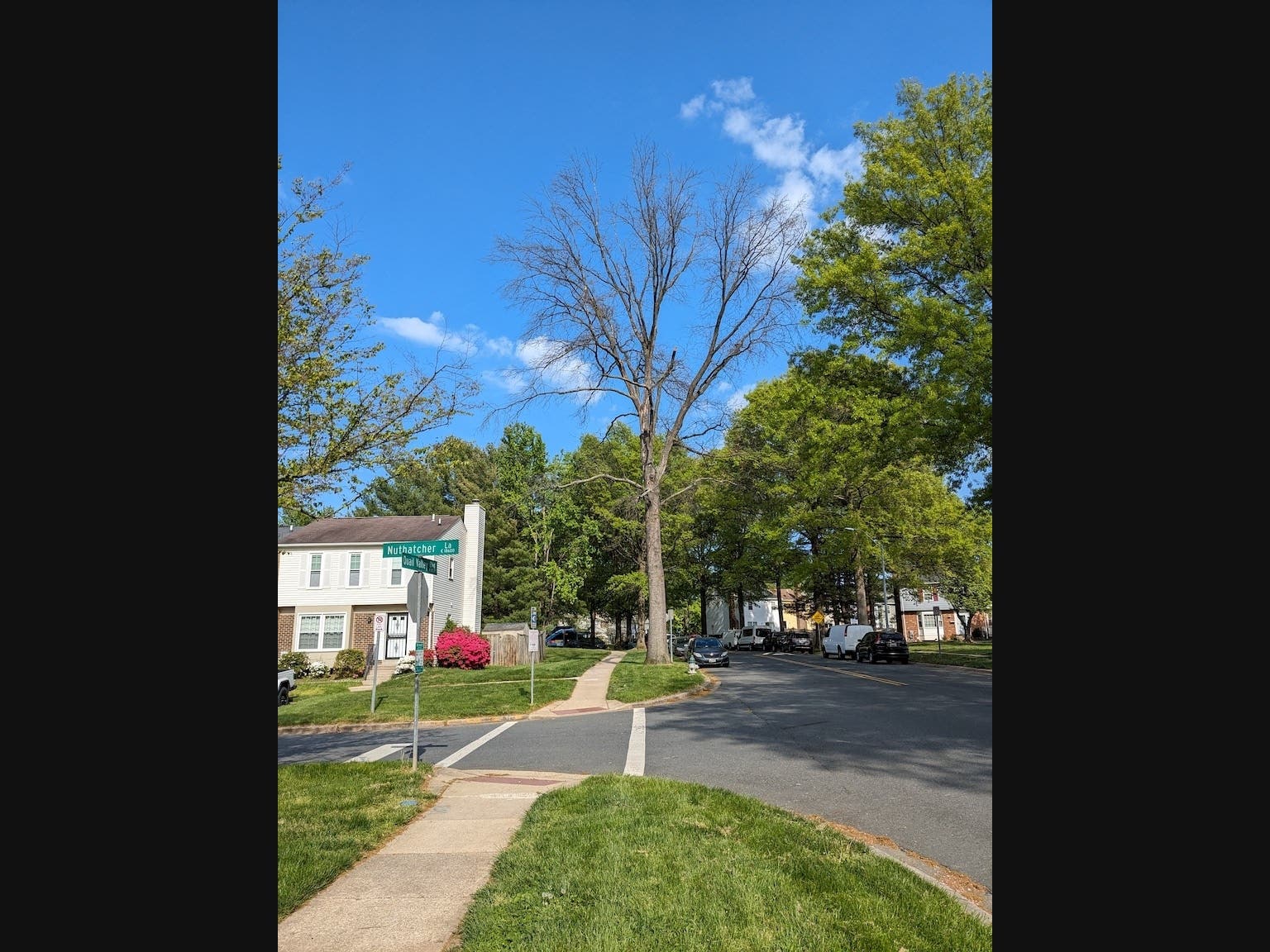
Well, here's a photo of a huge dead oak tree that is dropping branches onto the sidewalk today. It's on Montgomery County land.
Residents made 311 calls to the county as early as last year, asking the county to take down the tree, which is on the curb-lawn near the intersection of Nuthatcher Lane and Quail Valley Blvd. The county reports that it is working as fast as it can (being short on tree-care staff, and arborist contractors working at full tilt) to fully remove hundreds hazardous trees along the county's roadways. We understand the challenge.
But why "fully"?
Why does a tree need to be fully removed? It's much quicker to simply remove the hazardous dead limbs, leave the remaining trunk (the "snag"), and then move on to the next hazardous tree on the list. The snag slowly softens as it decays. It does not fall over. You can see the county using this method in county parks, where the 15- or 20-foot snag becomes "an apartment building for wildlife," feeding woodpeckers and providing burrows for birds and chimpmunks. If the snag is considered an eyesore for humans nearby, come back and take it down on the work crew's second pass, after they've snagged the limbs on all such dangerous trees around the county as their first response.
We'll hope the county will turn this dead tree on Quail Valley Blvd. into a snag soon. Meanwhile, a concerned citizen is marking the perimeter of the limb "fall line" with yellow caution tape, in hopes of steering pedestrians off the sidewalk and onto the grass to avoid the danger of a falling limb.
(We've contacted the county, and will post their response to this blog at the top if one is received.)
On a happier note, our Quail Valley HOA responded to residents's concerns over hazardous trees (on HOA property) by taking down about ten of them over the course of three short weeks. Our common community is establishing a tradition of walking around the grounds twice a year, with an arborist, to confirm resident reports of tree problems, to spot new problems, and to confirm that earlier work has been entirely completed. (See photo)
State law requires that a licensed arborist evaluate a tree over 20 feet tall if there's a question about its safety. Many communities have problematic "legacy trees" that are "the wrong tree in the wrong place." Tree care is (unwisely) not included in the planning document (mandated by the state) that each HOA must compose for its long-term care of HOA facilities. Each HOA's "reserve study" should include the costs of tree management. That's one state-level reform of the law that we need. Property management companies and landscape companies are often negligent in their care of trees. HOAs are often poorly advised on their management of trees. (See photos of strangled tree) Removing dead or diseased trees, and planting new ones, is more expensive if not done properly. Every community should plan for the stewardship of its trees.
Of course, we need trees for shade, carbon capture, rainwater retention, and for the livability of our human landscapes. Counties and HOAs are beginning to follow best practices by planting a variety of trees in any location (so the next tree disease will not knock out a whole row); using native Maryland varieties that survive our weather and clayish soil; and planting smaller species in places close to houses, buildings, or utility lines.
Snagging can become the first response to the presence of a huge dead tree on public land. Remove the limbs and leave the trunk. Prioritize the protection of human life. Feed the woodpeckers. Save the rest of the task for later.
Steven Sellers Lapham is a 24-year resident of Quail Valley HOA and author of the "Living on Cuckoo Court" blogs at tinyurl.com/CuckooCourt.