Neighbor News
Kissing Fish, Swamp Scanooing, and Slop: Adventures at Echo Hill
Every fall, Barnesville seventh graders spend three days and two nights at Echo Hill Outdoor School on the Chesapeake Bay.

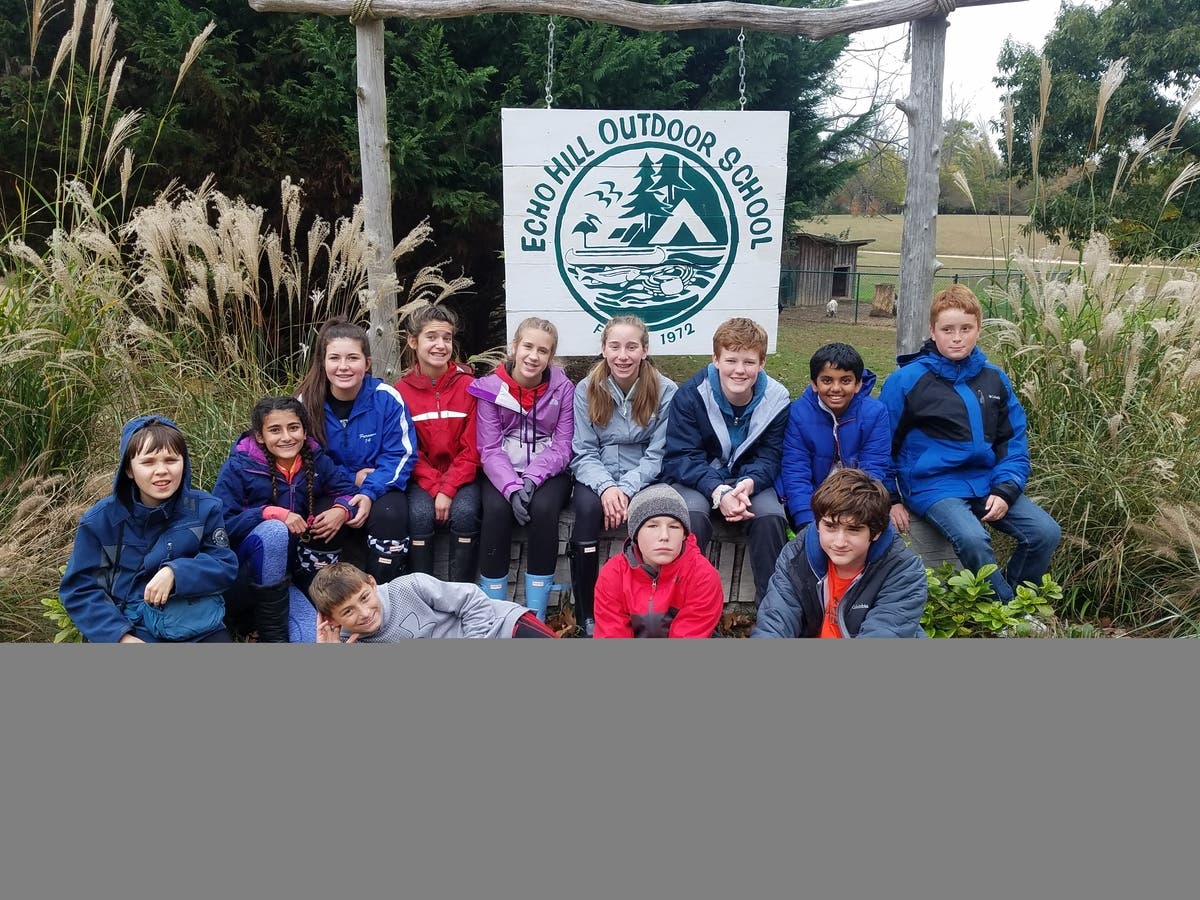
Every fall, Barnesville seventh graders spend three days and two nights at Echo Hill Outdoor School on the Chesapeake Bay for an environmental science field study program and team building.
In Advisory, students compared their experiences with eighth graders who went last year, sharing scientific facts, favorite foods, and funny stories.
Carissa summarized the experience: “To meet any challenge, you need to be confident, make a goal, and have fun.”
Nick talked about how the eels that make their way into the Bay have no gender. Charlie recognized that over 70% of all animals in the world require an estuary (like the Bay) at some point in their life for survival. Gabby recognized that the Bay’s water is brackish -- a rare combination of saltwater and freshwater.
The outdoor school sits alongside The Big Marsh, a freshwater shrub swamp protected by the Nature Conservancy, and its campus includes 172 acres of beaches, marshes, forests and fields, abundant with wildlife. Additional facilities include a barnyard with goats, a recycling center, an organic garden, a Native American site, and a fleet of historic wooden Chesapeake work boats. Barnesville students attend classes and workshops about the relationships among the various ecosystems as well as the surrounding farms and businesses.
A highlight of the trip each year is time spent on a working fishing boat. This year, students caught several eels, blue crabs, perch, and other fish. The boat’s captain discussed many features of the Bay and the entire Watershed surrounding it. As is a Barnesville tradition, students took turns kissing fish they caught.
Middle School Social Studies Teacher Mr. Hart said, “The students were probably most fascinated with the story about how the eels make their way to the Bay and then return out to the Atlantic late in life to reproduce and just die.”
Middle School Science Teacher Erin Farah accompanied the students for a Farm Ecology class that included visits to several different farms in Kent County. One of the farms was a century-old plantation. The students explored the grounds and toured original farm buildings, including a tobacco drying shed and a hand-dug ice house. They learned about how the early occupants of the plantation would have lined the ice house with ice blocks and sawdust, using the underground constant temperature of 53 degrees Fahrenheit to keep their food from spoiling.
The students also visited a more modern farm that uses high-tech equipment like a combine to harvest corn, soybeans, and wheat. Mrs. Farah said the students were astonished at how large and sophisticated the machinery was.
Finally, the students visited a working dairy farm. They learned about how much food and water a cow needs to ingest daily in order to produce milk. They even got to take turns milking a cow by hand, although the farmers use milking machines on a daily basis. Students got to visit and pet the calves as well.
Navigating the swamp via scanoo (three canoes tied together) students observed invasive species of plants, including mistletoe growing high in the trees. They learned that mistletoe is a parasitic plant. They were fascinated to learn that the swamp mud was originally harvested to be used as fertilizer. The company that did this work went bankrupt in the 1970s and abandoned several machines used to scoop and dry mud prior to selling it.
As a teambuilding exercise, students braved a High Ropes Course that included climbing 40 feet to a platform and then ziplining back down. Auveen was impressed with one of her classmates for climbing the wall blindfolded even though she was injured. Even Mr. Hart gave the climb a try and appreciated the supportive chants from the students waiting at the end of the zipline.
Chris said, “Ziplining was my favorite activity because we all set a goal for ourselves to reach the top, and we all accomplished the goal. It was also a fun experience to interact with each other and have fun. Also, Taylor was my favorite counselor and we had him for this activity.”
Nighttime adventures included a hike in the woods with games mimicking nocturnal hunters, and a walk along the beach, Students were amazed that while they were seemingly in the middle of nowhere, they could see lights from Baltimore and two other cities light up the shoreline of the Chesapeake Bay.
The class created a presentation to summarize the experience. Following are excerpts:
Find out what's happening in Germantownfor free with the latest updates from Patch.
- Chesapeake Bay Facts -- The mouth of the Chesapeake Bay is about 12 miles wide between its northern point near Cape Charles, Virginia, and its southern point close to Cape Henry, Virginia. The Bay is surprisingly shallow. Its average depth, including all tidal tributaries, is about 21 feet. A person who is six feet tall could wade through more than 700,000 acres of the Bay and never get his or her hat wet. The deepest part of the Bay, located southeast of Annapolis near Bloody Point, is called “The Hole” and is 174 feet deep. The Chesapeake Bay holds more than 18 trillion gallons of water.
- List of Wildlife -- Students identified 35 specific plants and animals they saw on their adventures. Perhaps most notable was Bald Eagle, which they spotted from the boat, in trees and flying near the swamp.
- Bay Studies -- During the Bay Studies class we learned about animals in and around the Bay. We also learned about salinity of water and the environment it provides for vertebrates and other critters. We also learned about how the plants like algae blooms can start to kill the ocean’s environment.
- Dairy Cow Milking Station -- The cows live in a pasture of grass. They get milked twice a day, and they eat about 20 pounds of concentrate and roughage per day. They drink 50 gallons of water per day. We got to milk the cows and the utters felt weird.
- Slop -- At Echo Hill we ate three meals a day. After each meal counselors would take all of the uneaten food off of everyone's plates and weigh it. They did this to help us realize how much food we waste, and that it isn't just food at the beginning, it starts out as materials and is processed into food.
A photo album can be viewed on Facebook.
(Editor’s Note: In Advisory, several eighth graders were quick to ask the returning seventh graders about their favorite foods. Thursday’s lunch was a Thanksgiving feast, with turkey, potatoes, dressing, and gravy. Mmmmmm...)
Find out what's happening in Germantownfor free with the latest updates from Patch.
Barnesville School of Arts & Sciences is an independent private school in Montgomery County, Maryland offering innovative preschool through 8th grade programs. Cross-curricular teaching encourages students to explore how subjects relate to one another, helping them to make connections that spark inquiry and deepen understanding. Small classes enable skilled teachers to engage each child in an academically challenging environment. Our 30-acre campus is our extended classroom, and we integrate nature into everyday learning. Barnesville is certified as a Maryland Green School by the Maryland Association for Environmental and Outdoor Education, demonstrating achievement in curriculum and instruction, community partnerships, and best management practices.