Schools
Jack Andraka: North County's 'Rock Star'
Sophomore Jack Andraka's invention of a test to detect pancreatic cancer easier and cheaper is just one of the local kid's latest achievements.
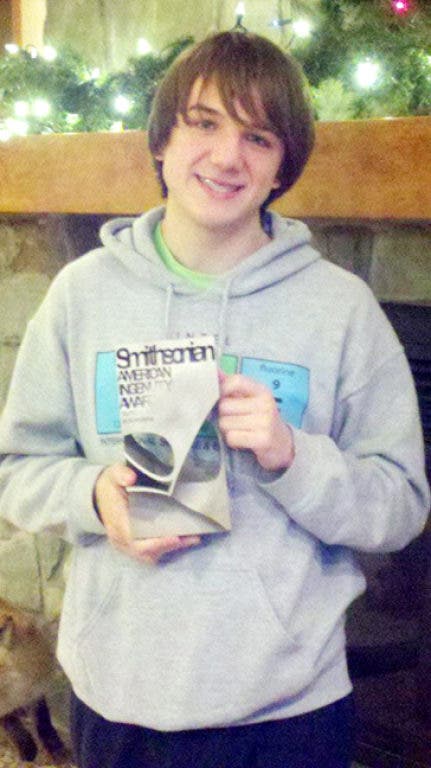
Dressed in a gray hoodie and jeans, Jack Andraka looks like a typical 15-year-old high school sophomore with a Justin Bieber haircut, circa a year ago.
But once he starts talking about his science fair project, it becomes clear Jack is no average high schooler. His science project is far beyond the typical baking soda volcano many youths construct.
And after winning a pair of prestigious national prizes for that science project this year, Jack drops names of celebrities into conversation with the ease of a budding celebrity he himself is becoming.
Find out what's happening in Glen Burniefor free with the latest updates from Patch.
Oprah called, wanting an interview the day after his sit-down with Patch for possibly her magazine or talk show on her network. Yes, that Oprah. He's met Presidents Barack Obama and Bill Clinton, as well as several members of European royalty.
A Crownsville resident, Jack is the subject of a lengthy profile in this month's Smithsonian magazine, after a reporter and photographer shadowed him at where he is in the Science, Technology, Electronics and Mathematics (STEM) program.
Find out what's happening in Glen Burniefor free with the latest updates from Patch.
So what was this science project? Only a paper sensor that could change how pancreatic, ovarian and lung cancers are detected, potentially saving lives. About 100 people die from pancreatic cancer daily, Jack said.
"It's 168 times faster, 26,000 times less expensive than the current gold standard and has close to 100 percent accuracy at diagnosing these diseases," said Jack, who speaks quickly but with confidence. "It costs 3 cents and takes five minutes to run."
Jack first became interested in cancer research after a close family friend died from pancreatic cancer. The cancer was diagnosed late and had metastasized, Jack said.
Last year as a freshman, he began his research and found that tests are inaccurate and outdated at 60 years old.
"I mean, that's older than my dad," he said.
Jack thought if he could lace a nanotube network with mesothelin-specific antibodies and introduce a drop of a pancreatic cancer patient's blood, he could detect the deadly cancer. His epiphany, he said, came as he was reading a scientific journal and half-listening to his biology teacher talk about antibodies.
His project almost didn't get off the ground. His teacher confiscated the journal after catching him reading it, made him stay after class and lectured him for a half-hour on respect before returning it, he recalled.
"It's like zeroing in on a needle in a stack of needles," Jack said. "They bind to one specific protein. I thought, maybe if they react with mesothelin in a rats' nest of nanotubes, it would change its electrical properties."
Having a confidence beyond his years seemed to serve him well as he sought space to work on his idea. He wrote up his proposal and sent it to 200 scientists. One hundred ninety nine rejected it.
"I can't do clinical research on my kitchen counter top," he reasoned.
But Anirban Maitra, a Johns Hopkins pathologist and pancreatic cancer researcher, contacted him with a "maybe." Jack would have to defend his proposal before Maitra and several other researchers, who asked dozens of questions.
Seven months of work in Maitra's lab followed before Jack learned his idea worked. And he believes it could be applied to other diseases if the antibodies were switched.
From there, Jack's cancer test went onto the Intel International Science and Engineering Fair (ISEF)—the world's largest pre-college science competition—in May. Jack won the top prize, the Gordon E. Moore Award, of $75,000, named in honor of Intel co-founder and retired chairman and CEO.
He is the first freshman to have won, and the video of his acceptance looks like a unknown actor winning an Academy Award. Winning the award was a lifelong dream, Jack said.
"There was never a freshman winner. I was like, 'Oh my God,'" he said of the experience in which he leaped out of his seat, ran to the stage and bowed down before the presenters.
It was there that he met Presidents Obama and Clinton and had his brushes with royalty. He also met other notable leaders, like U.S. Surgeon General Regina Benjamin, although he admittedly didn't know who she was.
Even his mother, Jane Andraka, acknowledged the event was like being in Hollywood.
"It is like the Oscars. I'm lucky he's 15 and needs his mom, so I can go and hang out in the background," she said.
And the accolades kept coming. The Smithsonian called to tell him he won a Smithsonian American Ingenuity Award this past spring. The December magazine profile followed.
"I didn't even know there was a Smithsonian award. When they called, I said, 'You have the wrong number,'" he said, adding being shadowed by a Smithsonian magazine reporter and photographer was like, "being a rock star!"
The Smithsonian was so excited about Jack's project that it created a new category to recognize youth achievement, said Michael Caruso, the magazine's editor. Originally, officials were examining his project in the technology category, but couldn't ignore the work of Sebastian Thrun, a roboticist who helped found Udacity, which offers online education at a low cost.
But Jack's work was too good to go unrecognized, Caruso said.
"We created a category specifically for Jack, and we're so thrilled with it, we're going to continue it," he said. "I don't think he even knows that."
But just because the Smithsonian created the category didn't mean Jack's test had an easy ride. Officials wanted to be sure his project was the best among his peers, Caruso said. They reached out to 19 museums as part of that new search.
"He's a great combination of scientific curiosity and dedication," he said. "Every time you look at a prodigy, there's a tremendous amount of work and perseverance."
So what's next for Jack? Seven companies—including Quest Diagnostics and GenTech—are fighting for his patent rights. He's working on his next science project, but "my patent lawyer would kill me if I told you about it," he said.
He's getting ready for the next ISEF competition, in which he may compete against his 17-year-old brother, Luke, who is a senior in North County's STEM program. And he's most excited about the X Prizes, which will award $10 million in 2014 to a team that can create a handheld health scanner, according to its website. No team of young adults has won, but Jack is gathering other ISEF winners to fix that.
"It'll be quite fun to see how we do," he said.
Get local stories delivered right to your inbox or smartphone everyday with our free newsletter. Simple, fast sign-up here.