Health & Fitness
Franklin Middle students delve deep into research for oral history projects
Feature on 8th grade students at Franklin Middle who complete a year-long oral project that sees them researching topics ranging from Madonna's impact on fashion to the impact of Three Mile Island.


Story and photos by Jeff Flynn, Franklin Middle School
If you visited Franklin Middle School recently you may have seen a student dressed as Madonna, another in sixties teen attire, and many others displaying fashions and uniforms from past decades.
They weren’t trying to start a new trend. Instead, these eighth-graders were
presenting the results of their year-long oral history projects for David Thursz’s GT American History class. The project required them to delve into research on a specific decade, and more importantly, on a specific topic that had impact upon society. Students completed extensive research, including interviews with people who had first-hand knowledge of the events in question.
Find out what's happening in Owings Mills-Reisterstownfor free with the latest updates from Patch.
Jesse Johnson, who was dressed in a soldier’s uniform as he presented, looked at what life was like for soldiers during World War II. He found his interviews fascinating.
“They still remembered so much about the war and how it really changed
history,” he said.
Find out what's happening in Owings Mills-Reisterstownfor free with the latest updates from Patch.
Maddie Sparks, who was able to dress as Madonna after a trip to the thrift store, researched the impact of the Material Girl’s fashion upon youth culture.
“A lot of people wanted to be her,” Maddie said. “She made a lot of styles really popular.”
Naimah Jangha, who was dressed as if she could have come right out of the early sixties, researched the Children’s Crusade, which was an important event during the civil rights movement in Birmingham, Alabama in 1963.
“Thousands of children went out of their middle schools and high schools to fight for equality. Bull Connor decided to turn dogs and hoses on them, and they still reacted peacefully. It attracted worldwide attention and got more adults involved,” Naimah said. “I thought they were really brave, and I was inspired.”
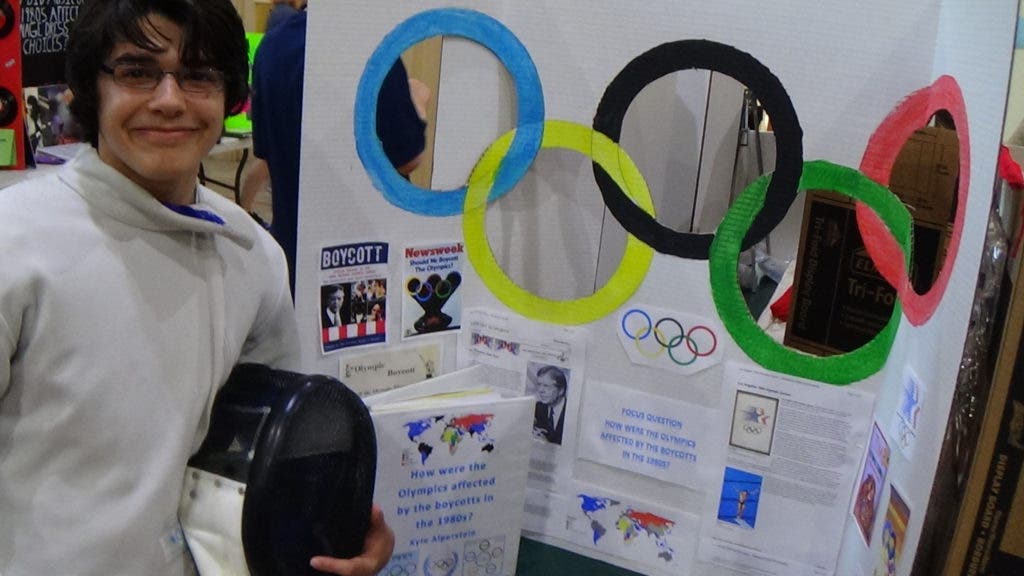
Kyle Alperstein, who was dressed in fencing attire has ambitions that guided his research on the American and Russian Olympics boycotts of the 1980’s.
“The Olympics have always been my dream. It will be my end. I want to go to the Olympics. So I just thought Olympic boycotts, Olympics. I want to do it and hear about what happened.”
After completing his research, Kyle thought the boycotts weren’t effective.
“We did it. They did it back to us. It’s what happens during the Cold War,” he said while adding that competition suffered. “Russia and America were the two key competitors during those times. So when one is removed, you’re not really winning. It’s more of a handicapped win.”
Thomas Kiley looked at the impact the Three Mile Island incident of 1979 had upon the use of nuclear power. Upon completing his research, he wasn’t as fearful of nuclear power. He visited the area around Three Mile Island as he did interviews, and even interviewed a person who later worked at the plant.
“People were afraid that things could go even more wrong than they did, and
then Chernobyl happened six years later, and that led to the decline of the nuclear power industry,” he said.
Next up for these researchers will be ninth grade, and the hope is that they’ve begun building the research skills that will help them succeed. At Franklin Middle, the fall will bring another batch of eighth graders beginning year-long research projects of their own.