Politics & Government
Former South African President de Klerk Reflects on Middle East Tensions, Apartheid at Meyerhoff
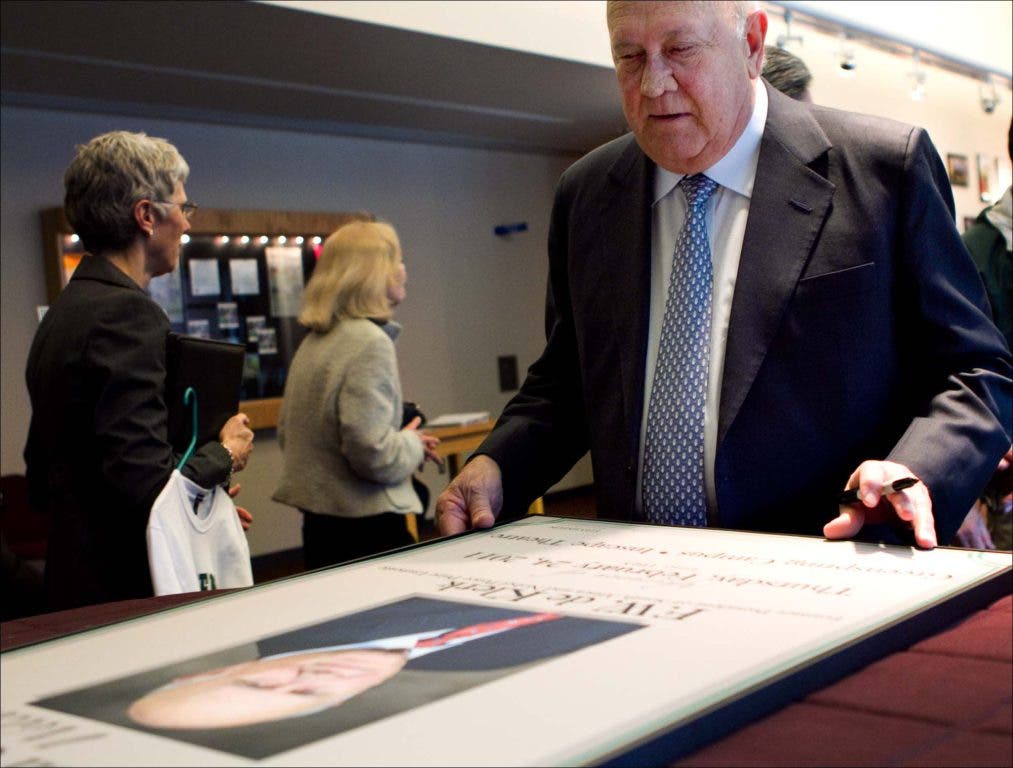
Former South African President F.W. de Klerk engaged with listeners and spoke candidly about his 40-plus years in politics, from how he ended apartheid to the release of Nelson Mandela.


A world leader stopped by the Mid-Atlantic region Thursday to remind citizens that it’s easy to forget how often history can repeat itself.
Attendees from Baltimore and beyond gathered at the Joseph Meyerhoff Symphony Hall to hear not inspiring works of music, but words of wisdom and experience from former South African President F.W. de Klerk. The Nobel Peace Prize winner was introduced by Sheilah Kast, host of “Maryland Morning” on Baltimore NPR member station WYPR 88.1 FM, who also facilitated a question-and-answer session.
De Klerk, a man who has ended apartheid and freed his predecessor, President Nelson Mandela, from 27 years in prison, shared with listeners some perspective and insight into the current civil turmoil in Middle Eastern countries like Libya and Egypt. De Klerk, a lifelong politician, transformed the National Party’s platform of white supremacy in South Africa, which became the New National Party in 1994.
Find out what's happening in Owings Mills-Reisterstownfor free with the latest updates from Patch.
A strong supporter of nationalism’s ideals, de Klerk said, “Libyans are killing Libyans, Egyptians are killing Egyptians," but peace must come first within a country before it can resolve its issues with others, just as it was with South Africa's apartheid.
“Parties must talk to each other and … abandon stereotypes of their own opponents,” he said.
Find out what's happening in Owings Mills-Reisterstownfor free with the latest updates from Patch.
And despite the tension that he found from within his own country — he said any move every which way caused a struggle — he realized “the greatest risk would be to do nothing at all.”
De Klerk emphasized that leaders of today should be willing to negotiate to ensure lasting peace and security.
Listeners included season ticket holders, a $265 to $395 investment, at the fifth installment of seven at Baltimore Speaker Series this year. Jen Erdman, an adjunct history professor at Stevenson’s Owing Mills campus, said she related to de Klerk’s talk on several levels because of her curriculum and an upcoming trip to South Africa for Stevenson students.
“I thought he was fantastic,” Erdman said. “I was particularly interested in what he had to say on in the civil rights movement … it’s just an amazing experience to get to see de Klerk.”
De Klerk attributed the evolution of racism in the U.S. as an influence in the apartheid movement in South Africa, after audience members submitted questions that brought up issues of race and economics.
Erdman was joined by friend and Stevenson alumna Sara Goodhand, who said she saw de Klerk when he chatted with students on the Greenspring campus earlier that day.
“The (Series) speakers don’t always come beforehand,” she said. “So it was good to get to see him then for those 20 minutes with students.”
De Klerk told students to ask themselves, “do you know enough about Africa?” at the university’s Inscape Theatre Thursday afternoon.
Stevenson sophomore Katharine Shelton didn’t get to see de Klerk on campus, but was able to get a ticket for the evening event.
“I thought it would be very interesting to go see (de Klerk),” she said, “and see how things from his view are done in the world — and how they’re going right now, especially in Libya and Egypt.”
This year, the series has already welcomed New York Times columnist Thomas Friedman, Eat Pray, Love author Elizabeth Gilbert, as well as Frank Abagnale, whose life inspired the movie Catch Me if You Can.
Political commentator Mark Shields of News Hour with Jim Lehrer will be speaking March 15. Tickets for the remaining events are available.