Local Voices
OFFICE TENANTS REJECTING TRADITIONAL BUSINESS COMMUNITIES IN FAVOR OF THOSE NEAR MASS TRANSIT


For additional information contact: Larry Lichtenauer, LH&A, Inc.
410-363-6205
Owings Mills, MD (July 30, 2013) – As an increasing number of commercial office tenants reject lease renewals in traditional business communities, in favor of relocating to projects positioned near mass transit or urban markets, property owners are grappling to uncover methods to curb and alter this exodus. According to a recent article appearing in GlobeSt.com, the solutions to this growing challenge range from repurposing the buildings to alternative uses that satisfy the needs of medical, residential or retail users, to total demolition and rezoning. Many of these office parks are losing leasing battles to the emerging Transit-Oriented Development concept that is sweeping the country.
Find out what's happening in Owings Mills-Reisterstownfor free with the latest updates from Patch.
The article indicates that “as traditional office campuses age and face competition from newer product with modern amenities, property owners need to either upgrade the buildings to keep them competitive, choose an adaptive reuse scenario to address a different end-user or start from scratch with a complete demolition and re-zoning.” The piece points to a number of suburban office campuses constructed in the late 1960s in the New York State region that have endured skyrocketing vacancies in recent times. The local government altered the zoning to allow for new uses ranging from senior housing, retail and residential units targeting young professionals.
Find out what's happening in Owings Mills-Reisterstownfor free with the latest updates from Patch.
In addition, a report issued by Smart Growth American suggests that the construction and operation of Transit-Oriented Developments (TODs) have the potential to generate up to “ten times more tax revenue per acre than conventional suburban development.” Cost savings are primarily realized by reducing upfront infrastructure costs from between 38% and 50% and reducing by 10% the cost of the ongoing delivery of services.
Also, the spring issue of Better! Cities & Towns reports that residential properties located near transit stations achieve and maintain higher values over the long-term. It provided insight into how certain amenities, such as established transit stations and retail outlets, combined with trees, public spaces and a pedestrian-friendly environment can contribute to these sustained values and attract residents.
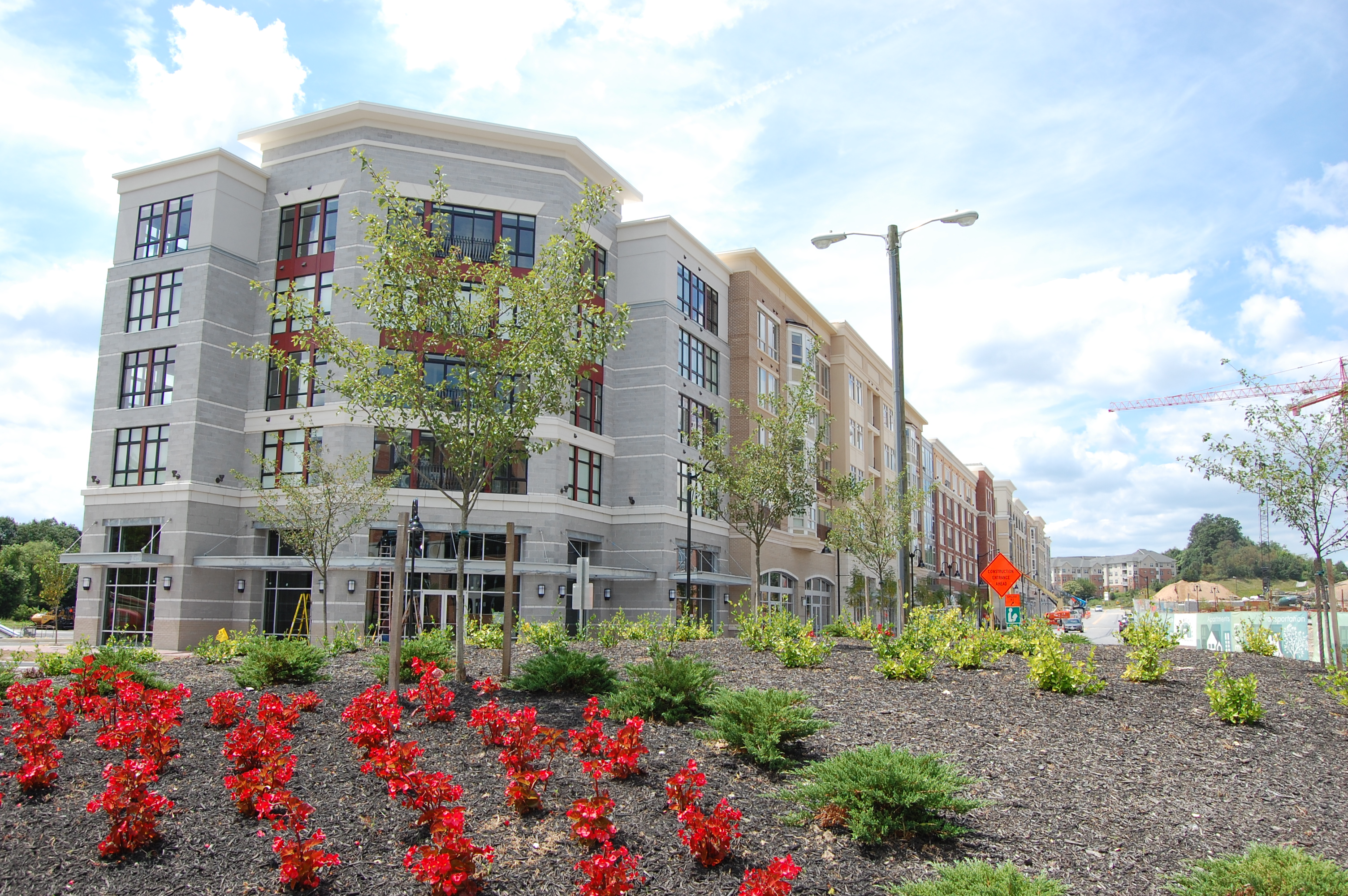
An example of a Maryland-area Transit-Oriented Development is Metro Centre at Owings Mills, a project encircling the Owings Mills Metro station in Baltimore County. Two five-story buildings, cumulatively containing 56,000 square feet of retail space on the ground floor and 240 market-rate apartment homes on the upper four floors, are nearing completion. The TOD’s first amenity, a 120,000 square foot building housing the largest branch of the Baltimore County Public Library and a new satellite location of the Community College of Baltimore recently opened. Also underway is construction on a new four-story, 200,000 square foot Class “A” office building, which represents the inaugural phase of the 1.2 million square foot office component of the TOD.
Metro Centre at Owings Mills is being developed by Owings Mills Transit, LLC and will be managed by David S. Brown Enterprises, Ltd. It is designed to support more than 1.2 million square feet of Class “A” office space; 200,000 square feet of complementary retail space; 1700 residential units; educational facilities totaling 120,000 square feet and a hospitality component offering up to 250 rooms.
“As businesspeople and the general public face greater demands on their time, they crave increased convenience and accessibility to gain back this loss and become more efficient,” stated Howard Brown, Chairman of David S. Brown Enterprises, Ltd. “Compact, pedestrian-friendly communities as defined by TODs are rapidly becoming one of the answers, as consumers and businesspeople are comforted by being connected to technology and public transportation,” he added.
Metro Centre at Owings Mills is positioned on a 45-acre parcel of land near the intersection of Interstate 795 and Painters Mill Road, with direct access to Exit 4 (Owings Mills Boulevard) of the Northwest Expressway and the Owings Mills metro stop. Owings Mills is one of Baltimore County’s two designated growth areas.
Approximately 5000 people utilize the Owings Mills Metro station during weekdays, and more than 2000 people access the station during the weekend. In addition, more than 40,000 visitors are expected at the Public Library each month and nearly 8,000 students and faculty members are predicted to access the Community College of Baltimore on a monthly basis once it opens this summer.
More than 160,000 consumers reside within a five-mile radius of Metro Centre at Owings Mills, with an average household income exceeding 85,000. In addition, more than 65,000 employees work on a daily basis within this radius. More than 110,000 vehicles pass the site each day from Interstate 795 and 4,100 commuters board the Owings Mills Metro Stop each workday. The downtown business district of Baltimore City can be accessed in approximately 20 minutes from the project.
David S. Brown Enterprises, LTD., founded in 1933 and headquartered in Owings Mills, MD, is a full-service real estate company providing leasing, sales and management services. For additional information, visit www.davidsbrown.com
Get more local news delivered straight to your inbox. Sign up for free Patch newsletters and alerts.