Business & Tech
Owings Mills Mall at 25: Not Aging Well
The mall in Owings Mills has gone from upscale "fashion" mall to a mall in crisis in its quarter-century of existence.
This is the first in a multi-part series about the Owings Mills Mall, its checkered past and its uncertain future, on the occasion of its 25th anniversary.
Jeffrey Freedman said his first trip through the Owings Mills Mall was as a 2-year-old in his parents’ stroller in 1986, the year the mall first opened its doors.
from the time called the mall the “cornerstone of one of the biggest building booms on the East Coast.” It was to be known as an upscale “fashion” mall, not a just a simple shopping mall.
Find out what's happening in Owings Mills-Reisterstownfor free with the latest updates from Patch.
July 30 marks the Owings Mills Mall’s 25th anniversary, but the mall today can’t be what executives at The Rouse Co. of Columbia, MD, the original owner of the mall, expected after an opening day crowd of about 100,000 shoppers in 1986.
Freedman, 26, of Owings Mills, knows his parents rolled him through the mall that first year, but his first vivid memories aren’t until the early 1990s.
Find out what's happening in Owings Mills-Reisterstownfor free with the latest updates from Patch.
“I remember when, at the very beginning, it was so busy,” Freedman said. “Every store was open. It was just a really nice place to be, a lot of people there.
“Everything was full in the food court. I could go with my parents, go with my family and it would be hard to find a seat for dinner on a weekend at 9 o’clock.”
Then, the mall was lauded for features like its marble floor, imported from France, which was sprinkled with gold dust on opening day, and the inclusion of an upscale Saks Fifth Avenue store. It was just one of the mall’s anchors, credited at the time with drawing other upscale shops to the mall, too.
But the marble flooring is just about all that remains of those days.
Saks bolted from the premises after a decade. Other anchor stores, like Sears and Lord and Taylor, have come and gone. JCPenny and Macy’s currently hold down anchor spots.
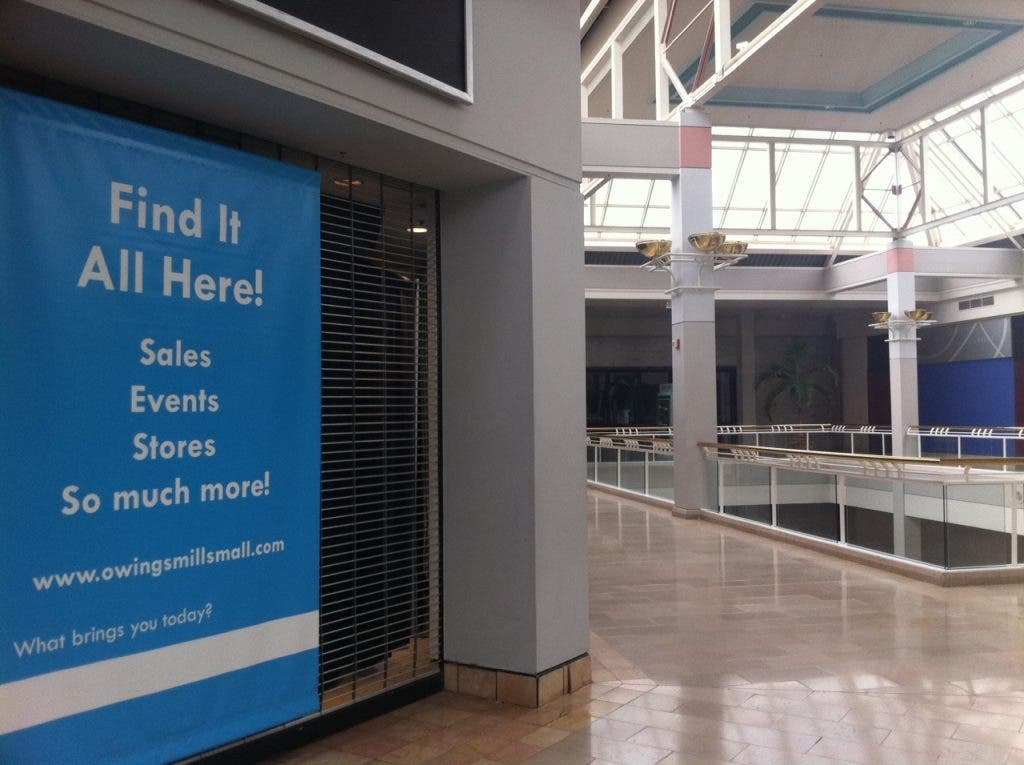
Many other storefronts sit nearly bare, adorned only by curtains of metal bars blocking entrances to empty compartments where business was once done.
Rouse gave way, too. The mall was bought by General Growth Properties, Inc., in 2004, and now, Freedman has no trouble finding a seat in the food court.
“Now there’s, like, five people there when you walk in,” he said. “It was just so busy (in the 90s), anytime you would come in and walk around there were lots of families there, a lot of people.”
At more than 800,000 square feet, the mall at one time housed nearly 160 stores. By October 2010, the mall’s vacancy rate was over 22 percent, according to The Baltimore Sun, and more stores have closed since.
Freedman, who said he cares about the mall because he grew up with it, said it’s been hard to watch what he calls a gradual decline in the number of stores and foot traffic through the two-level mall.
“I would say, well through the 90s, it was a great place to go. This place was Mecca; everybody went there; it was an exciting mall,” Freedman said.
It wasn’t until the early part of this century, he said, that things really started to take a turn for the worse, despite the apparent revolving door at some storefronts.
The perception that the mall was crime-ridden didn't help, he said, but it's difficult for Freedman to understand exactly how the mall has gotten to its current state.
Next: On Monday, we'll look at the state of Owings Mills Mall today, and address whether crime really is an issue there.