Politics & Government
Senior Sees Maryland Politics In A New Light
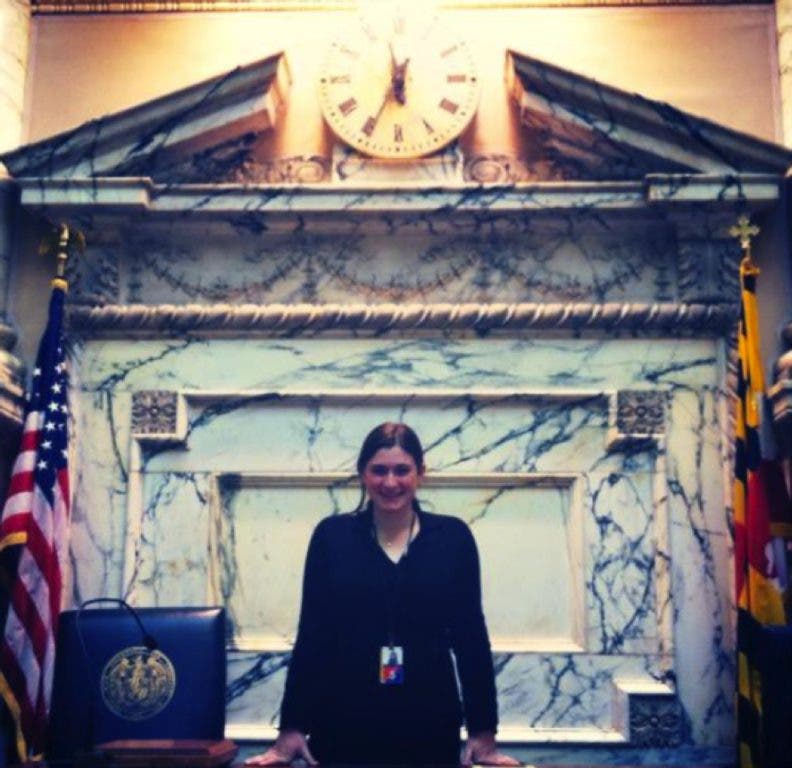
Franklin High senior Alana Quint served as a page in the Maryland House of Delegates.
In 1970, House speaker of the Maryland General Assembly (MGA), Thomas Hunter Lowe, started a program that allows high school seniors to take part in the legislative process on a local level by serving as pages to the Senate and House of Delegates. The program takes 105 pages with 36 alternates. Participants serve a total of two nonconsecutive weeks during the 13-week session that goes from January to April.
Over chips and carrots in a noisy lunchroom, Franklin High Senior Alana Quint gave me some insights into the program, how she was selected and what duties her first weeklong session consisted of in Annapolis.
Any school in the county may send a nominee to compete in the application process. Nominees must submit an essay describing why they should be chosen.
Find out what's happening in Owings Mills-Reisterstownfor free with the latest updates from Patch.
“This is the 14th year that Franklin’s had someone picked to be in the general assembly,” said Mr. Lesh, Franklin’s AP Government teacher. “I think this has given her a chance to see it at the ground level and how it works and to make the connections with people that’ll help her along that next step, which is usually some sort of internship or undergraduate work.”
Alana was assigned to work in the House of Delegates with one half of the group of seniors while the other half was assigned to the Senate. Besides the buttons for “Yea” or “Nay”, delegates in the MGA also have one to summon a page. Alana and the rest of her group would respond to different seat numbers in the chamber when they flashed on a light board.
Find out what's happening in Owings Mills-Reisterstownfor free with the latest updates from Patch.
“Most of the time, I was called over for coffee, hot chocolate or water,” she said. But they can’t get up so there is an actual purpose for us being there.”
Besides helping the delegates to stay hydrated and awake, Alana and the rest of the pages helped administer and make copies of the overwhelming loads of paper that accompanied a week full of proposed bills, some of which were quite controversial. Topics included the Maryland Offshore Wind Energy Act of 2013 that had failed to pass both chambers for two years prior. The act mandates that a certain portion of wind energy be generated to supplement Maryland’s overall electricity use by 2017.
Also being debated and amended while Alana was in the House of Delegates was SB 160, a law that puts the blame of any harm or injury caused by a dog on its owner. However, Alana mentioned that their recent vote differed in the fact that, “The old legislation was only for pit bulls so this time they passed it for all breeds.” Owners would only be acquitted if they had a strong enough defense.
Alana also had the opportunity to sit in on both the House and Senate Judiciary committees where she could see the process in which bills are conceived and proposed.
“It was interesting because they were debating the death penalty repeal and when they voted they were so split but they were also proposing amendments about whether or not it should be added to the Maryland constitution or what crimes it applies to.”
After a successful vote in the Senate favoring repeal, the House approved the bill to rid Maryland’s criminal justice system of the death penalty this past Friday. Mayor Martin O’Malley says that the bill will be on his desk next month.
While Alana said that she had her own personal beliefs and ideas regarding the issues being debated, she and the other pages had to keep their opinions to themselves. Even though we’re speaking in terms of coffee and hot chocolate, or who gets the copies of bills from the pages first, Alana and the rest of the program’s participants were given a strong bi-partisan message by the end of their first week.
“We were working through the nonpartisan part of the statehouse, so we weren’t really allowed to show any emotion. We’re supposed to help people regardless of their party. They don’t want us showing a side and helping someone else based on that.”
In between legislative sessions and meetings, Alana said she and the others would explore Annapolis on foot and see what the local culinary community had to offer for lunch. With the spirit of compromise already imbued in them, they set aside ideology and made a decision.
“We ate at this one place called Chick and Ruth’s which is really famous in Annapolis…we ate there about three times.”
Taking into account all the unnecessary but seemingly necessary coffee runs along with the bills from the renowned local eateries, Alana calculated that she spent about $150—an expense that the program anticipates and counteracts with a generous stipend to all participants in order for them to really get the full on Annapolis experience.
And that’s exactly what she got. The program allows high school seniors to see the legislative process in live action and fully grasp what goes on in those two mysterious chambers of the General assembly that many young people always seem to overlook.
“It was a really good opportunity because it really helped me understand exactly what they do because I got to witness it, until I went it was kind of fuzzy.”
When asked, Alana said she does think that kids overlook state politics for the glamor and easy access to news that comes with only following politics on a national level. But she thinks that should change.
“I think that state politics affects kids more than they realize and it’s a lot easier to take part on a state level. I mean Annapolis is only forty minutes away and most sessions are open to the public.”
Alana will conclude her “pageship” following her second session next week. She hopes to meet the mayor then.