Business & Tech
You Are What You Eat
A diverse group of professionals gathered in Reisterstown to discuss issues concerning sustainable agriculture.


How much of a connection is there between where our food is produced and the communities we live in?
This and a litany of other issues concerning our food production system were on the minds of everyone attending "We Are What We Eat: Community Health Through Sustainable Farming Annual Conference XII."
This was a gathering of a variety of professionals including farmers, educators and non-profit managers. There were more than 25 workshops offered and 40 guest speakers present on Friday, Jan. 14, and Saturday, Jan. 15. The event was organized by Future Harvest: A Chesapeake Alliance for Sustainable Agriculture, an organization which brings farmers, consumers and other professionals together to work on issues surrounding sustainable agriculture practices in the Chesapeake Bay watershed.
Find out what's happening in Owings Mills-Reisterstownfor free with the latest updates from Patch.
The two-day conference was hosted by the Pearlstone Conference and Retreat Center and Kayam Organic Farm. The center hosts a number of events each year and strives to be a working model of sustainable business practices and organic agriculture.
The conference opened with a welcome meeting where organizers outlined features of the conference. Jakir Manela, the president of the board of directors for Future Harvest, excitedly welcomed guests just before the workshops began.
Find out what's happening in Owings Mills-Reisterstownfor free with the latest updates from Patch.
“This is our biggest event ever with upwards of 300 people here,” he said. “Our mission is to make farming sustainable and profitable,” he said.
The workshops were offered in five tracks, including sustainable fruits and vegetables, grass based systems, value added/profitability, urban agriculture and sustainable communities.
One of the workshops offered Friday afternoon was entitled "Agriculture Education for All: Inspiring the Next Generation of Sustainable Farmers." Its speakers discussed agriculture education and ideas for those interested in developing or expanding a program of their own. There were suggestions on things like how to coordinate volunteers and time management strategies as well as tips on engaging in conversations about complex issues surrounding food production.
Kacie Warner, an educational programer at the Washington Youth Garden, discussed with a few simple activities to get people thinking about larger issues. One such activity asks participants to name what they ate for breakfast. A chart was passed around with the names of common breakfast foods and the approximate mileage the food usually travels to reach your kitchen.
“It’s designed to move people along incrementally, getting people to think about the impact just a simple breakfast has,” she said.
Another demonstration involved using as apple as an analogy for the planet. She explained that although it’s a huge planet, there is relatively limited space to grow food. Warner begins cutting away portions of the apple that represent large sections of the planet not suitable to agriculture. When she finishes the exercise she is left with a tiny sliver of apple peal about the size of a thumbnail that clearly demonstrates her point.
“We can see what little space we have to use to feed over six billion of us, and counting,” she said.
These simple demonstrations are important when implementing agriculture education programs because large issues are explained in simple ways, she said.
Workshop Moderator Chris Turse spoke about how he thought the workshop went and why this issue is so important.
“I think there’s a lot of interest in it and it’s really taking off," he said. "My cohorts and I are really interested in these issues and this issue is at the forefront because there are so many connections with farming."
Eileen Watts , manager of Hard Bargain Farm in Prince George's County, was interested in improving her agriculture education program. She spoke of the importance of showing her students how food production ties into a number of other aspects in their lives.
“We just want kids to see some of these connections,” she said. “I’m just here to pick up as much as I can.”
Tamara Todd, the challenge course manager for Genessee Valley Outdoor Learning Center, attended the conference to learn more about implementing mor sustainable farming techniques and connecting with the community more.
“We’re looking to transition to grass fed beef and create an agriculture education program as well,” she said.
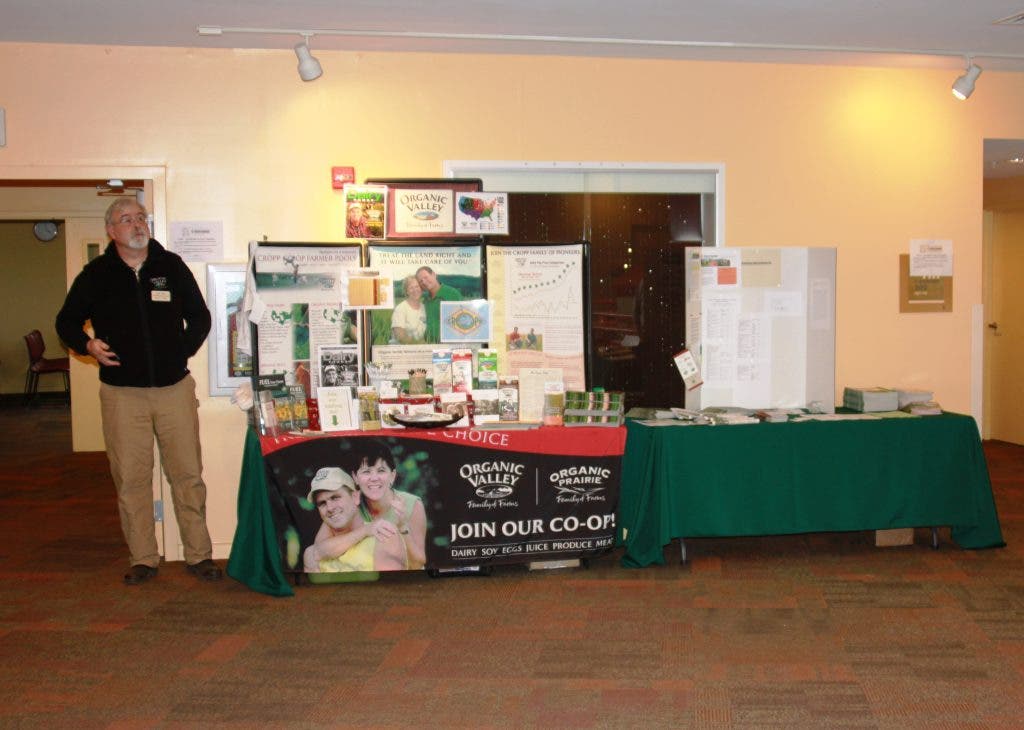
There were over 30 sponsors for the conference and information tables lined nearly every wall of the conference center. From website development for small farms and other related businesses to advocacy groups like the Chesapeake Bay Foundation guests had ample opportunities to network and learn more. Other notable sponsors included Maryland Department of Agriculture, Maryland Grazers Network and Organic Valley.
Nadine Braunstein, a registered dietician from Parkville, is currently working to establish a community garden in Cherry Hill. She sees sustainable food production gaining momentum in Maryland.
“There is a vibrant community in Maryland,” she said. “There’s a passion for food here and local farmers are very near. I think that is very exciting and, as a dietician, I think it’s great.”
At the annual membership meeting, Future Harvest officials and members discussed focusing more effort towards advocacy and legislation-related work this year.
“How can we leverage our strength as a movement to make progress?” Manela asked.
Joan Norman, the chair of the advocacy committee, spoke about why the board has decided to move in this direction. During a trip to Capital Hill she was able to catch the attention of lawmakers with concrete numbers of people who support sustainable local food production.
“I told them I feed 10,000 people a year and they all vote,” she said. “It's not about our own voices, it’s about our collective voices together because there’s plenty of things coming at us, like it or not."