Community Corner
Then and Now: Memories of a Childhood in Lutherville
My interview with Susan Gelston Mink turned into an impromptu tour of her old Lutherville neighborhood.

“Memory Lane” is not a street in Lutherville, but it might well be once you get Susan Gelston Mink started on her stories about her life on Morris, Francke and Seminary avenues.
I met Mink for lunch last week, hoping to pick her brain for some mid-century nuggets about the old fire department parades and the soap box derbies in Lutherville for my “” column.
I ended up in her car, trespassing at Oak Grove, slouching down in her passenger seat while she parked in the driveway, got out, and walked around the yard.
Find out what's happening in Lutherville-Timoniumfor free with the latest updates from Patch.
“I keep waiting for someone to come out and yell at me,” I protested from my hiding place in her Acura.
“Well, I’ll just tell them I lived here,” Mink answered me cheerfully, unafraid to re-explore her childhood stomping ground.
Find out what's happening in Lutherville-Timoniumfor free with the latest updates from Patch.
Oak Grove, in the 300 block of Morris Avenue, might be the oldest, most historical house in Lutherville, but for Mink, it’s just the house where she was raised in the 1950s.
“I loved this house so much,” she said. “This was all field when we moved here, and that was really pretty. And that oak tree—there was another one there, because we had a hammock between them.
“That was my bedroom, the middle dormer," she said, pointing. "Some of the boxwoods are still alive, I see. This square addition was called Jackson’s House, and that used to be the slave quarters, with the slanted roof. And that dang oak tree is still there. Holy cow.”
She stood on the lawn, surveying the property. She clearly had opinions. I tried to act brave from inside the car.
“Oh, they’ve changed it. This wasn’t here. And this wasn’t here either. And this was a breezeway. I just think this is the most beautiful …” She trailed off, apparently realizing that someone, other than a cat who had been keeping a wary eye on us, might be watching.
“I should tell them what I’m doing,” she said.
She headed to the front door to knock and announce herself to the owner, but no one answered. I won’t tell you whether she peeked in the front door.
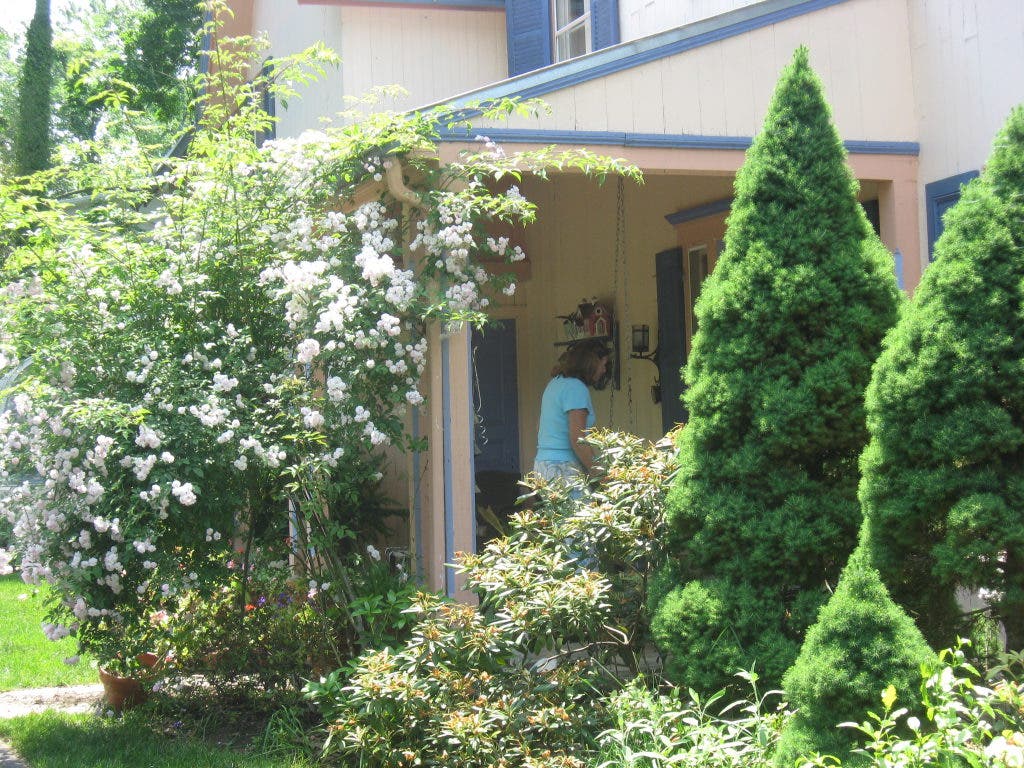
Oak Grove was built by Lutherville’s founder, Dr. John Morris, in the 1800s. It’s a lovely, pink Victorian home with flowering vines and gardens, set back far enough from Morris Avenue so it's barely visible from the street. Its most famous resident was John Waters, but that does not impress Mink.
She lived there before him.
“It’s just beautiful, don’t you think? It’s funny to have lived in a house and have other people know more about it. My parents wanted to buy it, but they wouldn’t sell it to them. But then they sold it to the next people. They sold it to General Purnell Cooper, ‘Purlie,’ and his family, who was a big deal in World War II in the Battle of Normandy. Before the Waters family.”
The cat was still eyeing us.
“Miss Black was my cat,” said Mink, lost in her memory.
Then she got back in her car and moved on to the house next door.
And she pulled into the driveway there, too.
“Is this your house?” Mink yoohoo-ed through her driver’s side window to a man who was unloading groceries from his car.
He looked friendly. I relaxed.
“I hope so,” he answered congenially, as if this happened to him every day. “I’m walking into it.”
“I just want to tell you what a wonderful job you’ve done remodeling it. The daughter of the family that was here was my best friend growing up, and I just love what you’ve done. And that thing over the door, it makes such a difference. I just think it looks great. I hope you love it. We had good times here.”
Mink sat back, satisfied with her proclamation.
“We pretty much rebuilt it,” he acknowledged.
“Well, I hope you’re enjoying it,” said Mink, backing out of the driveway.
And then she looked at me carefully.
“Am I boring you?”
The early years on Seminary Avenue
Susan Gelston Mink was born in 1947 in an old house in the 200 block of Seminary Avenue. Her mother, Jeanne, rented an upstairs apartment from the owner, Kay Ruckert Butz, who was also Mink’s godmother.
Mink’s father, George, whom her mother called Winky, was away in the war, as was Butz’s husband. Mink’s mother wasn’t such a fan of bunking with her mother-in-law, so she rented the apartment for herself and her son, Hugh, whom she called Juggy.
Mink arrived after the war, when father returned home, when Juggy was 10.
The family called the baby Susu.
They lived in the Seminary Avenue apartment for three more years, and two years after Mink was born, her little sister, Anne, was born too.
“This is the house I was born in,” said Mink, from the Acura as we cruised slowly down Seminary. “It has a really deep yard. They have a garage down there. And this is where John the dog lived. If this street weren’t so busy now, I’d love to live in that house. With that porch.”
We both tutted appreciatively over the sweeping, wrap-around porch with the high roof, built in true Victorian style. Currently, the house is decked out for the summer with American flag-patterned swags, and has been repainted in what Mink considers “funky colors,” of which she does not necessarily approve.
There’s a lot of changes in Lutherville of which Mink does not necessarily approve.
“And there’s a screen porch on the back. My niece was born when I was 13, because my brother is 10 years older than I am. And my mother sent us up here to spend the night the night she was born. And I couldn’t sleep, because I heard the traffic on Seminary. It was probably only three cars.”
Mink noticed the porch swing, which faces Seminary. She thought for a moment.
“Funny way to face it.”
Mink can remember the fire department parades, which used to march right past the house down Seminary.
“I have memories of being on the porch there, watching the fire department’s parade. I remember it going down Seminary Avenue, and watching the parade from that porch,” she said.
She also remembers, during her early years on Seminary, briefly being shipped off to a family named Fishpaugh.
The Fishpaughs lived along the railroad tracks, which was a part of Lutherville Mink was firmly not allowed to explore until she got older. “The other side of the tracks” was off-limits.
But when Mink was 2, her mother fell and hurt her arm. Baby Anne was handed off to her grandparents, and a very young Mink stayed with the Fishpaughs while her mother recuperated.
Somehow she remembers this. She also remembers seeing the name Fishpaugh pop up in one of John Waters' screenplays, and she wonders about the connection.
An older Mink was eventually allowed to walk along the railroad tracks and lay down pennies to be squished, and she appreciated, enormously, being allowed to trick-or-treat in the Fishpaughs' neighborhood.
“The houses were closer together,” she explained simply, and any of us who’ve ever trick-or-treated will know instinctively what that means.
Join us next week (click ) for the rest of Susan Gelston Mink’s story about growing up in Lutherville.