Crime & Safety
5 Baltimore County Rescuers Assisting With Florence In Carolinas
Emergency personnel from Baltimore County are among those assisting with the response to Florence; see how they are helping.


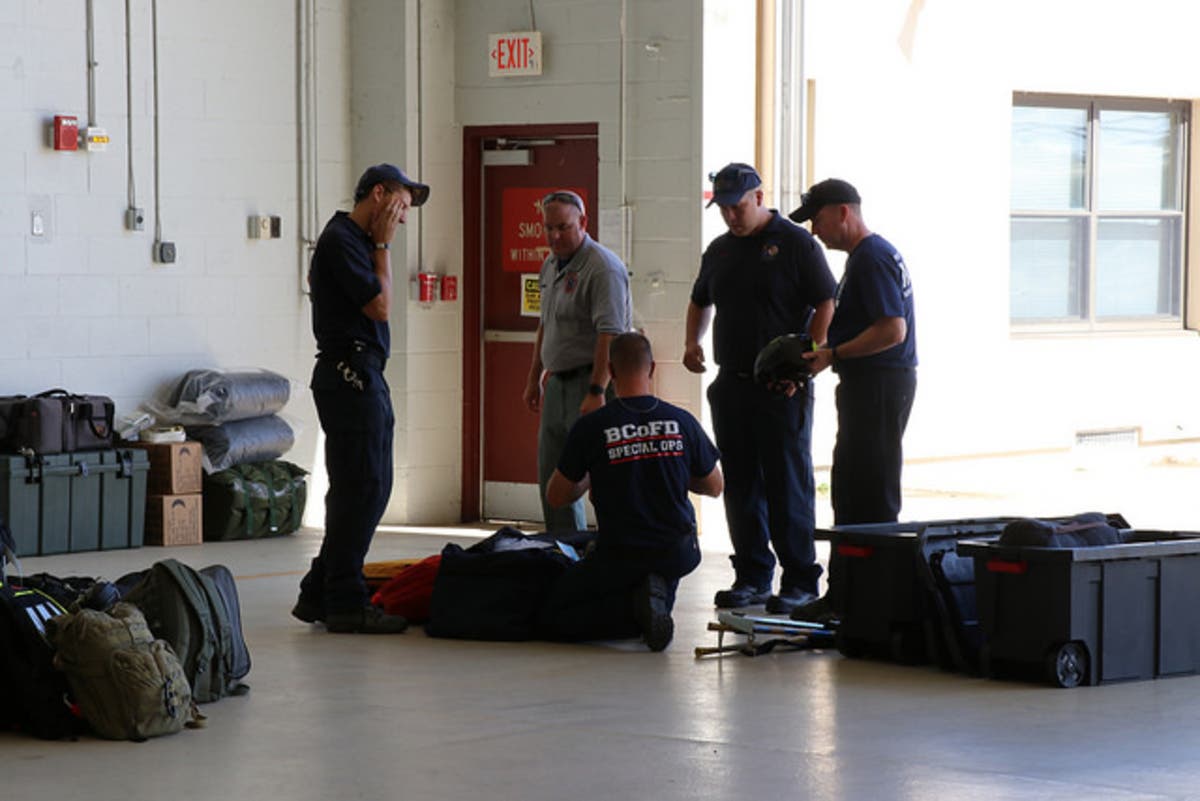
BALTIMORE COUNTY, MD — Multiple first responders from the Baltimore County Fire Department have deployed to assist with relief from Florence in the Carolinas. Three members of a special helicopter rescue team are in North Carolina, and two others are handling water rescues and evacuations in South Carolina.
The three who left Sunday for North Carolina have been "engaged in missions all morning," county officials reported Monday. The trio is part of MD-HART (Maryland Helicopter Aquatic Rescue Team), made up of specially trained rescue personnel who work with the Maryland Army National Guard for helicopter-based rescue missions under difficult conditions. Often, they don’t know what they’re picking up until they arrive — cargo, people or vehicles — according to the National Guard.
MD-HART sent two UH-60 Blackhawk helicopters with eight crew members and three maintainers to North Carolina. The team trains for emergencies that require helicopter response, such as rescuing vehicles in swift water and flood zones as well as rescues from structures, rooftops, streets, mountaintops and wilderness.
Find out what's happening in Towsonfor free with the latest updates from Patch.
Here are the three Baltimore County members of MD-HART who are currently based in based in Raleigh, North Carolina:
- Fire Lieutenant David Gouak
- EMT/firefighter Shane Sierakowski
- EMT/firefighter Andrew Hays
Before MD-HART went to North Carolina, three members of the Baltimore County Fire Department had already been deployed to another area in Florence's path as part of a Federal Emergency Management Agency (FEMA) special operations team.
Find out what's happening in Towsonfor free with the latest updates from Patch.
These Baltimore County Fire Department members deployed Sept. 10 to Columbia, South Carolina:
- Fire Captain Kelvin Seigle
- Fire Lieutenant Brandon Watkins
- Fire Lieutenant Michael Szczesniakowski
Watkins and Szczesniakowski are assisting with water rescues and evacuations, according to the Baltimore County Fire Department, which reported Seigle returned early because of a personal emergency.
As members of Pennsylvania Task Force 1, a FEMA special operations team, they staged at the South Carolina Public Safety Training Center in Columbia, South Carolina, and were enlisted to help with the National Guard in Dillon, South Carolina.
The Baltimore County rescuers join emergency personnel from more than 25 states who are helping with the response to Florence. More than 1,000 first responders have been working in 214 swift water rescue boats searching for people in need of rescue from their homes, according to North Carolina public safety officials.
Florence's death toll rose to at least 17 across the Carolinas Sunday as the storm continued lashing both states with torrential rain that has left hundreds of miles of roads and entire towns under water.
More than 200 people were pulled from floodwaters Friday in the small city of New Bern, North Carolina, where rescue workers had to leave another 150 people behind as the storm conditions worsened; they were forced to return to get them Saturday.
Some of the rescues Saturday were particularly dramatic, including Coast Guard helicopters that hoisted 13 people trapped in a home into the sky to safety. Among the 13 adults were an older woman who waded through the waist-deep water on crutches to the chopper's rescue basket. She is expected to be OK, as are the other dozen people plucked from the murky water.
“We are working now in doing everything we can to prevent more deaths,” North Carolina Gov. Roy Cooper said in a statement Sunday.
- More Than 900 Saved In NC Water Rescues: Gov. Cooper
- Florence Causes Deadly Flooding; Death Toll Rises
- MD Weather: Florence In Forecast, Advisories Issued
More than 30 inches of rain have been reported in parts of North Carolina, officials say, leading to catastrophic flash flooding and prolonged river flooding with the possibility of landslides in North Carolina and southwest Virginia.
Hours after making landfall early Friday morning, Florence was downgraded to a tropical storm. But the storm has remained so large and so slow to move across North Carolina that some areas of coastal North Carolina have been hit by more than two feet of rain.
The storm shaped up as a two-part disaster. The initial onslaught battered buildings, deluged entire communities with storm surge, and knocked out power to more than 900,000 homes and businesses; and the second delayed stage has been triggered by rainwater working its way into rivers and streams. Flash flooding could devastate communities and endanger dams, roads and bridges.
There were 11 rivers at major flood stage and an additional nine approaching major flood stage Sunday night, North Carolina emergency officials reported; in addition, 13 rivers were at or approaching moderate flood stage.
Emergency crews have received more than 24.1 million calls for service since the beginning of the storm event, North Carolina emergency management officials reported Sunday night.
This article includes reporting from North Carolina Patch editor Kimberly Johnson.
Main photo of Baltimore County rescuers leaving Sunday, Sept. 16, courtesy of Maryland National Guard.
Get more local news delivered straight to your inbox. Sign up for free Patch newsletters and alerts.