Schools
On-the-Go Highland Educator Nominated for Teacher of the Year
Freiss has spent his entire teaching career at Highland.

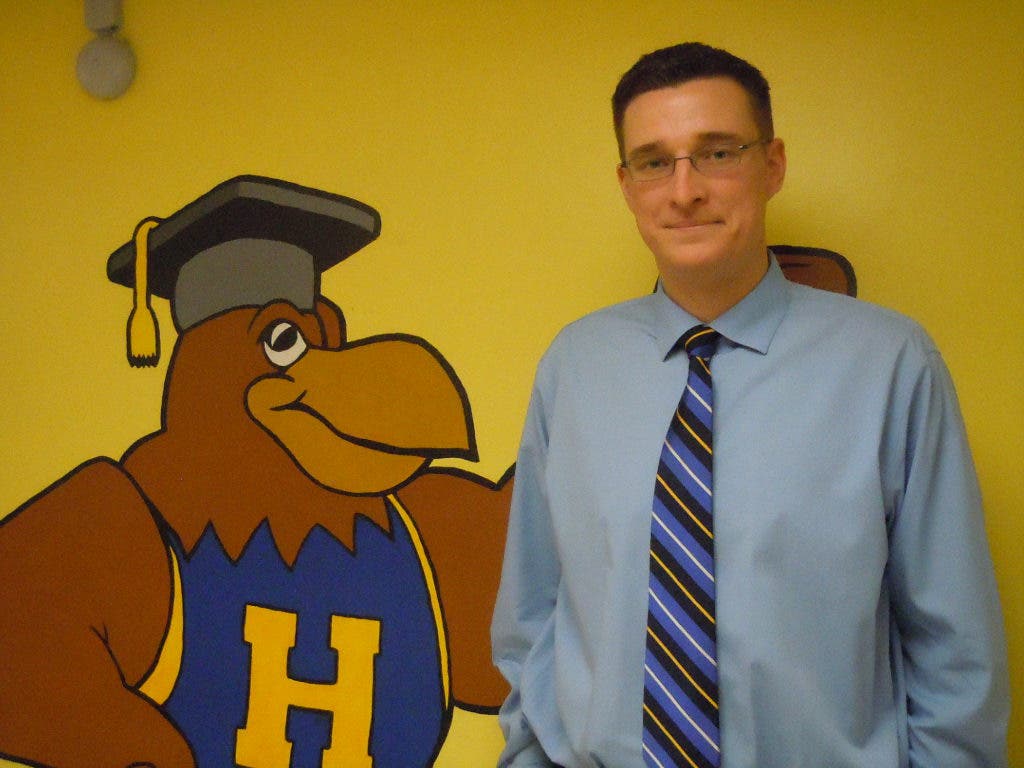

Brian Freiss, a Math focus teacher at , is one of Montgomery County Public Schools’ three Marian Greenblatt award winners. Through that award, Freiss is a nominee for the school system’s Teacher of the Year award as well. The winner will be announced April 27.
Wheaton Patch spoke to Mr. Freiss last month about his work at Highland and being nominated for Teacher of the Year
Wheaton Patch: As a Focus teacher, what do you do?
Find out what's happening in Wheatonfor free with the latest updates from Patch.
Freiss: This is my tenth year working, all at Highland, all in Montgomery County. For eight years, I was a 5th grade teacher, and we had a lot of interventions in place for reading. And we never really had anything in place for math, so two years ago the administration allowed me to create a position where I work alongside our math content coach - that’s our go-to person in the school.
I do a little bit of everything. This year its changed even more so. I teach the advanced math class for 5th grade. I pull those kids out, which enables the 5th grade teachers to have smaller class sizes. I plug into a 2nd grade classroom. Last year, I pulled kids out and I did an intervention. This year I’m plugging into a class. And I co-teach with a 3rd grade teacher where I teach advanced math, which is 4th grade math, to 3rd graders. This year, I’m [also] teaching a 4th grade class.
Find out what's happening in Wheatonfor free with the latest updates from Patch.
I work with grades 2 through 5, that’s what the focus is. I help to lower class size but I’m also co-teaching as well.
WP: What’s an intervention?
BF: That can mean a lot of different things. What I’m speaking of is more along the lines of kids who are grade levels behind. There’s kids in 5th grade, but maybe they’re on a 3rd or 4th grade math level and there’s things they need reinforced. The 5th grade teachers need to keep moving forward and that stuff may not necessarily be in their curriculum. I would pull kids out to do that, to strengthen their math.
Last year I didn’t teach a 4th grade class, instead I pulled out 4th graders and did acceleration. I see intervention as two different ends of the spectrum. There are kids who are behind and then there’s the kids you can push ahead.
WP: How does having to switch between all those things affect your day?
BF: I’m constantly on the go, I’m in charge of student council as well, so sometimes I’m eating my lunch as I walk down the hallway.
My 5th grade class is every morning, from 9 a.m. to 10:30 a.m. then I go hop into a 2nd grade class from 10:30 a.m. to 11. From 11 to noon, I manage to eat my lunch, then a little planning , copying, maybe some meetings. At 12:05 to 1:45 p.m. is my 4th grade class, then I go to my 3rd grade class until 2:30. At 2:30, I’ll be planning again or I’ll finally have time to breathe. It’s very busy, but its something we definitely need.
WP: Why did you want to become a teacher? What brought you to Highland?
BF: When I was younger, I enjoyed school a lot, I know my parents really instilled a love of learning in me when I was young. I was probably not the best-behaved child all the time but I just enjoyed learning and being in school. When I got to middle school, I played basketball, and I got an opportunity to work with young kids playing basketball, so I started to do some coaching. Eventually I worked with our head basketball coach and started running basketball camps with him. I had a good rapport with the younger kids, and I really enjoyed doing it, so I thought I could turn it into a career.
I went to the University of Pittsburgh where I got my undergrad and my graduate degree there. I student-taught in inner-city Pittsburgh. I went to a job fair when I graduated from Pitt. [Montgomery County] was my first interview. The next thing I know they offered me a contract in the next week. I kind of took a leap of faith and accepted it because I had a personal goal to have job by July. I got a phone call from an old assistant principal [at Highland], so I interviewed here and I felt that this was someplace I could make a difference, just knowing the student population compared to the other school. I felt like it was a lot like my student-teaching experience as well.
WP: What has been difference between that student-teaching experience and working here?
BF: I think my level of enthusiasm is the same. I still do enjoy what I’m doing - a lot has changed here at Highland and I’ve definitely learned a lot more as I’ve been here. The diversity here is far greater than my student-teaching experience or my own, I’m from a suburb just north of [Pittsburgh] and I very rarely had any interaction with a Hispanic population. My student-teaching experience was predominantly African-American, so the diversity is everywhere here
As a teacher I need to be aware of cultural backgrounds. My first couple of years there wasn’t a lot of parent interaction and I thought that’s just the way it is. I realized it was a matter of me being willing to reach out to [parents] - that’s one thing I think I’ve done a good job with, over the years, I don’t hesitate to contact or reach out to parents.
WP: Can you tell me about the afterschool basketball program you started?
BF: We just started it back up. One thing I noticed at this school is that not a lot of kids participated in after school sports, there’s not a lot for elementary school level - at my elementary school in Pittsburgh we had regular afterschool sports programs, and I noticed we didn’t really have that in Montgomery County.
I just like sports, I basketball, so I started an afterschool basketball program and our PE teacher came on. It’s a way for us to reinforce things that are happening in school. It’s majority 5th graders, and it’s probably groups of boys that some people wouldn’t necessarily want to have all in one classroom, I guess, is one way to say it.
But every kid’s good at something - they might have behavior problems at school but be really good at sports. I know for myself, playing sports, I played baseball, basketball, football growing up, it kind of kept me out of trouble. I know it forced me to be a lot more responsible.
I can start that now and they can continue to play when they go into middle school and high school.
WP: What’s the program like?
BF: They come in, they always do homework first, we spend a good 20 to 25 minutes on homework where we can help them do their homework, then we do some sort of drill or skill. We teach them, and then they practice and then maybe we’ll play a game. This year we’re switching it up, we’re not just going to do basketball, we’ll do hockey, we’re going to do football, try to do a bit more just to expose them to everything.
WP: They must be anxious to get their homework done.
BF: Totally, but that’s what we stress to them - that grades are just as important as playing sports. But it’s hard because we can only accommodate so many kids, every kid wants to be in it.
WP: What about another program you helped start, Dinner for Dads?
BF: I noticed parental involvement was a big issue here - parents weren’t involved and more particularly fathers weren’t involved - and you wanted kids to have positive male role models. I’m the only male classroom teacher here, I definitely notice the kids look up to me. It’s a little bit scary at times because kids have said to me, “Mr. Freiss, I see you more than I see my dad,” because their fathers are working multiple jobs and you realize you really are a role model.
With Dinner for Dads, we really created opportunities to have dads come in with their kids. We have dinner and we’ve done different things over the years - we’ve had teaching tools so they can help with homework, or ways they can be involved at home. Depending on culture, sometimes, it’s the mom deals with school, and dad deals with behavior/discipline, things like that. So I wanted make it so its not just your mom who’s involved in homework, it can be your dad too.
WP: How did you get people involved in this?
BF: I can’t take full credit for it - it was definitely collaboration with our parent-resource person at the time. It’s been phenomenal, the first year, there were not that many parents, but last year it was through the roof. It was probably over 50 dads, way more than we expected - it was awesome to see they were there. At Highland, it’s important that we create opportunities for parents to come out with their kids.
WP: How do you feel about being nominated for Teacher of the Year?
BF: It’s very humbling, obviously. I’m not an “all about me” person. I feel that this award is a testament to our entire school - everything that’s happened here at Highland. There’s a lot of people here who put in a lot of their time into the school - it could probably be any teacher that could have been nominated. It’s great to be recognized on more than the school level. It’s exciting for the school, its exciting for the parents, the kids are super excited too.
Get more local news delivered straight to your inbox. Sign up for free Patch newsletters and alerts.