Health & Fitness
Radiate—A South Asian Art Exhibit at Windsor Art Center
Contemporary Artwork by South Asian artists


When I read about a traveling exhibit by South Asian artists at Windsor Art Center, CT, I could not resist myself. Having recently curated a similar exhibit I had to see this one.
I wrote to the gallery and Pat Fahey, one of the board members of the gallery, and a key supporter to this exhibit, invited me warmly to see the exhibit. Because the gallery is open only few days a week and the exhibit ends on June 15th, we drove one rainy and messy Saturday all the way to Windsor, CT. The gallery (windsorartcenter.org) is located in a former freight house owned by Amtrak and will celebrate its 5th anniversary this September.
We were struck by the center’s quiet and beautiful surroundings! Pat had mentioned that the curator of this exhibit Ms. Kathryn Myers, an art professor at UConn, had done a marvelous job of choosing the artists and putting the artworks together. After the event I had many insightful exchanges with Kathryn. Her passion and effort touched my heart and I didn’t know if I should write about the artists she was promoting or about her passion!
Find out what's happening in Actonfor free with the latest updates from Patch.
Going through the exhibits was a real treat. It was vibrant and versatile, and appealed to both emotions and logic. While Shelley Bahl’s video juxtaposed the cultural expectations of parents, teenager conflicts, and changes in life as an American teenager, Sonia Choudhary’s book “I Am Sin” reflected conflict with her culture. There were white gloves next to this book but I didn’t realize that they are meant to put on and turn the pages that are inscribed with quotations and talks from abused Pakistani women. Ebenezzer Sunder Singh, a Tamil Christian and a Fulbright scholar, had 3 digital prints of himself in primal postures.
Amina Ahmed’s work on Islamic sacred poems seemed open to multiple interpretations. The art and the setting generated a creative and meditational atmosphere. The walls of a room were meticulously covered with white wings and there was religious chanting going on with a rug and pillow on the floor to feel the atmosphere.
Find out what's happening in Actonfor free with the latest updates from Patch.
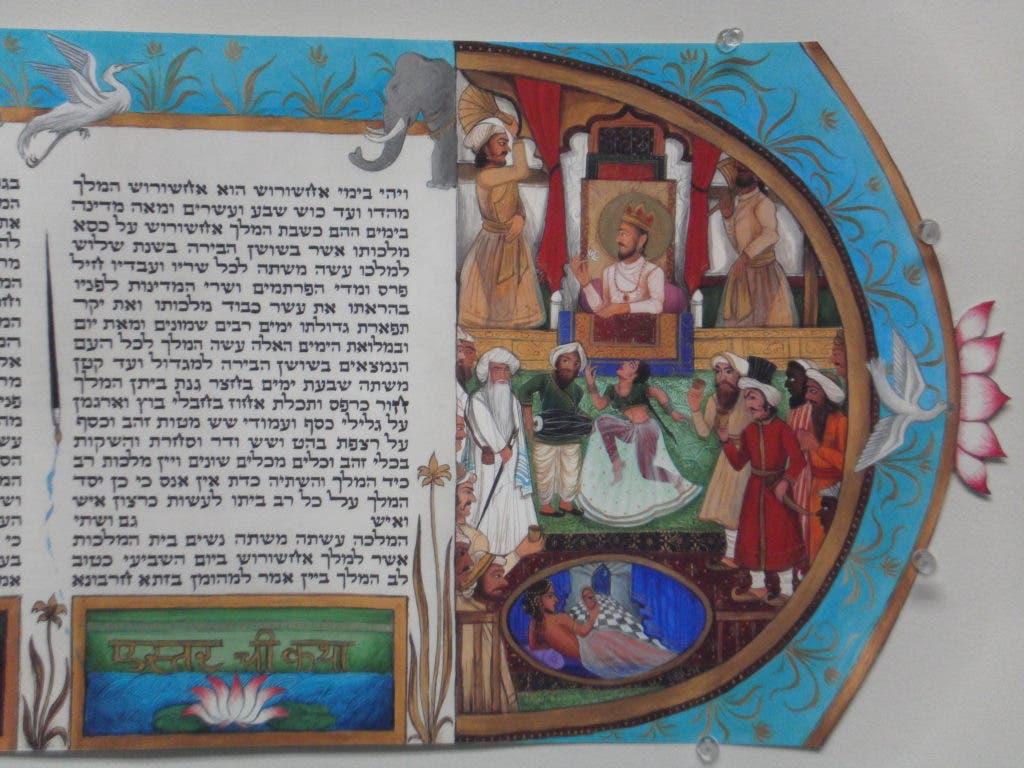
Siona Benjamin’s colorful work that occupied another room reminded me of ancient Indian veda script. Siona has a multicultural background with Hindu, Muslim, Catholic, Jewish and Zoroastrian streams which is reflected through her work that invokes a sacred feeling in the observer. Her work seems to be influenced by Indian miniature paintings and the ancient practices of storytelling and archival rendering.
Anjali Deshmukh’s digital print is quite experimental and open to any interpretations using magnets and game plan while next to it Neil Chowdhury had displayed a digital montage of his interpretation of India by creating juxtaposition. Vijay Kumar has been a witness of the cruel partition of India and Pakistan and offers his interpretation of Ayodhya violence. After the partition he moved from Pakistan to India and learned that people can coexist in peace and harmony.
Annu Palakunnathu Matthew has cleverly drawn the connections between generations through animation. Though only one piece of her work is displayed, we enjoyed watching it from different angles. Samantha Batra Mehta’s black and white work seems to show the life in plants. Kathryn mentioned that Samantha’s scrolls like paintings are reminders of her grandpa’ garden where she had spent lots of time.
Both Kathryn and I have been captivated by the work of a Tibetan artist and monk Tenzin Wanghuk. He has been closely associated with the Dalai Lama and now enjoys drawing sand mandalas. He disrobed himself to share his work and beliefs with others. While Mandalas are supposed to be temporary and are ritually destroyed upon completion, Tenzin experiments with ways to make them more permanent by changing format, process and basic ideas. His Mandalas remind me of Indian horoscopes and Tantric images that accompany the birth of a child and similar other auspicious occasions.
I spoke at length with the curator UConn Prof. Kathryn Myers. Below are some fragments of the conversation that provide insight into the design and intent of the exhibition --
Why did you choose the title “Radiate”, what does it mean to you?
I used it because of the idea that there is a core point of connection with all of the artists and that everything more or less radiates outward and again back inward. I was also thinking of the term "Radiant" because that's how I feel about the work in the show.
Why did you choose to show this exhibit at Windsor Art Center?
I chose to have the show in Windsor because I had a wonderful experience during an exhibition I had two years ago, and approached them with this idea, which they were very receptive to. Pat Fahey worked amazingly hard in successfully applying for some grant money and we also had some support from Asian American and India studies at UConn.
What was the goal of this exhibit? How did you choose these artists?
“I wanted to provide an opportunity for some emerging artists I know, my former student Sonia Chaudhary and the former monk Tenzin Wangchuk, to show in the company of more established artists who I've known for many years. I had earlier worked with Sonia Benjamin, Annu Matthew and Shelly Bahl in a show I organized at UConn in 2004. I was also able to include some new friends like Ebenezer Singh and Anjali Deshmukh who are, like me, Fulbright alums. As well I included artists who I had not known of, but whose work I loved when I saw it in the Erasing Borders exhibition, such as Samanta Mehta and Neil Chowdhury. I was also able to include artists who are constantly helping other artists exhibit their work but neglect to show their own work, like Amina Ahmed and Vijay Kumar. Amina used to be the visual arts coordinator for the Indo American Arts Council in New York and Vijay curates the large Erasing Borders show every year and both are a conduit for new South Asian artists coming to the US. It was hard to only pick 11 artists but because the show is traveling to Chicago and I'm working as an individual without a budget, I also needed to be somewhat conservative with the size of the show.
“…For the Windsor audience I thought that while I wanted to educate the audience about South Asia through the various themes and techniques the artists are dealing with, I wanted to explore not only the common streams owing to their connections to South Asia, but also demonstrate their diversity. Every time we try to pigeonhole or categorize, essentialize or exoticize, we find an artist with a completely unique set of ideas, life experiences, and emotions. The interplays of their experiences in the US as American citizens, born in the US such as Sonia Chaudhary and Anjali Deshmukh, or emigrating more recently in the case of Amina Ahmed or Samanta Batra Mehta, can affect them differently. For example, artists who may have recently immigrated to the US may feel a pressure to represent their culture, to express "Indian" content in their work to define and distinguish themselves in a hugely diverse country. These ideas were explored this past fall through a panel discussion that Anjali, Amina, Neil and Sonia ware part of, so I learned a lot from them.
“…I also chose the artists because I love the work they do. I usually pick artists with any show I organize first based on my aesthetic response to their work, and then go from there.”
---------------------------------
I will urge the readers to visit the Art Center before it ends on 15th of June. It’s a carefully planned and thought provoking exhibit that encourages the viewers to delve into their own life experiences and memories, and to establish a familiarity and relationship with their most intense feelings.