Politics & Government
Newbury Street Water Main Replacement Project Gets Underway Next Month
Boston Water & Sewer Commission unveiled its plan at a public meeting last week.
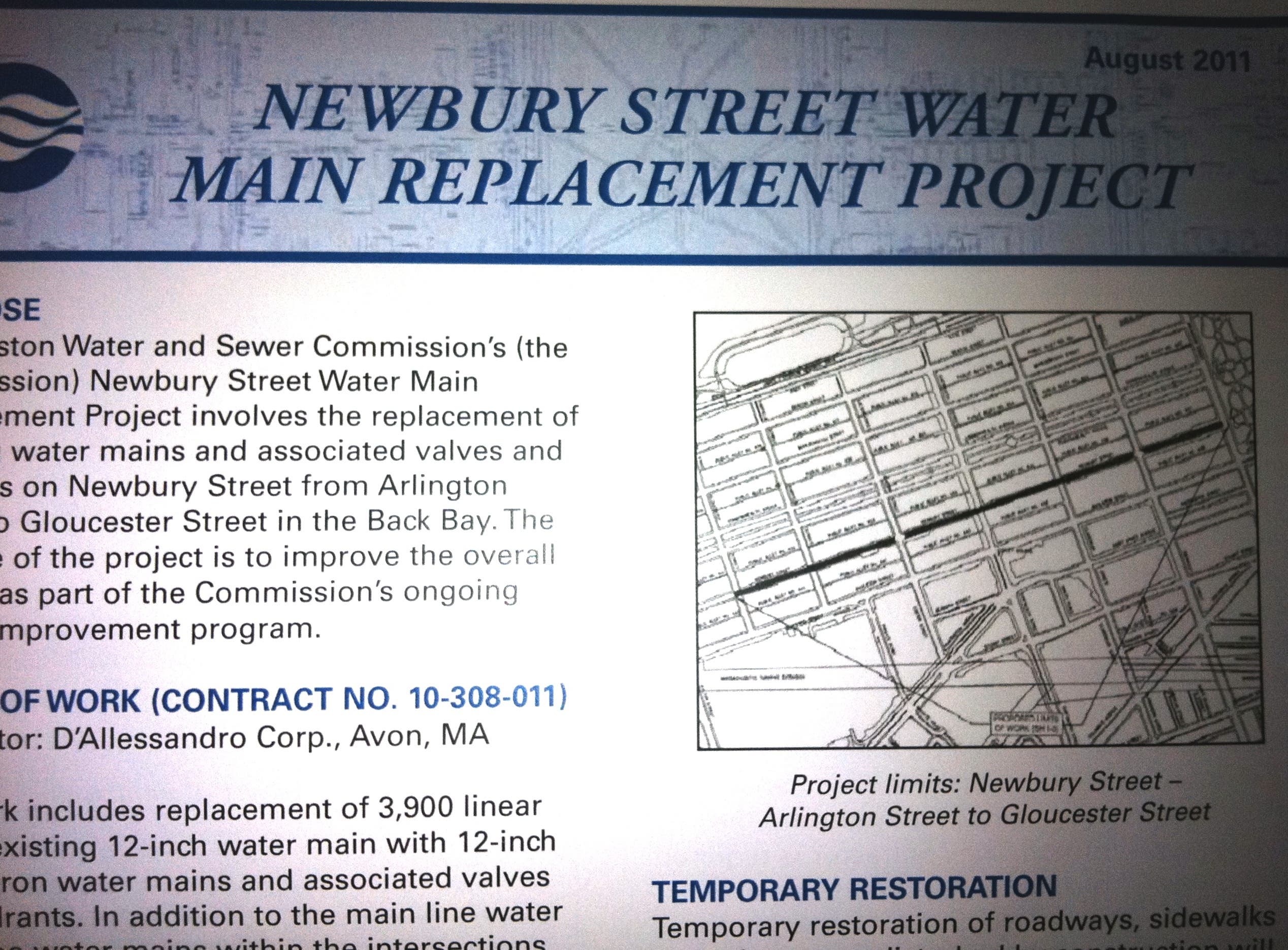
It has to happen sometime, so it may as well be now: the water pipes servicing Newbury Street need replacing.
During a relatively quick meeting in the Copley BPL’s Boston Room last Thursday evening, plans were unveiled for a multi-phased pipe-laying project that will begin this fall. The permanent repaving, the final step in the clean-up process on the other end, won’t be done until 2013. Though the actual pipe replacement will be long over by then, extra time is allotted for settling, lest there be any slow-to-surface disruptions of the sewer system below.
Boston Water & Sewer Commission’s Director of Construction, Irene McSweeney, went over the City’s plan in meticulous detail, presumably in an effort to quell any anxiety harbored by salon and restaurant owners, several of whom were in attendance.
Find out what's happening in Back Bayfor free with the latest updates from Patch.
“With the exception of properties on the corners which may be tied in water mains on the side streets, nobody should be without water for more than about twenty minutes,” she said.
McSweeney explained that all of the work involved in readying the temporary bypass system, a 6” wide interim piping that will run along the street’s gutter lines, can be done in advance; this leaves only the short window for service interruption between disconnecting from the main source and getting tied into the temporary one.
Find out what's happening in Back Bayfor free with the latest updates from Patch.
In the instance of corner businesses, a 24-hr. period without water may be required, but McSweeney stressed the need for shop owners to confer with the appointed Community Outreach team ahead of time to determine the least impactful time to do this and that a minimum 48 hours notice would be observed.
The objectives of the project are certainly straightforward: Newbury Street’s piping, much of which is either lead or cast iron, dates back to between 1901 and 1913. The only exceptions are the blocks from Gloucester St. to Mass. Ave., which were replaced in 2006, and the cross sections at Exeter and Berkeley, both of which were done when those cross streets got new pipes not long ago.
The proposed schedule is as follows:
- Gloucester to Fairfield—September to November, 2011
- Fairfield to Exeter—April 2012 to June 2012
- Exeter to Dartmouth—June 2012 to August 2012
- Dartmouth to Clarendon—July 2012 to September 2012
- Clarendon to Berkeley—September 2012 to October 2012
- Berkeley to Arlington—October 2012 to November 2012
- The final paving will be applied after the thaw the following year.
McSweeney referred to the Commission’s contractors of choice, the D’Allessandro Corp., as “…qualified and competent,” and said they’ve been with the Commission for 20 years.
D’Allesandro has estimated laying 40ft. of pipe each weekday, Mondays through Thursdays, between 7:00 a.m. and 4:00 p.m. On Fridays, temporary paving will be applied. Additionally, ongoing treatments of calcium chloride will be utilized as a measure of dust control and saws will be used instead of jackhammers. The project will employ a rolling work station that will impact 100-125ft. of parking/storefront space each day.
The thoroughness of the Commission’s presentation and McSweeney’s firm reassurances seemed to keep attending business-owners calm, but not entirely convinced; several of them asked for clarification about loss of service as if they didn’t believe twenty minutes was really possible.
McSweeney said that clear, ongoing communication is the best way to keep the process as hassle-free as possible.
“Calling the Mayor’s office isn’t the fastest, most effective way of getting something to happen regarding this project,” she said. “The best way to make sure your concerns are heard is to step outside your business and talk to the project manager or one of the field engineers working in the street. We will provide the proper numbers in advance, so If there’s an emergency after work hours you can get someone out to the site immediately.”