Neighbor News
Science fair enthusiast coming to Boston for book signing
Science fair record holder Barnas Monteith will sign copies of his new book, "Dinosaur Eggs and Blue Ribbons" on Feb. 21.
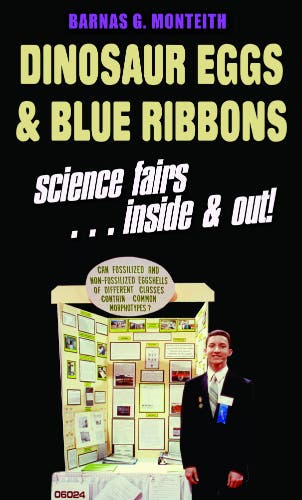
Barnas Monteith, a record-holding science fair winner, is coming to Boston on Feb. 21, 2015, to celebrate the release of a unique memoir that he hopes will make the world of science more colorful for future generations.
EVENT DETAILS
Feb. 21, 1 p.m.
Book signing with record-holding science fair winner and author Barnas Monteith (“Dinosaur Eggs and Blue Ribbons: Science Fairs Inside and Out”)
Barnes and Noble, Prudential Center, 800 Boylston St., Suite 179, Boston
(617) 247-6959
Dinosaur Eggs and Blue Ribbons takes young readers on a journey into adventure science as experienced by a young aspiring scientist who turned scientific inspiration into scientific success. The author recounts his adventures, from field research in the dinosaur Badlands to lab research in museums and universities. The book is full of anecdotes and advice from the world of science education and contains practical advice about creating display boards, getting ready to talk to judges, and other preparations for the big science fair day. Throughout the text and appendix are examples of original, winning science fair materials as well as links to a wide variety of proprietary online resources which complement the text.
Find out what's happening in Back Bayfor free with the latest updates from Patch.
In the end, the hardships of entering a science fair are all worthwhile when you work alongside some of the top scientists in the field, make groundbreaking discoveries, and win big in the science fair and beyond.
ABOUT BARNAS MONTEITH
Find out what's happening in Back Bayfor free with the latest updates from Patch.
Barnas Monteith is a science enthusiast with a special devotion to the inquiry-based science & engineering education movement. Barnas was and still is one of the top award-winning science fair participants in the country. His research on the biochemistry and microstructure of dinosaur eggs won first place in every science fair he joined, including regional state, national, and international fairs.
As an adult Barnas has founded and led companies in software engineering and the manufacture of industrial diamonds for use in the semiconductor and green energy industries. Barnas chairs the Massachusetts State Science and Engineering Fair, where he works to bring the excitement of original research to middle and high school students across the state. He helped the science fair start its Curious Minds initiative, which helps educate teachers in how to teach inquiry science in the classroom and how to get kids involved in science fairs. He also serves on science education advisory councils to the governor of Massachusetts, the Massachusetts Department of Education and a number of other policy advisory boards.
Barnas has lived and worked in both Taiwan and mainland China, and he speaks passable Mandarin. His other interests include gardening and fishing, and he is currently raising Chip-Chip and Chap-Chap, two birds he rescued when their parents abandoned them after their nest fell onto his front porch during a storm.
Previous books by Barnas Monteith include two in the Galactic Academy of Science series, The Furious Case of the Fraudulent Fossil and The Harrowing Case of the Hackensack Hacker.
Q&A WITH BARNAS MONTEITH
How did you first get involved with dinosaurs?
Like so many children, I’ve loved dinosaurs for as long as I can remember. Just like space ships and aircraft carriers, dinosaurs are larger than life and could do amazing things. They were actual prehistoric dragons and monsters, fighting to the death to win the right to leave their marks on the future gene pool.
Besides, the characters behind the science of paleontology and archaeology are pretty cool. Classroom professors or researchers during the school year, in the summer they transform into world explorers and adventurers. They seem to have lives like Indiana Jones or Alan Grant of Jurassic Park, making groundbreaking discoveries while surrounded by wildlife and scenic landscapes. And it’s true: field expedition work is a real thrill.
How did you first enter a science fair?
My middle school had a very small class science fair about demonstrating scientific concepts. It was fun, though not in my field of primary interest, which was dinosaur evolution. However, I did walk away with a lot of experience and a couple of first prizes. During that time, I also had a chance to meet paleontologist Dr. Jack Horner, a cool character (the inspiration for Alan Grant in Jurassic Park) and a great mentor. Jack was at the cutting edge of evolutionary and dinosaur behavioral science. I began to learn about how likely it is that the birds we see flying around today evolved from giant dinosaurs of the past.
I decided to work on a brand new field of paleontology, at the intersection of biochemistry, computer data mining and a little bit of plain old fashioned field work. I worked on some pretty cool microscope and computing systems, looking at dinosaur and bird eggshells to see how they evolved.
What was your worst science fair moment? Your best?
Worst: being told at the International Science and Engineering Fair that my project was going to be disqualified because my vertebrate specimens might expose judges to pathogens. I explained that my hundred million year old eggshells posed no current risk to the judges and general public, and eventually my project was allowed, but in the meantime I almost had a heart attack.
Best: my first grand prize award at ISEF. I won a free trip to San Diego and to Spain for the European Science Fair. The press coverage alone was pretty heady for a kid from an average family in a small town. I also truly bonded with one of my science fair award winning colleagues, who later became my best friend in life.
What projects are you working on right now?
Lots of things, but two in particular. One is a picture book on evolution. The second is a new Tumblehome product called the SenSay Sensor System. The SenSay is a small, rugged, modular sensor data capture and analysis tool designed to make science experiments in labs or the field easier and more fun for children of all ages.
You’ve led the Massachusetts State Science and Engineering Fair for several years. What are you trying to accomplish with the fair?
I‘ve seen first-hand the kinds of positive impacts a science fair can have for a child - even from modest means, and from a community and school system which has faced many challenges in recent decades. At best, science fairs can be life-changing and can lead to opportunities which result in lifelong success.
As chair, I helped improve the finances of the MSSEF so that it could grow. During my tenure we also started the Curious Minds Initiative, which funded schools in high needs areas to start their own sustainable district science fairs, and to expand the grade levels in which science fairs were conducted. We developed curriculum and offered it through colleges throughout the state so teachers could improve their understanding and implementation of inquiry STEM in general, and science fairs specifically. We hope to see this program evolve into its own graduate degree for budding teachers. We also included engineering projects, and we offer free patent prosecution for the very best ideas, which win our patent awards.
What dinosaur would you most like to meet? Which one would you most like to be?
Like so many kids around the world, I’d love to meet that most well-known of meat-eaters, the Tyrannosaurus Rex. I’d love to find out which of our theories about T-Rex are true. I would most like to be some kind of ‘raptor. I like the idea of speed, agility and power, and being light enough that I could nearly fly. Remember, ‘raptors were only one step away from being birds, and they even had very light bones and feathers too. Not to mention a cutting claw nearly half as big as my own head!