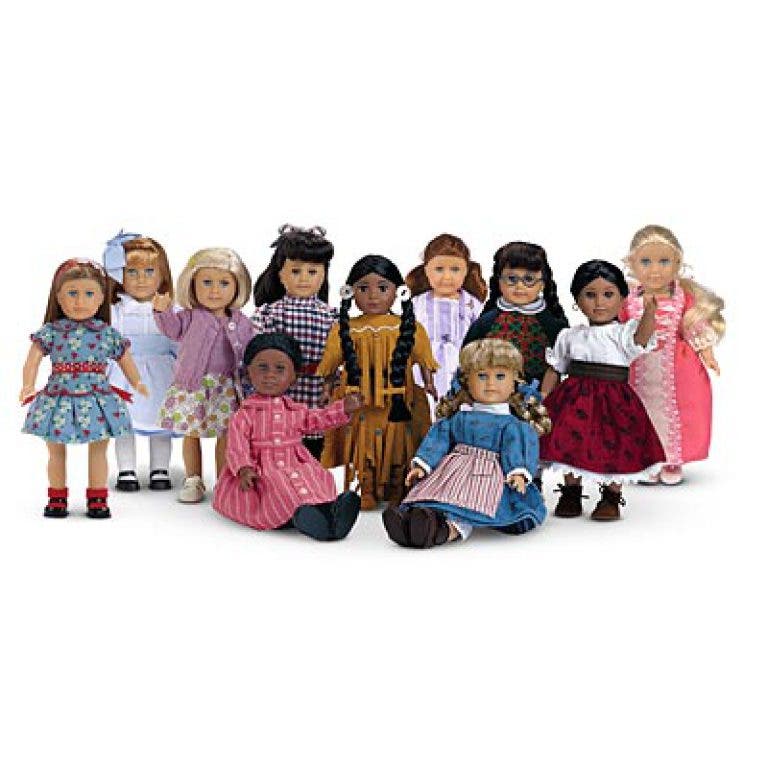
For the past several years, I have enjoyed teaching a history class at the Butler Elementary School as a part of the Butler PTA’s After-School Enrichment Program. The class – “American Girl History Club” – introduces my young students to various periods in our country’s history, using the popular American Girl® dolls as the jumping-off point for discussions of various eras of American life.
Basically, we take one or two dolls each week and explore the period they “lived” in. For example, when we study the Civil War, we do so through Addy’s eyes as her family escapes slavery and heads North in 1864. When we study the Native American experience, we do so through the eyes of Kaya, a Nez Perce girl whose story is set in the Northwestern part of America with her family.
We talk a lot about the individual dolls’ day-to-day lives, and in doing so, my young students often ask insightful questions and contribute amusing comments. Over the years, I have written down their inquiries and observations and I thought I would share some of these with you.
Find out what's happening in Belmontfor free with the latest updates from Patch.
• • •
Kit Kittredge is a young girl who grows up in the 1930s and provides the opportunity to teach about the Great Depression. I review the basics of what led to the Depression, what it was like to live during that time, and what Kit’s family may have experienced during these years of financial difficulty.
Find out what's happening in Belmontfor free with the latest updates from Patch.
I once opened the class with this question: “Before we begin to explore Kit’s life, can anyone tell me something about the Great Depression that occurred in the 1930s?”
A single hand shot up: “I think this was a time when many people were sad and that is why they call it the Great Depression.”
I do not happen to know from where this time period got its name, but I realized I would have a little digging out to do. I began to explain that people were nervous about money and stopped buying things. Also that many stores and factories closed, causing people to lose their jobs. I added that some banks ran out of money too.
“Well,” one student commented. “My dad has lots and lots of money, so there’s no depression for my family.”
• • •
Rebecca Rubin is nine years old in 1914 and lives in New York City with her parents and grandparents. Her family emigrated from Russia, I inform my students, because the Tsar disliked Jewish people and was treating them badly.
“That is not true, Miss Lisa,” I am informed. “You must be thinking of that Hitler guy.”
After I clear that up and cover, in 20 minutes, a semester’s worth of material on Russian pogroms, emigration, and the immigrant experience in New York City, including tenement housing, my students and I light candles, drink grape juice, and share Hallah bread to create our own Sabbath, as the Rubins did each Friday evening. As we said the traditional blessings and broke bread together, I encouraged questions.
A hand tentatively went up. “We are not supposed to light candles in school and I think we will get in trouble if you don’t blow them out now.”
“It’s OK,” I replied. “It’s for educational purposes.”
Having brushed up on both Jewish history and the history of Sabbath rituals, I was really eager for questions pertaining to those topics.
Another hand went up. “But what will happen to us if Mr. McAllister walks by and sees the candles?”
Before I could offer more reassurance, someone shouted: “THERE HE IS!” and ducked under the table.
Who ever said kids ignore rules has not been to my class!
• • •
Kirsten and her family voyage across the ocean in 1854 from Sweden to settle in Minnesota for better farming opportunities.
We spent some time discussing what it must have been like to live for two months cramped on a ship with no fresh food and very few comforts from home.
That lesson elicited the following:
“Why couldn’t they go fishing off the side of the ship and eat fresh fish for dinner?”
“Weren’t there any midnight buffets in olden times?”
• • •
Occasionally, we have the opportunity to study a modern American Girl doll. Kanani, for example, is 10 years old and lives in Hawaii. For this particular lesson, I get to teach about our country’s 50th state, how it was formed, and its tropical climate. We discuss volcanoes as well as Kanani’s commitment to protecting the seals and sea turtles that live near her home.
At the end of class, I often ask the girls if they know a famous person who was born in Hawaii.
A hand goes up: “Angelina Jolie?”
“No,” I prod. “This is a person who is leading our country.”
Another hand: “George Washington?”
“Who is currently leading our country ... ” I hint.
Nothing. Blank stares.
I am beginning to fear the “birthers” have had a more far-reaching influence than anyone has imagined. Cutting to the chase, I ask: “Who is the President of the United States?”
“Oh,” they finally say. “Obama!”
“Does he speak Hawaiian?” I’m asked.
As is often the case with my bright young students, the answer is: I really don’t know, but I’ll try to find out.
Let me end by saying that it’s an absolute joy to teach this class – and it has helped to further my appreciation of the work that our real classroom teachers perform all the more.