Schools
History Day is ... History at the Chenery
Refocus on writing and analysis will push National History Day to a club.


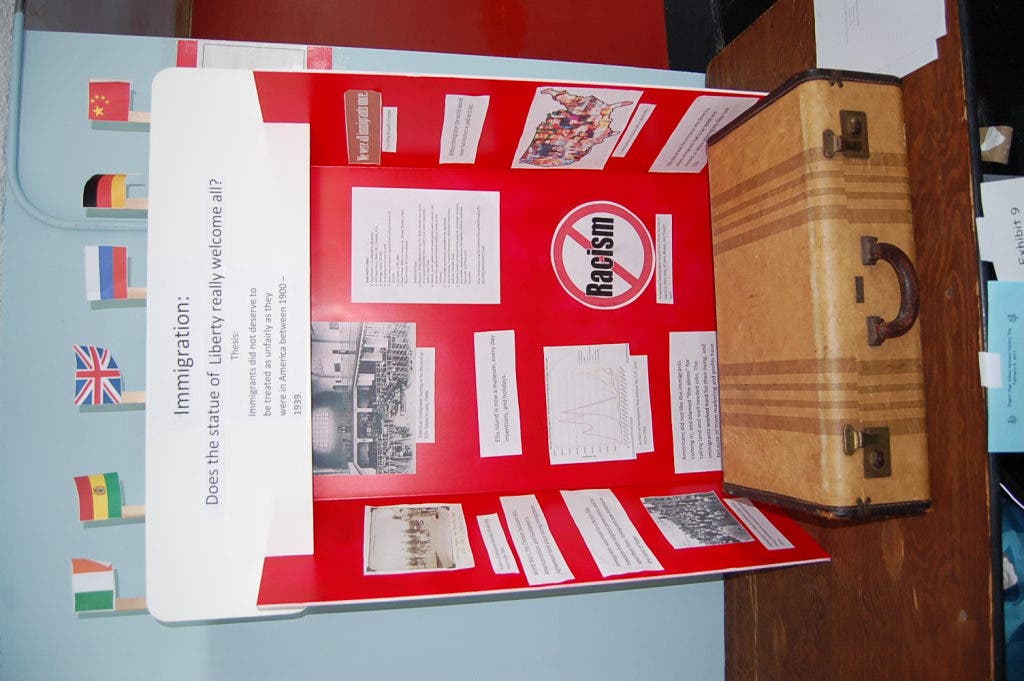
National History Day has been a rite of passage for eighth graders for more than a generation spending months researching a subject and placing their conclusion on a colorful exhibit board or acting out one significant moment from the past.
And Chenery has had its share of students in the past decade who have been recognized in regional and national contests.
But History Day's own history has come to an end, at least as a year-long requirement, after the at its Tuesday, June 5 meeting voted to approve a change in the eighth grade social studies curriculum.
Find out what's happening in Belmontfor free with the latest updates from Patch.
The new course of study will now emphasize writing, reading and research skills while seeking to expand the depth and breadth of student's knowledge in history, according to Deborah McDevitt, director of Social Studies for the district.
And there will be a greater amount of the subject to get through in the coming school year with an emphasis on critical thinking, said McDevitt, including writing and producing a great number of works over the school year.
Find out what's happening in Belmontfor free with the latest updates from Patch.
But facing the new criteria was National History Day, the yearly national contest where students produce theme-based history project which is not only a great introduction to hands-on history but also a big time consumer for students and staff.
McDevitt calculated that on average, students spend 50 out of 180 class days working on their projects from inception to final presentation. On top of that, an additional month of added homework is required to fully complete the project.
In addition, the Middle School has modify the curriculum in the past to accommodate History Day including pushing back the time to begin research on the project to benefit students with stronger research and writing skills and limiting project topics to what was being taught.
"What we found out that we were still not able to meet the frame work of common skills" required by the state education guidelines, she said.
"(History Day's) a wonderful program but its unbalanced," said McDevitt.
To free up the time required to meet the course load, History Day will no longer be in the Social Studies curriculum and become a voluntary after-school club, run by a teacher being paid a stipend.
This does not mean the death of National History Day, said McDevitt, but rather a change more in line with other school districts including a successful one in Somerville which has sent more students to the National Championships in Maryland than Belmont.
But McDevitt admitted a similar club at the High School has not been active for the past two years through lack of interest.
But there was a sense by a few members that the loss of an in-depth approach to history will hurt history education in Belmont.
School Committee member Kevin Cunningham said seeing his son complete his own History Day project, he appreciated the student self-selecting the topic and taking complete ownership of the project and the way they think about history.
Under this new curriculum, "I feel like it's teaching to the test," said Cunningham, a lament that Dr. Thomas Kingston, Belmont's Superintendent, said is a long-standing debate in the Social Sciences.
The one person at the committee meeting who had practical History Day experience was Rachel Hanna, a student adviser to the School Committee.
"I learned so much from doing History Day," she said, "It was the first time history clicked for me" as the process in researching a single subject was so serious and analytical that it meant more than just reading about that part of history.
But Hanna also understood the need for a broader approach to history "but it was still a great way to (learn the subject.)"
Get more local news delivered straight to your inbox. Sign up for free Patch newsletters and alerts.