Community Corner
Surviving the Sinking of the 'Titanic': In Her Own Words
Common Street's Caroline Brown describes what occurred one hundred years ago today




One hundred years ago today, early in the morning of April 15, the largest ship ever built at the time, the White Star Lines RMS "Titanic" sank after striking an iceberg on her maiden voyage.
And on the ship was a Belmont resident – whose house once stood between Royal and Dunbarton roads –coming home from Europe with two of her sisters, all who attended the funeral in France of their eldest sister, an English duchess.
Caroline Lane (Lampson) Brown of Common Street, the widow of John Murray Brown – the son of one of the founders of Boston publishing house Little, Brown and Co. – had the added distinction of being the final passenger to board the last lifeboat, having been provided the seat at the insistence of a women she met and got to know on the voyage.
Find out what's happening in Belmontfor free with the latest updates from Patch.
Brown, her sisters – Charlotte Appleton (who was Evans' aunt) and Malvina Helen Cornell – New York heiress Edith Evans and Col. Archibald Gracie, who became the women's escort after he discovered they all were traveling alone, were sailing back to the United States when the ship hit the iceberg at 11:40 p.m. April 14.
For some reason, the women did not secure places on lifeboats until a half-hour before the ship sank. Brown's two sisters were on lifeboat 2 which was set into the sea at 1:45 a.m.
Find out what's happening in Belmontfor free with the latest updates from Patch.
After all of the main lifeboats had been set off, if was Gracie who guided Brown and Evans to one of the four collapsible lifeboats. When told that there was only a single space left, Gracie said that Evans turned to Brown and said, "You go first, you have children waiting at home."
Brown stepped into the boat but Evans faltered and the boat eventually left without her. As the boat hit the water, a mere 15 minutes before the ship sank, a seaman called up to Evans that "[t]here's another boat going to be put down for you." But that lifeboat would never come.
Evans would be one of only four first-class female passengers to die in the sinking, one of 1,517 who lost their lives that night.
See the moment Evans gave up her seat to Brown in the movie, "A Night to Remember" enclosed in this web page. (The event happens around the 20 second mark)
Brown would later meet her sisters and Gracie, who somehow survived standing on an upside down collapsible for several hours, when the "Carpathia" rescued her boat at 7:15 that morning, the final boat retrieved from the sea.
When she arrived back to New York on the "Carpathia" – before traveling to her daughter's home in Concord to rest – she provided an interview with the Boston American newspaper on April 18, three days after the sinking on the day of the ship's arrival in port. Hers was one of the first 'first-person' accounts of the tragedy.
Below is a transcript from the interview that was discovered by Belmont Town Historian Richard Betts and was included in the Dec. 1987 issue of the Belmont Historical Society's Newsletter.
"It was between 12 and 12:30 a.m. when the 'Titanic' struck the iceberg and it was between 2 and 2:30 a.m. when she sank. She settled slowly from the time she was struck."
"I was asleep at the time of the impact in the same cabin with my two sisters, Mr. E.D. Appleton of Bay Side, Long Island and Mrs. Cornell of Lexington Avenue, New York."
"At the same instant, the siren began to shriek. It was the shrieking which gave us the intimation of the collision. Then as we awakened, there was a frightful crunching and the 'Titanic' seemed to be trying to climb the iceberg; she kept sliding and pushing on top of the iceberg and it was this that ripped her plates open. The iceberg seemed ot have scraped a part of the bottom right off."
"One of my sisters put on a fur overcoat and we all rushed out on deck. Some of the passengers went forward and picked up handfuls of ice which had fallen on deck and brought it back to show to the others."
"At first, many of the passengers thought it was a great joke to run into an iceberg. They believed that the vessel was unsinkable. But in a few minutes, they saw that it was no joke when the vessel began to settle. The berg which the 'Titanic' stuck was enormous."
"The crew went to their post right after the smash and they stayed there like heroes to the end. They worked calmly and with precision and the newspapers cannot say too much in their praise."
"The orders came to lower the lifeboats and the officers and crew assigned the women and children to their places. The boats got away as fast as possible rowing into the darkness. The weather was clear. There was no rioting for places."
"Of course, there was considerable excitement among the passengers. One man shot several men who were trying to get into the boats. I was told it was Major Butt (Major Archibald Willingham Butt, military attache to Pres. Roosevelt, who drowned) who did the shooting. An attempt to launch two lifeboats after the one I was in left, failed."
"Oh, I shall never forget to the end of the days that tragic sight as the "Titanic" disappeared below the waves. The musicians were standing on the top deck up to their knees in water still playing as ordered, when the vessel took the final plunge. The musicians had gone from deck to deck as the boat was sinking."
"The discipline of the crew was splendid. Those poor fellows went to their deaths like heroes. There was no frighting to prevent the women and children from getting into the boats. Colonel Jacob Astor proved himself a hero. He stood helping the officers in their work. Being an expert yachtsman, he was of great assistance."
"After (Astor's) wife left in one of the lifeboats, she cried out to him that she wanted to go back to the Titanic unless he came along with her. He called out to her saying, 'When my time comes, I will go; stay where you are.' Those were the parting words of Col. Astor and his young bride."
"As the lifeboat in which I was sitting was getting away from the 'Titanic,' the sailors on the doomed vessel yelled, 'Pull for your lives.' It was well that they did for we had gone but a few hundred yards – not more than one-eighth of a mile when the 'Titanic' went to the bottom.
The men passengers kept going from one deck to another too. Just before the "Titanic" plunged to the bottom of the ocean. I saw scores of men jump from the deck and rigging into the water. The men let out the most blood curdling shrieks just as the vessel was going under. It was terrible. All the lights on the 'Titanic' were burning as she sunk to her grave."
"There was no awful final plunge. The 'Titanic' slid swiftly and gently to the bottom, bow first, and there was apparently no great suction, as we clearly saw some people on a raft right near the propellers as that part of the ship went into the air. The people on the rafts were not drawn to the bottom by the suction. They were so close that we thought the propellers would hit them."
"There were about twenty persons in our lifeboat, three of whom were members of the crew. We women help to row the boat. We took our turns. All of us blistered our hands terribly, and as we were very thinly clad, it helped keep us warm for the weather was very cold. I had on only a nightgown, a pair of stockings and a thin wrap."
"We rowed and rowed and rowed and finally, about 5 a.m., we were picked up by the 'Carpathia.' Our boat was the last one picked up."
"We did not despair while floating among all those cakes of ice. We knew that the wireless operator on the 'Titanic' had sent out calls for help and we felt that they would be picked up by someone. A great many of the people in our boat suffered from frostbite."
"One of the remarkable features of the whole thing was that, although many of the women were thinly clad and suffered intensely from the cold, there was not a single case of serious illness die to the exposure after the survivors were taken aboard the 'Carpathia," said Brown.
Brown was eventually reunited with her sisters and Gracie – who survived the night, wet and standing on an upside down collapsible – on board the"Carpathia" and was surprised to meet her uncle and aunt, Mr. and Mrs. Charles Marshall, who were passengers on the vessel.
Brown died in Concord on June 26, 1928 at 75. She is buried in the Brown family plot at Mount Auburn Cemetery.
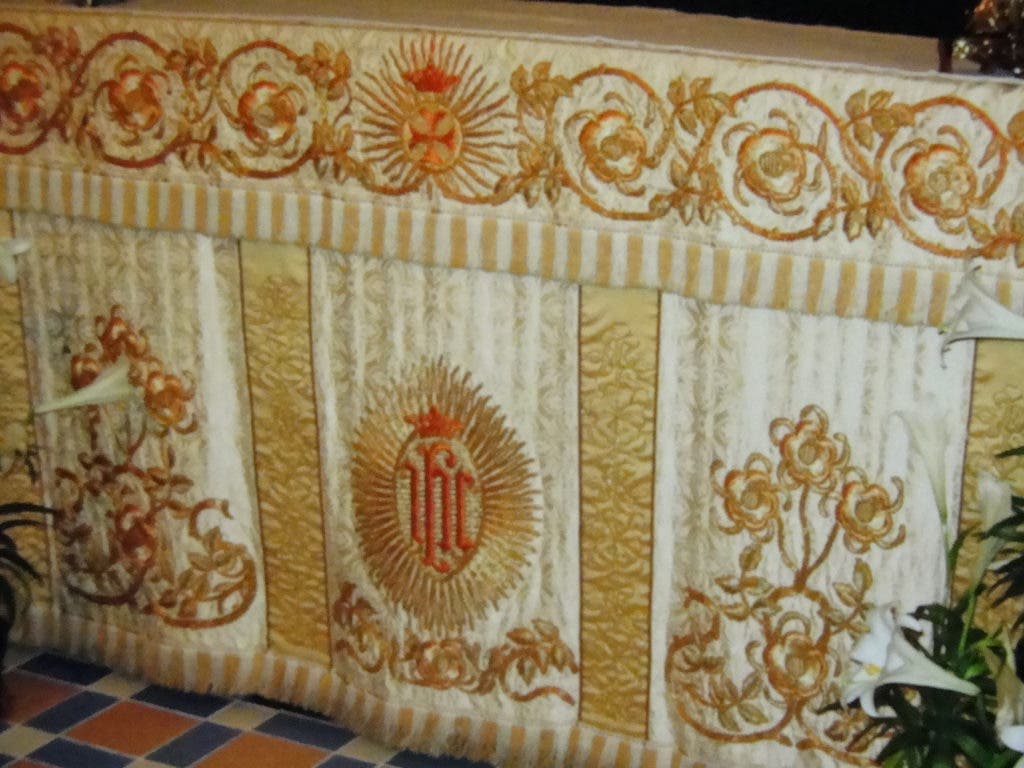
But the connection between Belmont and the 'Titanic" continues to this day as Brown presented All Saint's Church – which she and her family help found – a white Super Frontal embroidered in gold for use on the alter at Christmas and Easter; a "Titanic" memorial to those who lost their lives on that night 100 years ago.
Get more local news delivered straight to your inbox. Sign up for free Patch newsletters and alerts.