Schools
Shore Country Day Receives Go-Ahead to Develop Wetland Learning Spaces
The Beverly Conservation Commission approved plans to rehabilitate natural wetland areas and create an outdoor classroom on Shore's campus.

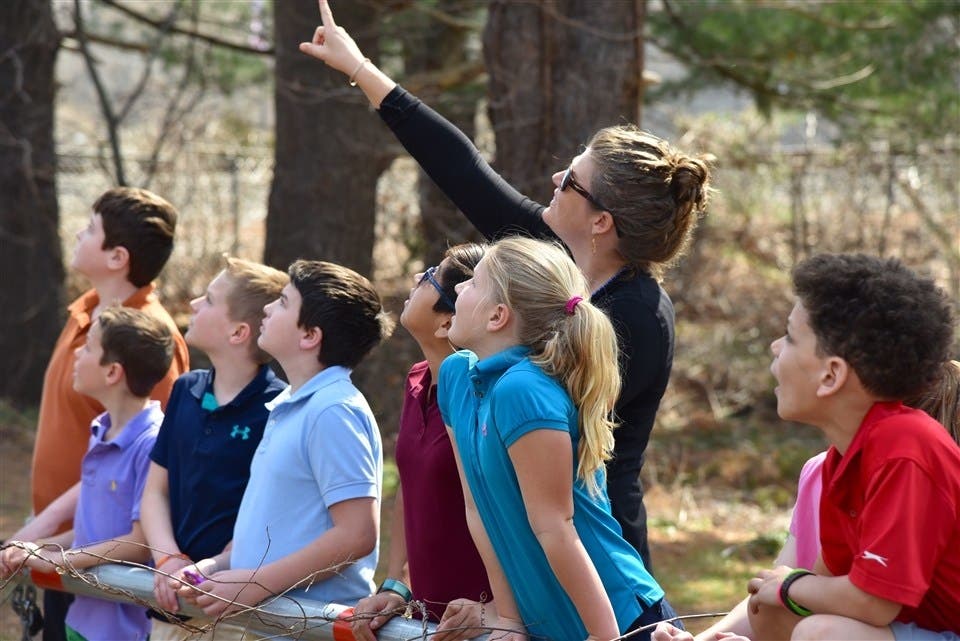


The Beverly Conservation Commission has determined that Shore Country Day School's plan to rehabilitate vegetated wetlands on its campus to create natural areas and outdoor classrooms may proceed. The determination represents a critical milestone for the Beverly private school, which has launched an ambitious outdoor education initiative that will transform areas throughout its 17-acre campus.
The Commission's verdict, announced April 13, was the culmination of a process that began months a, when Shore science teachers led by Whitney Morris, Betsey Holland, and Robin Koval began preparing materials to show the state that Shore's plans were not subject to restrictions or additional oversight by the Massachusetts Department of Environmental Protection, under the Wetlands Protection Act. To earn the go-ahead, Morris presented photos, maps, and a detailed description of the proposed work before the Beverly Conservation Commission in March.
The approved plans would transform an overgrown, nearly one-acre wetland area adjacent to Shore's lower sports fields into a rich educational environment featuring trails and outdoor classroom spaces. The project represents just one piece of the school's larger effort to dramatically expand outdoor learning spaces on campus to further support experiential education at every grade level. Other components of the outdoor education initiative will include a dedicated natural discovery space for Pre-K, K, and first grade students in an unused courtyard; and a substantial all-school learning garden that would serve as a new focal point between the Lawrence A. Griffin Center for Creativity and the Walsh Science Building.
Find out what's happening in Beverlyfor free with the latest updates from Patch.
In the Lower Fields wetland area, according to Morris, "It's of utmost importance to Shore that the area remain as natural as possible, so that classes can observe and study the flora and fauna of the local ecosystem." Nonetheless, she admits, much work will be required to transform the neglected area into a space that is safe and easily accessible to all. "The area is overrun by noxious weeds and plants such as poison ivy and stinging nettle," Morris explains. The school will eradicate these, as well as create boardwalk-style pathways and cleared class meeting areas. To allow students to study the stream that runs through the property without causing erosion or degradation of the soil, a single opening to the water with a gradual natural slope will be designated for visitor access.
"Our final mission," says Morris, "will be to remove the trash and other debris that has accumulated over the years. This will include the removal of buried wire fences, old tires, plastic and metal canisters, as well as other waste. Our goal will be to return the area to as pristine and natural a condition as possible, working with students to create a healthier wetland ecosystem."
Find out what's happening in Beverlyfor free with the latest updates from Patch.
Lower School S.A.I.L. (science and art integrated learning) teacher Betsey Holland is already envisioning the possibilities for the wetland space and the other outdoor environments being planned. "What I love about being outside with kids," she explains, "is that it inspires the first stage of the scientific method, which is asking questions. It's not a ready-made lab experience in the classroom. Nature is always changing, and the kids are natural question-askers who are ready to follow every twist and turn to find their own answers."
Whitney Morris elaborates, "The outdoor space will bring science to life for our students in a hands-on way. Rather than us re-creating nature in the classroom, students will get to see what we're learning about as it's actually happening in the wild." The stream by itself, she says, offers a host of opportunities for investigation. "Students will be able to test water quality, search for microorganisms and other life, study erosion, and much more." The water, she admits, seems to immediately enthrall the kids.
There's much more to discover, Morris says. "From the trees to the birds, animal tracks, insects, wetland plants, and invasive species such as bittersweet, there's a lot going on in this one small space." And many of these natural elements connect directly to the curriculum, across disciplines and grade levels. "It's not just for science teachers," Morris explains. "For example, it's for homeroom teachers looking for inspiration for writing projects, or for art teachers in search of natural colors, textures, and shapes." There will even be opportunities for community service: Shore has been tasked by the Conservation Commission with removing the invasive bittersweet vines that are threatening native trees. "Students will work directly to help clean up the local ecosystem, which will benefit everyone," Morris says.
Three classroom areas planned for the space will offer seating to encourage students to reflect on and discuss what their discoveries. These will accommodate multiple classes at once, so that outdoor learning will always be available.
Head of Lower School Sara Knox, who is helping to spearhead Shore's overall outdoor strategy, explains that wild, natural spaces play a critical role in the school's approach. "We want to give children opportunities to take risks, to get lost, in a way that they aren't typically able to in our academic environment. Trips and outdoor experiences have always been part of the curriculum at Shore; now they can be part of our campus."