Neighbor News
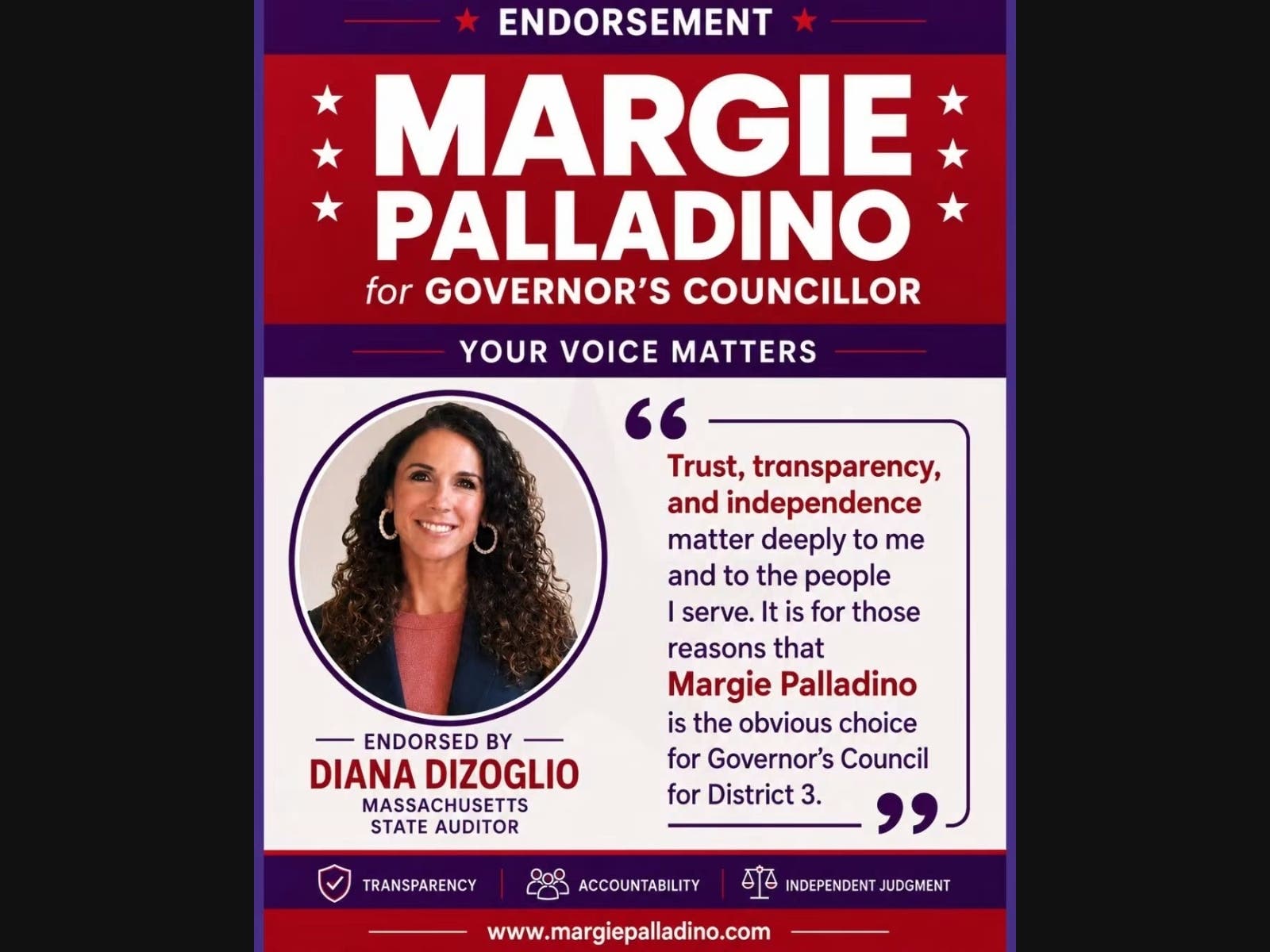
Diana DiZoglio Endorsed Margie Palladino For Governor’s Council
A statewide endorsement, a controversial 4–3 judicial confirmation and years of family-court advocacy have put Margie Palladino at the top.
BOSTON — A statewide elected official has endorsed her.
A controversial judicial confirmation has put the Governor’s Council under a microscope.
And now Margie Palladino is asking voters to take a closer look at the people who help choose the judges who can shape the lives of Massachusetts families.
Find out what's happening in Bostonfor free with the latest updates from Patch.
Massachusetts State Auditor Diana DiZoglio has endorsed Palladino for Governor’s Council, citing qualities including trust, transparency and independent judgment.
But Palladino's case for the office did not begin with an endorsement.
Find out what's happening in Bostonfor free with the latest updates from Patch.
It began years ago in the courtroom, in family-court advocacy and in efforts to change a system she believes must work better for the people who depend on it.
SHE DIDN'T START FIGHTING FOR FAMILIES BECAUSE SHE WAS RUNNING FOR OFFICE
Palladino is a former trial attorney, former partner at a Boston law firm and has Supreme Judicial Court experience.
She is also the co-founder and Executive Director of the Massachusetts Family Advocacy Coalition (MFAC), a grassroots organization dedicated to family-court reform and advocacy.
Her advocacy did not begin with this election.
For years, Palladino has worked with families, domestic violence victims, advocates and policymakers on fairness, justice and meaningful family-court reform.
Her work surrounding the Massachusetts coercive-control law, along with amicus briefs she has authored, reflects an effort to create broader change. Not simply address individual cases, but to protect thousands of families across the Commonwealth.
That is systemic advocacy: an effort to change policies, laws and practices that can affect thousands of families and communities.
Palladino chooses to stand behind domestic violence victims and families.
Not because an election requires it.
Not because it is politically convenient.
Because she believes families deserve a voice.
THEN CAME APRIL 1st
For years, the Governor’s Council operated largely outside the public spotlight.
Then came a 4–3 vote that changed the conversation.
The Governor’s Council confirmed Mary Ferriter to the Probate and Family Court after a contentious nomination that generated substantial public opposition.
Concerns raised by domestic-violence survivors and family-court advocates focused in significant part on Ferriter’s prior involvement with a controversial court-ordered parenting program.
And hundreds of domestic-violence survivors and advocates across the Commonwealth reached out to Governor’s Council members urging opposition to Ferriter’s nomination.
The issue was no longer simply a judicial nomination.
It had become a question about whether the voices of people directly affected by the family-court system were being heard.
DOLAN'S VOTE PUT THAT QUESTION FRONT AND CENTER
Governor’s Councilor Mara Dolan ultimately voted in favor of Ferriter’s confirmation.
Dolan subsequently defended her decision, saying she had conducted extensive vetting and believed Ferriter would be an outstanding Probate and Family Court judge who would be sensitive to domestic-violence victims.
But for survivors and advocates who had urged opposition, the vote left a much larger question:
When hundreds of domestic-violence survivors and advocates personally reach out to their elected representatives about a judicial nominee, what weight should their voices carry?
That is not an allegation that Dolan violated a law or ethics rule.
It is a question about trust, transparency, responsiveness and public confidence in the judicial confirmation process.
AND THERE IS ANOTHER QUESTION
Dolan is also an actively practicing attorney, including work in family law.
That creates another issue for voters to consider:
What safeguards should exist to protect public confidence in the independence of the judicial appointment process when a Governor’s Councilor is also practicing within the Massachusetts court system?
Again, this is not an allegation of wrongdoing.
It is a question about transparency, trust and the appearance of independence.
And in a judicial appointment process, public confidence matters.
WHY PALLADINO?
Because Palladino brings a combination of experiences that is unusual in this race.
Legal experience.
Trial experience.
Supreme Judicial Court experience.
Family-court advocacy.
And years of work focused on systemic reform.
Governor’s Councilors are not required to be attorneys.
But Palladino has spent years learning how the legal system works from inside the courtroom, and then spent years listening to the people who experience that system from the other side of the bench.
That gives her a perspective shaped by both law and advocacy.
BECAUSE COURTROOM DECISIONS AREN'T ABSTRACT
To someone outside the legal system, a judicial appointment can sound like a résumé and a vote.
To a family in court, it can mean something very different.
It can mean:
Where a child lives.
Parenting time.
Custody.
Safety.
And the future of a family.
The Governor’s Council does not decide those individual cases.
But it helps determine who becomes the judges who do.
That is why Palladino argues that judicial selection deserves serious public scrutiny.
HER WORK REACHES BEYOND FAMILY COURT
Palladino's advocacy is not limited to family-court reform.
Not only does Palladino stand up for domestic violence victims and families, she also supports LGBTQ+ rights, disability rights and anti-racism. All grounded in the belief that every person deserves dignity, fairness, safety, and equal justice.
The common thread is straightforward:
People deserve to be heard.
Families deserve dignity.
Justice and safety should apply equally to everyone.
DIANA DIZOGLIO'S ENDORSEMENT PUTS AN EXCLAMATION POINT ON THE CAMPAIGN
The endorsement from State Auditor Diana DiZoglio gives Palladino a prominent statewide validator as she seeks a seat on the Governor’s Council.
But the more important story is what came before the endorsement.
The legal career.
The courtroom experience.
The family-court advocacy.
The work on systemic reform.
The work surrounding coercive control.
The amicus briefs.
And the years spent working with families, domestic violence victims, advocates and policymakers.
The campaign came after the record. Not before it.
THIS RACE IS BIGGER THAN THE FERRITER VOTE
The Ferriter confirmation may have brought the Governor’s Council into sharper focus.
But Palladino's candidacy is about more than one vote.
It is about who participates in choosing Massachusetts judges.
It is about what questions should be asked of judicial nominees.
It is about how public testimony is considered.
It is about independence.
It is about transparency.
And ultimately, it is about whether the people most affected by Massachusetts courts believe they have a meaningful voice in the system.
That is the conversation Palladino is bringing to September 1.
THE OFFICE MOST VOTERS OVERLOOK MAY BE ONE OF THE MOST IMPORTANT ON THE BALLOT
The Governor’s Council is an eight-member elected body that provides advice and consent on judicial appointments and certain other gubernatorial appointments.
Its members may not receive the attention of a governor, senator or mayor.
But the judges they help select can serve for decades.
And those judges can make decisions affecting Massachusetts families for generations.
That makes the Governor’s Council anything but insignificant.
The Ferriter vote brought the institution into the spotlight.
Diana DiZoglio's endorsement has brought additional attention to Palladino's campaign.
But Margie Palladino is asking voters to look at something even more fundamental:
Look at the record.
Look at the experience.
Look at the advocacy.
And then consider what the Governor’s Council should represent.
Because when judges have the power to make decisions that can change the course of a family's life, the question of who chooses those judges isn't a small question.
It is the question.
September 1, 2026.
Governor’s Council District 3.
Margie Palladino.
Who chooses our judges matters.