

We brought back relics. Before the virus hit.
A small worn head of the Virgin Mary now rests on my bedside table. A faded, hand-painted portrait of St. Joseph with the Christ Child hangs on our wall. They came from the farmhouse in which my great-great grandfather Michael was born a hundred and seventy-five years ago in County Meath.
After my wife and I returned from a nine-day journey across the island earlier this month, we realized that the icons are more than religious. They have come to represent our narratives, which like all that come from distant shores, are by turns complicated, heartbreaking and full of hope.
Find out what's happening in Bostonfor free with the latest updates from Patch.
My wife’s family was forced to quit the country and give up her children. Her grandmother stepped off the boat in Boston ninety years ago, an exile of the Catholic Church.
My ancestor arrived in Philadelphia generations earlier, in Black ’47—forced to flee the world’s greatest economic and health disasters at the time. One that killed a million people and sent another two million across the Atlantic—its contagion taking more lives than its starvation.
Find out what's happening in Bostonfor free with the latest updates from Patch.
With today’s pandemic, history does not seem so far away.
Liam Michael, our son, has come home from college early. He looks at the relic that I just hung on the wall. We have ancestors from Lithuania, Switzerland and England, I tell him. This here is from the house of your third great grandfather in Ireland.
How lucky is that, he replies.
Before my wife and I left on our trip, I contacted a town historian in the ancient spiritual center of Kells, an hour north of Dublin. I ring him up when we arrive at the Headfort Arms Hotel, the elegant, 200-year-old de factosocial center. Willie has white hair, worries briefly about the possibility of rain and smiles easily.
“Welcome to the auld sod,” he says. He knows from our email exchanges before the trip that I have years of yarns, of searching maps, censuses, baptisms, marriages, deaths, and ancestry.com behind me. He is about verification through documentation, which is at the heart of successful genealogy.
He drives us to a place with three names—Drumbaragh, Springville and Light Town—so named for the candlelight that once emanated from the foot-square windows of the former houses there.
Three men stand in front of the two-story, boarded-up house that I had identified on Google maps. Willie introduces us. Patrick Brady is a tall, retired farm equipment salesman. His brother Johnny, a former politician with the Dáil Éireann, lives in a house a hundred yards away. His son Conor is clean-cut and works at a local high school in Oldcastle teaching English and geography. Conor spells the surname in Irish—O’Brádaigh—and points to a sentence in a genealogy he brought.
“Mary married a Carolan and was a farmer in Springville.” Turns out that the Carolan whom Mary Brady married is my cousin Bryan, from four generations back. There’s a will in the National Archives that Willie found online.
Bryan and Mary, like many who survived the Hunger, did not have children. As reporter in the country noted at the time, “One is struck by the absence of young men, and what is possibly more peculiar in Ireland, of young children.” Though the next generation flourished: after Bryan’s death in 1893, Mary’s brother Tom moved in, married Mary Reilly in 1905 and raised eight children here. Their son Patrick married Mary Connor in 1936 and raised eleven more, all born in the house, including the two brothers standing before me.
Today, Johnny raises beef cattle; he closed the house after his father died in 1987. Before us, there are two gabled barns of cut limestone, shimmering brown-green in the afternoon light, emerging from soil as naturally as trees. There’s a wall and a gate framing a small yard featuring a garden grotto built by their mother. The house itself is plastered grey, with a central chimney, seven windows and a porch sheltering the front door.
It was the home of a middle class farmer, Willie says, likely built by the landlord for a valuable employee such a blacksmith, which is what the Carolans were. Inside it’s dark; the wallpaper is peeling, a stairway leads to the second floor where light is spilling in from holes in the roof. In a bedroom, I find the small head of the Madonna. The dusty framed print of Joseph is leaning against a wall. Outside the house in the sunlight, I hold them up. The brothers grin. “Our mother’s,” they say. “Take them, take them.”
My only regret, standing there, is that I could not bring my father William or my mother Connie. Both are in their eighties and have played faithful audience for my genealogic adventures over the years.
Across the horizon beyond the house, a rainbow appears. Smile, I tell my ever-interested wife as I take her photograph. She beams.
The Big House
We’re invited “down the lane for a cup,” where we meet Johnny’s wife Kathleen. She has tea, coffee and a delicious vegetable soup waiting. Turns out she grew up in the house next door to the farm on which we are staying a few miles north, in Nobber. Nobber is the birthplace of the most noted of our surname—Turlough O’Carolan, the last of the Irish bard harpists whose melodies can be heard in any pub on the island. Everything is connected here. Johnny and Conor show us scrapbooks of the family and of Johnny’s two decades of elected government service. The Bradys are beyond hospitable. We’re invited back the next day.
Upon our return, we drive a short distance to a place called Kilskrye, site of a church, a school, two cemeteries and a holy well. Scíre was descended from the brother of Niall of the Nine Hostages and a cousin of St. Brigid of Kildare. She was a contemporary of St. Colum Cille who lived in the 6th century; her church became part of the monastery of Kells. St. Alphonus Liguori, the church, a “touchstone of the Gothic revival in Ireland,” was built during the Famine. Its construction was part of a relief effort led by Fr. Patrick Kelly, who, with Fr. Nicholas McEvoy, P.P., Kells, were forceful orators and critics of the ineffectual government policies during the devastation. It’s the parish of generations of Bradys.
We get into boots, called ‘Wellies’ after the Duke of Wellington, who spent much of his childhood south of here, at Dangan Castle, and who wore the first pair, I presume. We cross a small bog, a flock of sheep looking on. The old cemetery is a beautifully haunted place with ivy, stone, ruin-walls, Celtic crosses. Willie says the record shows Mary Brady is here though we don’t find a stone.
Next, Willie drives Johnny, his wife Kathleen, my wife and I to a churchyard on a solitary hill in the middle of a broad windswept plain. There’s high, weathered stonewalls here too—the ruins of the former Burry Parish chapel, dedicated to the Virgin Mary. The Catholics buried here are separated from the Protestants by a ledge. The Carolans are on the lower ground; many used wooden crosses that didn’t last.
Willie points out a polished headstone that shines. FitzSimons was the grandfather of Hollywood legendary actress Maureen O’Hara. She made a ceremonial visit here in 2012. “Your people are related to her,” Willie says, reminding me of the record he discovered—the Kells parish priest writing in the register that my uncle who remained, Michael, married Ms. Bridget FitzSimons on July 23, 1833. I imagine the scene suddenly from eight years ago: townspeople wheeling the redheaded O’Hara, still elegant at 92, across the field and up the hill to pay her respects to her relations.
The graveyard is on the estate of an old Anglo-Irish family, the Protestant landlords. Generations of Carolans and Bradys paid rent and answered them in the local petty court, like my uncle Michael, when he was fined for his pig, “found wandering on the public road near Balrath,” on June 7, 1866.
Willie tells us that for the first time ever (since 1671), Catholics live in the Big House of the Balrath-Bury estate, at one time containing 7,682 acres. “Moving up in the neighborhood,” he jokes. Johnny’s wife Kathleen laughs. “By degrees, slowly but surely, we are.”
The laughter is likely part of what the County Clare writer John O’Donohue calls humor here, with its “subtext of knowing the complete horror, but yet deciding not to bend to its ravages.” Religion is one of the country’s eternal divisions, mirrored in the estate stonewalls that remain rolling across the emerald fields of County Meath.
Surprisingly, Willie has contacted its owners and we are invited inside of Balrath. Everyone seems to know one another. A gracious elderly woman named Eileen serves us tea. Her husband Joe, who passed away last winter, worked here most of his life. The place today is a two-story, 18th century colonial revival villa that has since been scaled back: an old swimming pool fills the yard where a wing had been removed.
This former estate house is like many others across the country today—decaying testaments to an earlier age. During and after the Great Hunger, its owner, John Armytage Nicholson, cleared land to make room for the more profitable cow, so that two decades on, with death and emigration, Springville’s population dropped a whopping 80 percent, according to the census. In 1841 there were 50 houses, in 1871 only 11.
My uncle who remained, Michael, and his son Bryan, were among the impoverished tenants who had held land for generations. They had survived Black ‘47—so named for it was the worst year, with 400,000 dead and £17 million of grain, cattle, pigs, flour, eggs, and poultry exported, according to Thomas Gallagher in Paddy’s Lament. And they were furious.
Two decades later, on October 4, 1869, an attempt was made upon the landlord’s life. The community looked the other way.
Johnny Brady makes it seem like yesterday. “It was said that the landlord switched seats on the ride out to the estate,” he tells me. “So it was the driver who took the bullet, not the landlord.” Nicholson and his niece were wounded, the carriage driver died. Afterward a permanent police station for seven constables was established at his estate.
In 1872, more evictions followed, landlord Nicholson showing up with the 34th Regiment from Kells Barracks, sheriffs, sub-sheriffs and constabulary inspectors, himself wearing “a belt under his coat, from which at either side depended two formidable revolvers in leather cases.” He also carried “a sledgehammer, hatchet, and crowbar, in case resistance should be offered,” the Freeman’s Journal reported from Australia.
At the end of his life, Nicholson put a sick lady out into the road, Johnny tells us. “The priest went to ring the bells in the parish, and it was said that Nicholson couldn’t get the ringing in his ears to stop, went mad and died.” The story is true, at least in the minds of all those who stood with the dispossessed. It is told in Ireland’s National Folklore Collection, and Nicholson indeed expired soon after a notorious eviction took place involving a hundred soldiers, church bells and many priests.
At his death, Nicholson left an estate of £180,000, worth about $18.9 million in today’s dollars; just two decades later, my uncle Michael, at the far end of Nicholson’s field, left one worth £154, or about $21,000.
Inside Nicholson’s former home, we are shown the dining room, its sculptures, paintings and Georgian furniture reminiscent of long-gone inhabitants who once stood among the power elite of Anglo-Irish society. Think of the interiors of Downton Abbey a hundred years on and you get the picture. Nonetheless Kathleen Brady suggests my wife and I descend the spilling staircase so she can snap a photograph.
We smile big.
I am reminded that I come from people, with very little, who left this life in County Meath for America, in the middle of an immeasurable disaster, who were ostensibly evicted by the former overlords in whose home I now stood, and to make room for, what was it—more cattle?
That immigrant’s grandson—my paternal grandfather Walter—sold bread door-to-door at age 14, saving enough pennies to attend Philadelphia’s Drexel University in the 1920s. He was the first generation, a rarity that era, to obtain an advanced degree. Walter later built a successful engineering firm that my father William and his brother inherited, in Missouri, where I was born. How lucky I am to be helping the fourth generation of my family—my son and daughter—receive a college education.
And how complicated it must have been for the family when my grandfather’s father, Matthew, son of Michael and Anna, and a first-generation Catholic, eloped with Wilhelmina, a first-generation Protestant. Wilhelmina was pregnant at the time with their first child, Ann Marie. You just didn’t do that in those days yet so many did.
And how lucky my great grandparents were to not be in Ireland. That is, like the thousands of young women, pregnant and shunned, first by the Church then by Irish society, who had no choice but to leave their country, and were considered lucky if they were actually able to get away.
Quite simply, that first child, Ann Marie, freed our family.
The story goes that in north Philadelphia, March 1902, Wilhelmina wheeled my aunt in her pram three miles down Wyoming Avenue and Orthodox Street to the Immanuel Church on Tackawanna Street while her husband Matthew, the Catholic, was at the pub in Feltonville.
My aunt was baptized Lutheran, as were her siblings, including my grandfather, and that was that.
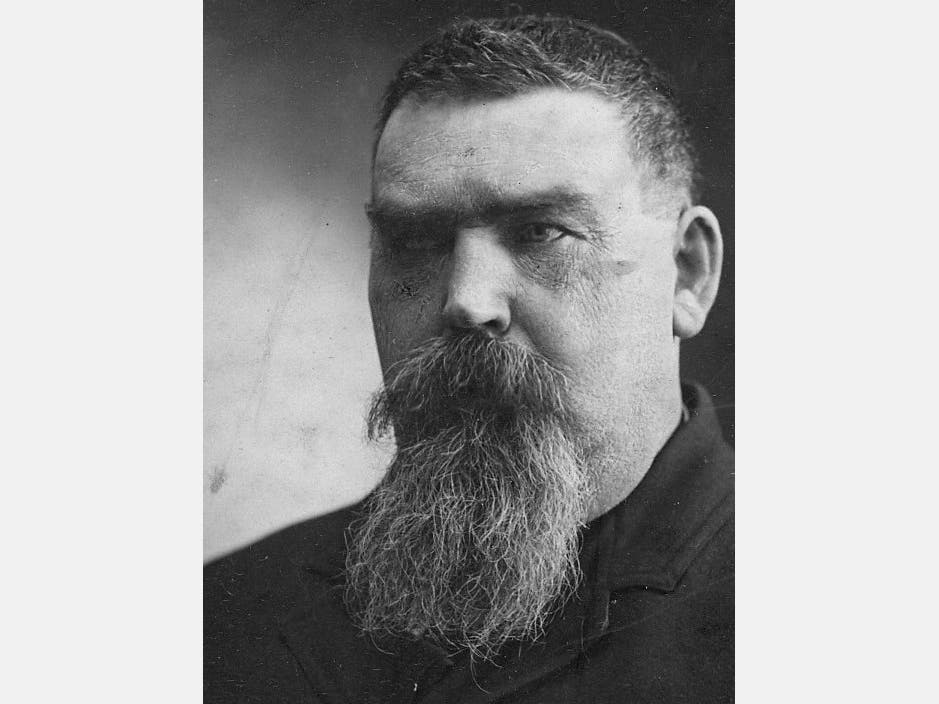
My dear aunt Ann would later in life inspire my quest—she showed me the turn-of-the-century oval portrait of my great-great grandfather Michael at her retirement home on Anna Maria Isle, Florida, in 1992.
To the West
On the way, we stop at Strokestown Park and the National Famine Museum, in County Roscommon in the middle of the country. Another Big House, Strokestown’s landlord Denis Mahon was assassinated after forcing tenants onto “coffin ships” to Canada on which many died. There’s an impressive tour, packed with fascinating touches of the era, the estate left in a natural state of decay.
The Museum, with an impressive trove of 55,000 letters and documents found here, boasts an archive, summer school, the National Famine Walk that follows an actual one made by 1,490 tenants, Great Famine Voices, an international tour that gathers stories of descendants (in which I took part in Boston), and a restored 6-acre garden. We listened in on a fascinating discussion about the Park’s expansion, with its lovely director, Caroilin Callery, and its knowledgeable academic coordinator for the Irish Heritage Trust, Jason King, and planned our return visit. We were reminded that one of the lasting effects were orphaned children, thousands of girls sent to Australia to be adopted into families there, which brings us to my wife’s story.
Ruth was adopted, at six weeks old, and raised by a loving, Irish Catholic family in Rhode Island. Her father was a prominent member of the Ancient Order of Hibernians in Newport, led the St. Patrick’s Day parade and loved everything Irish. She has naturally wondered over the years about her birth parents, but never went looking them.
Last summer I discovered that one’s real birth certificate, not just the adoptive one, could now be obtained in Massachusetts. It arrived and provided Ruth’s given name, “Sally,” and that of her birth mother, Sandra. After a quick Internet search, I discovered that Sandra had passed away, but also that she had another family after Ruth’s birth. Ruth then contacted and met her half-sister who provided information.
Turns out that Ruth’s maternal grandmother was born in Ireland and came to Providence, RI, at age 18. The story went that Sandra had been told by her mother, Lena, that her grandmother, in Ireland, Maggie, died when young. Suspicious that she was lied to, Sandra sent a friend in the 1990s. The friend went to see the village butcher, where she inquired about Maggie. There she discovered that Maggie had lived to be 103 and only recently died.
So when my wife and I arrived in Ennistymon, a picturesque village not far from the spectacular Cliffs of Moher, we were excited. We started with the butcher, naturally, who sent us across the street to the printer, who sent us down the lane to the cheesemonger at The Cheese Press, Sinéad Ní Gháirbhith Iłl, who sent us back across the street to see the ironmonger (hardwares) James Devitt, who sent us in the general direction, until we found ourselves at a door.
A young, bald man answers. He has my wife’s eyes. Ruth tells him that she believes their great grandparents are the same. That they didn’t have nine children, they had ten. To prove it, her grandmother’s obituary in the Providence Journal named Lena Veronica’s parents as Maggie and Patrick.
After a lifetime of estrangement and resentment, Lena must have wanted the world to know who her parents were.
“Those are my great grandparents,” Patrick says, laughing. “They lived right here. That’s crazy. It’s cool.” He looks at Ruth. “You are literally a relative as much as any of my cousins are.”
Patrick produces a narrative that Maggie published in the local parish magazine in which she reveals that her husband’s family did not want the marriage, that she and Patrick eloped to a different parish to marry. She makes no mention of the early pregnancy with Lena.
Ruth explains that Lena may have been pregnant herself when she arrived Boston in 1927 at age 18. She would have given that baby up for adoption. Indeed the 1930 census for Cranston, RI, shows that Lena worked as a servant next door to the Sophia Little Home, a home for unwed pregnant mothers. Lena married the following year and had two more children, one of whom was Sandra, Ruth’s birth mother. The cycle that began in Ireland repeated.
At age 20, Sandra fell in love and became pregnant but did not marry. She entered St. Mary’s Home, founded as the first infant asylum in Dorchester, Massachusetts, and gave birth to Ruth at St. Margaret’s in 1964. Ruth was adopted from St. Vincent’s in Providence.
“It’s amazing that no one could not have sex,” Ruth says. “No one could meet that requirement of the Church.”
“It’s madness,” Patrick says. “That sex is such a part of life, married or not. And what happened to our great grandparents was very hush-hush. A sin. They take your child because you weren’t worthy of bringing up the child. Tough times, they were. Very cruel.”
Patrick was born in England after his father moved there in the 1950s, when jobs were scarce and Ireland’s population hit an all-time low. Patrick moved to Ireland recently and lives in the home of his great grandparents, while his father, Irish-born, is in London. Patrick later introduces us to Ruth’s great uncle, Frank, her grandmother’s youngest brother. Frank is in his late eighties and says he never heard the story but his younger sister had been named Veronica.
“You didn’t mention those things in their time,” he says. “It’s a sin. You kept it down there.” He pushes his outstretched hand down, horizontal to the floor. “You would have no father and mother. You could be sent off to America and that would be it. You could never come back.”
There’s a sense that my wife and I gather—we discuss it later—that the Irish-American writer John Patrick Shanley captures in a 2013 essay. He recounts his own trip here, with his Irish-born father. The driving “on the wrong side” of cramped lanes, the “silence” of the farm, the “utterly different” speech of relatives (“strange mixture of calm and storm”), and a visit to a nearby graveyard—all of which Ruth and I experienced.
“I felt a bond with something dreadful and grand,” Shanley writes. We too felt it: These are our people.
Ruth’s second cousin asks when we are returning to the States; there’s rumor that a doctor here recently returned from Italy with the coronavirus. We’re trying to get home on Saturday, we say, though we don’t have much control over that. (We would first visit County Clare’s Mullaghmore Mountain, the sublimely beautiful heart of the Burren, one of the most distinctive landscapes in all of Europe, with the lovely and informative local Marie McGauran as our guide.)
Afterwards, it occurs to me that I, too, am an exile of sorts, as a young man leaving the region of my birth in the Midwest for the Nation’s capital, then to Virginia, where I met Ruth and where our children were born, then to Western Massachusetts where we now live.
That cycle of secrets and exile, of abandonment, has, perhaps, been paused.
When we married on March 21st, 22 years ago, with our families as witnesses, we were three months pregnant with our son.
Our daughter Hattie Claire was born a couple of years later.
We’ll keep them as close to home for as long as we can.
Michael Carolan was born in Kansas City, Missouri. He is a Professor of Practice in the Department of English at Clark University in Worcester, Massachusetts. He can be reached at mcarolan@clarku.edu.