Traffic & Transit
MBTA's Riders Pay Fares--But Kansas City Has Zero-Fare Transit
Time for `The New Boston" to become "Fare-Free Boston" for all T-Riders and Bus Riders in 2021?
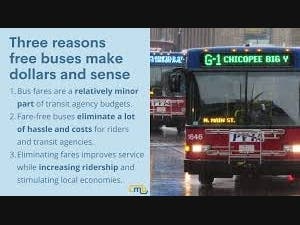
Like in Boston, over 25 percent of the people who live in Kansas City, Missouri these days are Black. Yet--unlike Boston--Kansas City, Missouri (whose population is 500,000 compared to Cambridge's population of 120,000, Brookline's population of 59,000 and Somerville's population of 81,000) has been providing its residents with a public transit service that has been fare-free since March 2020.
Unlike in "The New Boston" or in "The People's Republic of Cambridge," anyone in Kansas City, Missouri who needs public transportation to get to a job, a job interview, a school, a healthcare provider, a food provider or any other location in Kansas City is provided free access on the Kansas City Area Transportation Authority's "Ride KC" zero-fare buses.
As a result, in Kansas City, Missouri, more than 30,000 fare-free rides are taken daily, which translates into $1 million a month that is returned to the local economy instead of being spent on bus fares.
Find out what's happening in Bostonfor free with the latest updates from Patch.
In addition, removing the farebox on the Kansas City Area Transportation Authority's public transit buses, which allows riders to enter and exit the bus without stopping to pay, has enabled drivers to run on time without delay; due to the abence of farebox disputes that previously developed between drivers and passengers who wished to ride the bus--but lacked the $1.50 fare that had previously been required.
Also, because 90 percent of the daily incidents that felt threatening to some bus drivers and their passengers on Kansas City's public transit vehicles apparently developed as a direct result of disputes involving the $1.50 fare, the absence of farebox disputes on Kansas City buses, since the zero-fare system was created, has contributed to both drivers and their passengers feeling a sense of increased safety while working or riding on the buses.
Find out what's happening in Bostonfor free with the latest updates from Patch.
Not surprisingly, establishing a fare-free public transit system in Kansas City has led to an increase in the number of area residents who (rather than contributing to the climate crisis by driving their cars into the city each day) are commuting to work by public transit. But should new buses be necessary to provide service for the increased number of "car-free" residents who utilize Kansas City's fare-free transit system, 80 percent of the needed funds to purchase needed new buses would come from U.S. federal government discretionary transit funding.
Some politicians and elected officials in Boston and Cambridge have been talking in recent months about having the MBTA permanently set-up some more fare-free public transit service for riders in places other than on Boston's Bus 28 or in cities like Lawrence, Massachusetts. Yet in 2021 the MBTA is still providing most T-riders in Boston, Cambridge, Brookline and Somerville not only less fully fare-free transit service than Kansas City currently provides its residents, but less fare-free transit service than the MBTA provided prior to 2004.
Before 2004, for example the MBTA had long provided riders who lived in Boston and Brookline fare-free outbound transit service for any passenger who boarded the Green Line B, C or D trolleys at a surface stop west of Kenmore. And, consequently, a fare-free public transit service existed for outbound T-riders between Blandford Street and Boston College on the B-line and between St. Mary's Street and Cleveland Circle on the C-line, for example. As the tenth edition of Car-Free In Boston noted in 2003: "Outbound travel on any Green Line train is free if you board at a surface stop west of Kenmore Square."
In addition, according to the same book:
"The Mattapan trolley [Ashmont to Mattapan] is also free for all outbound travel...Finally, no fare is charged: Inbound from Dudley Station to Ruggles [Orange Line] on buses 15, 19, 23, 28, 42, 44, and 45; Inbound from Egleston Square to Jackson Square [Orange Line] on buses 22, 29 and 44...Fares may increase in 2004..."
One result of the MBTA's undemocratic decision to end all fare-free outbound public transit service on Boston's Green Line trolleys, of course, was that the time it took to travel from Kenmore Square to Cleveland Circle or to Boston College on the Green Lines increased; due to the traveling time that was wasted having to collect passenger fares at the surface stops at which T-riders previously had just hopped on the outbound trolleys for free.
Kansas City is not the only U.S. city which is moving rapidly to providing much more fare-free public transit for its residents in the 21st-century. Olympia, Washington, for example, which previously charged its residents $1.25 for a typical adult ride on its buses, now has a fare-free public transit system, in that city of 53,000 people. And since Olympia's public transit bus system became fare-free, the number of people who regularly use public transit in that city has increased by 20 percent.
In addition, in the downtown areas of cities like Cleveland, Baltimore, Savannah, Georgia and Akron, Ohio, for example, some form of fare-free trolley or fare-free bus public service exists.
As an alternative to creating a "fare-free for all" mass transit system like Kansas City has, some politicians and elected officials in Boston and Cambridge and some MBTA administrators (who often apparently spend more time each year driving around in their cars than riding on T-buses and trolleys) have discussed setting up a divisive "means-tested fare" pricing system in the Greater Boston area; which sounds similar to the unfair "Fair Fare NYC" pricing system that New York City's mass transit system set up in 2019.
Under New York City's means-tested fare pricing system, riders living alone whose annual income exceeds $12,760 and riders living in a 2-person household with an income exceeding $17,240 receive no benefit from the "Fair Fare NYC" means-testing fare pricing system; and still are charged at least $2.75 for an individual subway ride. And only around 232,000 people in NYC (where--like in Boston--over 25 percent of the people living in the city are Black) have been enrolled in its means-tested fare pricing "Fair Fare NYC" program--although around 1.7 million people living in New York City are considered economically impoverished, under the current U.S. economic and political system of racial capitalism.
In addition, even NYC mass transit riders who are able to pass the required means test are still also required to pay a half-fare for each individual public transit ride--rather than just being allowed to get on all the buses or subway trains for free.
Instead of using some kind of a progressive public transit tax (which might require tax-exempt non-profit institutions like Harvard or the Boston Foundation and for-profit U.S. or foreign-owned corporations like Bain Capital, Stop & Shop or the Fenway Park owners to adequately fund an MBTA that brings their students, workers, customers or fans in and out of Boston each day), Massachusetts currently uses a regressive sales tax (which is paid by many of the same T-riders it also collects fares from) to subsidize the MBTA's annual operating budget. Over $1 billion of the MBTA's operating budget each year, for example, is obtained from a regressive Massachusetts state sales tax.
MBTA administrators might claim that it can't afford to establish a fare-free public transit system in Boston in 2021. Yet in 2021, the MBTA administrators will be receiving $600 million in U.S. federal government bail-out funds and another $110 million in other one-time amounts from the federal government.
But, unfortunately for the T-riders and transit workers that the MBTA administrators exploit, the MBTA pays about the same amount each year in "debt service" to investors and financial institutions as it does in wages to MBTA employees ( an amount which includes the inflated salaries of MBTA administrators). In 2021, for example, $523 million or 22 percent of the MBTA's total annual revenues will be used--not to allow all "New Boston" and "People's Republic of Cambridge" riders to get on its buses and trolleys for free--but, instead, to fill the pockets of MBTA's parasitic creditors.
One political reason Kansas City has a fare-free public transit system is that--unlike Blue Cross-Blue Shield of Massachusetts--Blue Cross-Blue Shield of Kansas City apparently prioritized establishing a fare-free public transit system in Kansas City for the following reason:
"Blue Cross and Blue Shield of Kansas City have always been committed to the overall health of Kansas City. And we...understand the role public transportation can play not only in physical health, but the overall health of Kansas City. From better access to health care via zero fare transportation, to better quality of life overall, thanks to the elimination of public transportation from already stretched family budgets."
In addition, to help fund Kansas City's fare-free public transit system, Blue Cross and Blue Shield of Kansas City contributed $1 million to the Kansas City Area Transportation Authority's operating budget.
As a May 4, 2021 article by Bob Seay on WGBH's news website noted, "on Beacon Hill, Democratic Sen. Joseph Boncore of Winthrop, Transportation Committee co-chair, has filed a bill to make all buses fare-free across the state, including those operated by the MBTA and regional transit authorities." But when this writer emailed Massachusetts's Joint Committee on Transportation Co-Chair on June 29, 2021 and asked what the current status of "The Boncore Fare-Free Public Transit Act" bill was, neither the State Senator nor a member of his staff replied.
Ironically, although Oregon State University's endowment of $682 million is a lot less than Harvard University's endowment of over $41 billion, since 2011 any person wishing to ride a Corvallis Transit System bus in Corvallis, Oregon (where Oregon State University's campus is located) can do so without paying a fare; while bus riders in the cities where much wealthier Harvard's campuses are located are still required to pay bus fares by the MBTA in 2021.