Crime & Safety
More Human Remains, Final Evidence From Titan Implosion Removed
Months after the submersible's implosion, additional presumed human remains were recovered from within Titan's debris, officials said.


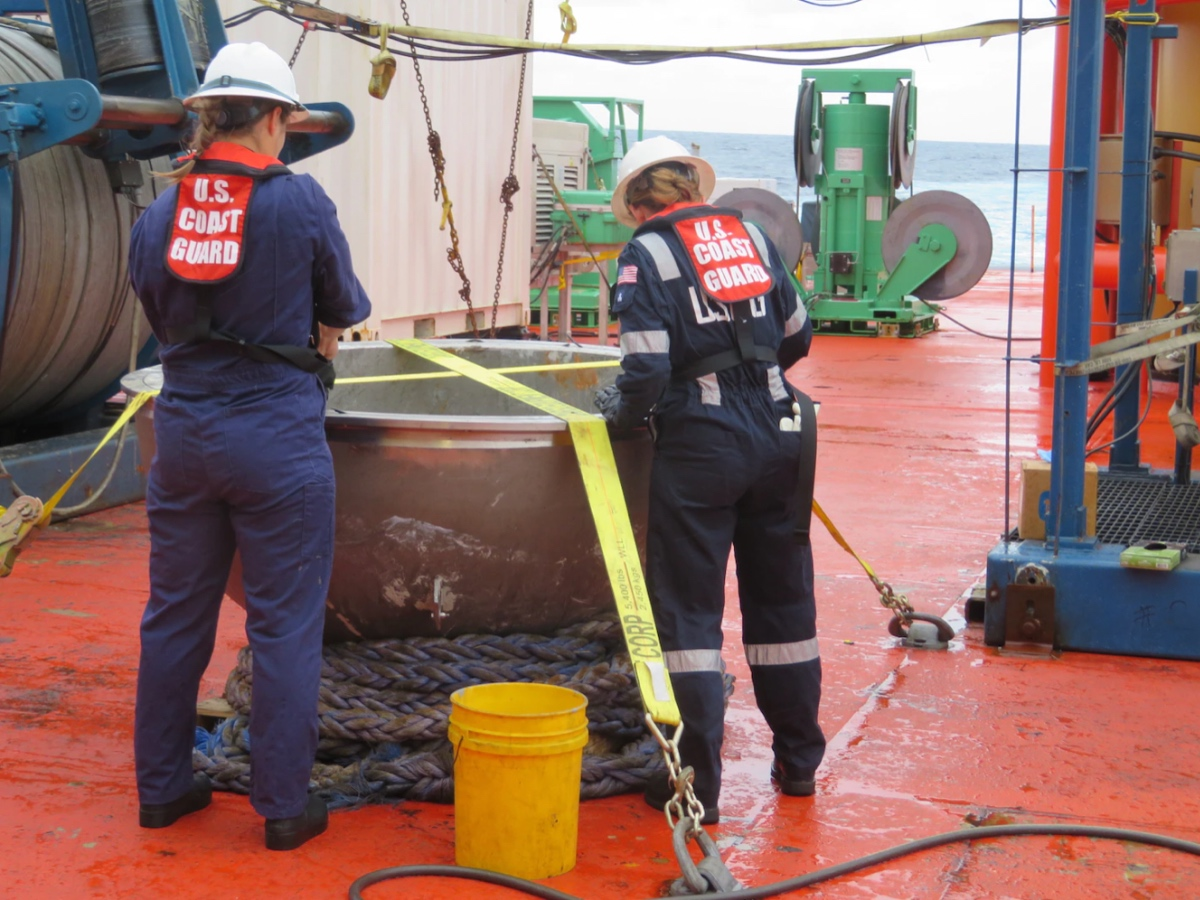
BOSTON, MA — Coast Guard officials removed the final remaining Titan submersible debris and evidence, including human remains, from the North Atlantic Ocean seafloor last Wednesday, the Coast Guard Headquarters announced Tuesday.
"The recovered evidence was successfully transferred to a U.S. port for cataloging and analysis," officials said in a news release. "Additional presumed human remains were carefully recovered from within Titan’s debris and transported for analysis by U.S. medical professionals."
The salvage mission was conducted by the Coast Guard’s Marine Board of Investigation, which is coordinating with the National Transportation Safety Board and agencies abroad to schedule an evidence review of recovered Titan debris, officials said. The goal is to determine the next steps for forensic testing.
Find out what's happening in Bostonfor free with the latest updates from Patch.
"The MBI will continue evidence analysis and witness interviews ahead of a public hearing regarding this tragedy," officials wrote.
The salvage mission, which was conducted under an existing agreement with U.S. Navy Supervisor of Salvage & Diving, was a follow-up to initial recovery operations following the loss of the Titan submersible, according to officials.
Find out what's happening in Bostonfor free with the latest updates from Patch.
Investigators from the U.S. NTSB and the Transportation Safety Board of Canada joined the salvage expedition as part of their own safety investigations, officials said.
Back in June, all five people onboard the Titan submersible for a tour of the Titanic's wreckage 12,500 feet deep in the North Atlantic Ocean were killed when the vessel imploded. The victims were the vessel's pilot Stockton Rush, the CEO of OceanGate, as well as his passengers—British adventurer Hamish Harding, Pakistani businessman Shahzada Dawood and his son Suleman Dawood, and French explorer and Titanic expert Paul-Henry Nargeolet.
The Titan, a 21-foot submersible, was reported overdue on the night of June 18 about 435 miles south of St. John's, Newfoundland in Canada. The craft submerged Sunday morning, and its support vessel lost contact with it about an hour and 45 minutes later.
Officials announced June 22 that a remote-operated vehicle — or ROV — deployed by the Canadian Vessel Horizon Arctic had found debris consistent with a catastrophic implosion near the site of the Titanic wreck.
The ROV found five major pieces of debris from the Titan, Paul Hankin, the director of salvage operations and ocean engineering, said at a news conference at the time. The front of the pressure haul was found in a large debris field and the other end of the pressure haul was found in a smaller debris field.
For days, officials, including U.S. Coast Guard teams from Boston, raced against the clock in a vast search and rescue attempt that involved resources from multiple countries.
The expedition was OceanGate's third annual voyage to chronicle the deterioration of the Titanic, which struck an iceberg and sank in 1912, killing all but about 700 of the roughly 2,200 passengers and crew. Since the wreckage's discovery in 1985, it has been slowly succumbing to metal-eating bacteria.
SEE ALSO:
- 'Banging' Sounds Concentrate Search For Missing Titanic Submersible
- Vessel Missing On Expedition To Titanic Wreck With 5 Aboard: Officials
- What To Know About OceanGate, Owner Of Lost Submersible
- Life-Saving Equipment Hindered From Titanic Sub Search: Report
- Pilot Of Missing Submersible Is From Prominent CA Family
Rush spent his life as an adventurer of the sea and sky. He became the youngest jet transport-rated pilot in the world at 19 in 1981, decades before he founded Washington-based OceanGate in 2009, according to the company.
OceanGate, however, has attracted scrutiny and in 2018 drew concern from dozens of industry leaders, according to The New York Times.
In a letter to Rush, the Marine Technology Society said it was critical that the company submit its prototype to tests overseen by an expert third party before launching in order to safeguard passengers.
The letter expressed concern that the company's "experimental" approach could have minor or catastrophic negative outcomes.
David Lochridge, OceanGate's former director of marine operations, expressed concern that the craft’s passenger viewport was only certified for depths of up to 1,300 meters, while the Titanic sits at 4,000 meters.
OceanGate's choices would "subject passengers to potential extreme danger in an experimental submersible," said a counterclaim from Lochridge against the company — filed after the company took legal action against him.
Lochridge also had worries about OceanGate’s use of acoustic monitoring to detect flaws in the vessel.
“At some point, safety just is pure waste,” Rush told a CBS News podcast last year. “I mean, if you just want to be safe, don’t get out of bed. Don’t get in your car. Don’t do anything.”
The Associated Press contributed to this report.
Get more local news delivered straight to your inbox. Sign up for free Patch newsletters and alerts.