Neighbor News
Progressive Party of Massachusetts Revisited: Conclusion
Time to recall in 2025 hidden people's history of mid-20th century Progressive Party of Massachusetts's campaigns in Boston and Lawrence?
In 1948, the Progressive Party of Massachusetts' executive director, Walter O'Brien, had entered the Democratic Party's primary in Boston's 10th Congressional District and had actually won the Democratic nomination there, by securing 20,000 votes. Although O'Brien subsequently lost in the heavily Republican district to his Republic opponent, Christian Herter, in the general election, 59,000 voters did cast ballots for O'Brien in November 1948.
The following year, O'Brien was the Progressive Party of Massachusetts' candidate for Mayor of Boston. And hopes were initially high among the approximately 1,500 party members in Massachusetts that their executive director might actually win the 1949 Boston mayoralty election. The minutes of the Progressive Party of Massachusetts State Committee meeting of June 24, 1949, for example, noted how O'Brien summarized the state's political situation at that time:
"Reports opportune year for stepping up activity. Unemployment prime issue in Commonwealth. Lawrence should be major concentration due to mass unemployment there, though Boston has many big problems, such as Nation's worst slums…"
Find out what's happening in Bostonfor free with the latest updates from Patch.
Another party leader, Amos Murphy of Lawrence, also reported that workers in Lawrence were "filled with angry and righteous resentment" and the possibilities were "enormous for placing Lawrence in vanguard of national progressive movement."
Born in Portland, Maine, O'Brien had been a shop steward in the CIO's Industrial Union of Shipbuilding Workers of America, prior to volunteering for the U.S. Merchant Marine in 1943. After World War II, he moved to Boston and was active in the Boston Tenants' Council before first running for Congress in 1948.
Find out what's happening in Bostonfor free with the latest updates from Patch.
At the time of the 1949 Boston mayoralty campaign, 25,000 to 30,000 workers were unemployed in Boston, so O'Brien proposed that a city public works program be established. He also came out in favor of rent control in Boston and in opposition to the MTA fare increase that inspired his campaign's famous "MTA Song".
The "temporary" fare increase on MTA lines was put into effect on Aug. 6, 1949, after its approval by the Department of Public Utilities at a 90-minute closed hearing.
Although O'Brien's subsequent stirring speech at an anti-fare increase rally on the Boston Common--that thousands of protesting Boston commuters attended--was well-received, the favorable crowd response did not translate into votes for the Progressive Party of Massachusetts candidate in the 1949 Boston mayoralty election. Less than 3,300 votes were received by O'Brien, while then-Democratic Party Mayor Curley received over 126,000 votes and the Boston corporate establishment-backed candidate, Hynes, won the election with over 137,000 votes.
To draw votes away from Walter O'Brien's 1949 campaign, the Democratic Party machine in Boston also entered another candidate whose last name was also "O'Brien". The Democratic Party machine's hope was that the dissatisfied voters who wanted to vote for "Walter O'Brien" would, in this way, get confused and end up casting meaningless votes for "Thomas O'Brien", instead.
The Progressive Party of Massachusetts' 1949 mayoralty candidate in Boston charged that a "generation of misrule in Boston" and an "unholy alliance of State Street and City Hall" had "kept Boston a sink-hole of reaction and corruption."
Walter O'Brien also accused the Democratic Party's Curley Machine of squeezing people to pay for obtaining city government contracts and leaving most Boston residents poor, while Curley "posed as anti-bankers."
Following its 1949 electoral defeat in Boston, the O'Brien for Mayor campaign attributed Hynes' victory to a "deluge of expensive advertising, radio and billboard blurbs and assorted maneuvers" and his endorsement by a "coterie of Republicans" and a Truman Administration cabinet member named Tobin.
Despite its 1949 defeat in the Boston mayoralty election, in December 1949 the Progressive Party of Massachusetts still had 18 genuinely active political clubs in Massachusetts. Its leaders also felt that these clubs should then begin to concentrate their organizing efforts in Worcester, Lawrence, Springfield, Dorchester, Roxbury, East Boston and South Boston.
And in 1950, Progressive Party of Massacusetts members were attempting to win the following demands in Boston:
1. Better housing in the South End;
2. Breaking Jim Crow in city jobs;
3. End to police brutality;
4. Increased welfare benefits;
5. More modern fireproof schools and playgrounds; and
6. A better city medical center.
But in Lawrence, Massachusetts, a local Progressive Party of Massachusetts leader complained about the lack of support from Boston members for their party's 1950 campaign to elect Amos Murphy to political office there. In a Nov. 11, 1950 letter to Boston party leader O'Brien after the 1950 election, for example, an Amos Murphy campaign supporter wrote the following:
"Dear Wally,
"To us, Progressives in Lawrence, it is clear that to date Boston Progressives, including yourself, have failed to see the significance of the Murphy campaign in Lawrence. This is apparent from the lack of support from Boston.
"This political blindness must be corrected now…"
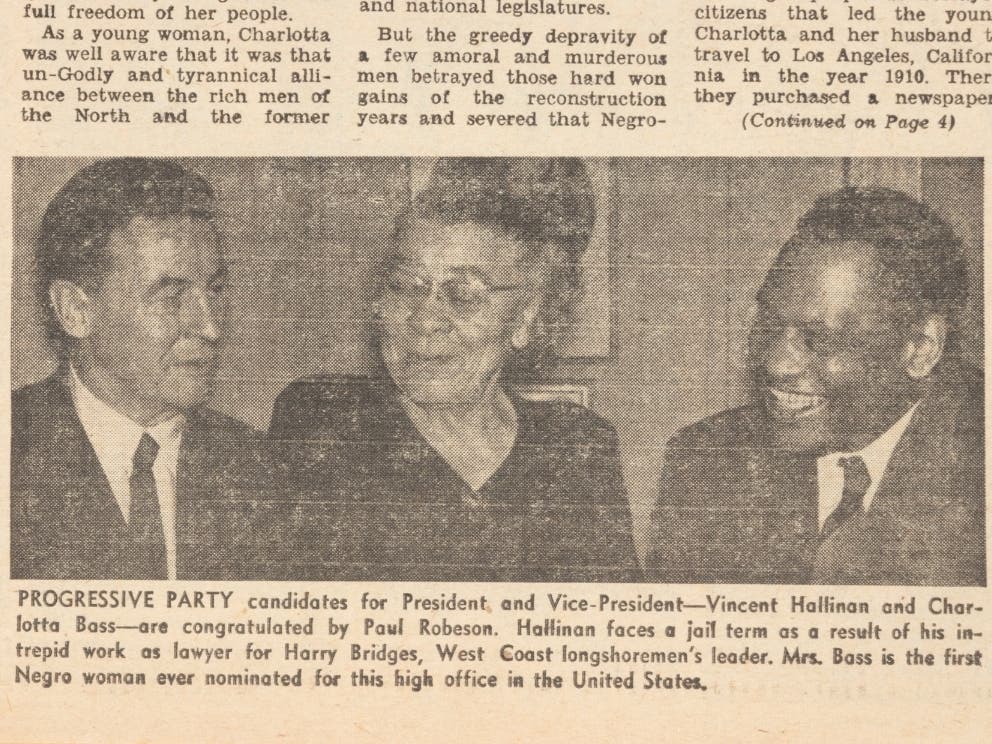
The following year, a Nov. 17, 1951 "Report of the Administrative Committee to the State Committee" of the Progressive Party of Massachusetts indicated why the party was generally unsuccessful in attracting African-American voters in Massachusetts, despite then being supported by Paul Robeson and W.E.B. Du Bois and despite its anti-racist political program:
"White supremacy attitudes are latent in the Progressive Party organization, its attitude toward Negro membership and especially toward Negro leadership in the Progressive Party."
Ironically, in the 21st century, some of the same political problems and weaknesses that characterized the Progressive Party of Massachusetts 74 years ago have also plagued some of the politically progressive groups that are seeking to defund local police departments and use the electoral process to establish rent control and end economic inequality, institutional racism and gentrification in Massachusetts in 2025. (end of article)