

New year, new resolutions, blank slate. That's what most folks think when December leaves us and we enter January, and they're right! It's never too late to get yourself on track with healthy food, diet, and exercise. If you've resolved to begin a health regimen, remember to take it slowly to avoid injury or burnout. Mobility and stretching go hand in hand, and in today's ever moving world, should be combined with stress relieving moves that will help you keep on your resolution track. Below, Roots owner Ginger Boermeester demonstrates three poses to help you de-stress and increase mobility and strength. If you're a beginner, remember that pain is not gain! Modifications for all of the below are available. Double up your mat or use a towel for knee pain. Don't ever put pressure on your head by resting on it.
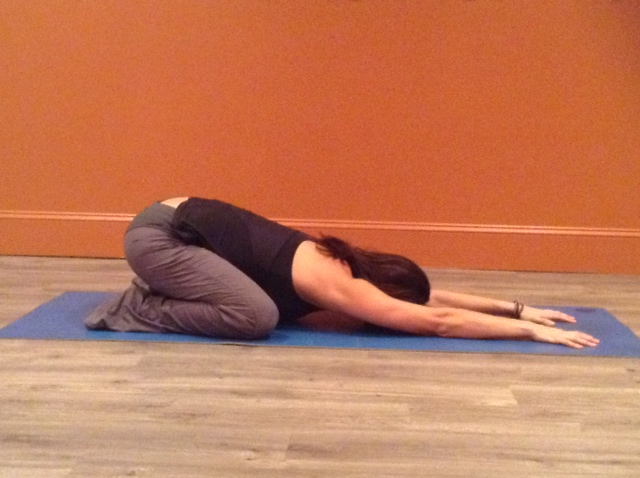
1. Child's Pose, also called Balasana: Child's pose is the foundational resting pose in many yoga classes. Benefits: This pose alleviates pressure in the lower back, hips, and shoulders, and opens your chest, allowing your lungs to fully expand. An excellent restorative pose, it helps ease the mind and can be done any time you need to find your center.
How to feel at peace in Child's pose: Start in a kneeling position, then drop your buttocks toward your heels. Bring your arms above your head and as you fold forward, allow the palms of your hands to rest on the floor in front of you. Your forehead is resting on your mat. You should feel a mild stretch in your shoulders and buttocks and down the length of your spine and arms. Ideally, your buttocks will be resting on your thighs, but it's okay if it's not - with practice and breath, your body should relax into this pose. Stay in this position for five breaths or more, then gently ease back up into a sitting position.
Find out what's happening in Burlingtonfor free with the latest updates from Patch.
2. Cat/Cow, also known as Chakravakasana. Benefits: Improves spinal flexibility and abdominal strength, creates elasticity in the muscles and ligaments of your spine and helps to maintain spinal mobility, increased breath control, improves circulation using diaphragmatic breathing, stimulation of the intestines.
How to increase spine mobility like a cat and cow: Start on all fours, hands shoulder width apart, aligning your shoulders with your wrists. Palms are grounded and knees are below your hips. Elbows are straight, they should not bend at all during this exercise. Your weight should be evenly distributed between your shoulders and hips. Your neck should be long, an extension of your spine, not hanging down. You should be in a straight line from your hips to your knees and from your knees to your ankles. Inhale and tip your tailbone up, lift your chest, and lean forward, allowing your chest to come through your arms. Think of a cow grazing on a field, it's shoulder bones protruding and chest dipping down. On an exhale through your nose, relax your head and tuck your tailbone all the way under, lifting your belly toward your spine. Your hands are grounded and your knees remain under your hips. Think of an angry Halloween cat, spine pushing towards the ceiling, tailbone tucking under. Be sure you are not leaning forward or lifting your head up and down. Inhale to a neutral position for a full breath (inhale/exhale) and repeat pose four more times.
Find out what's happening in Burlingtonfor free with the latest updates from Patch.
3. Puppy Pose, also known as Uttana Shishosana. Benefits: Stretches lower back and hips, releases tight shoulders, aids in balance. A progressive pose, beginners should slowly work their way into a full puppy pose.
How to look like a happy puppy: The puppy pose is a cross between the child's pose and a downward facing dog. Begin on your hands and knees with your knees hip width apart. Now, lower your head, neck and shoulders. Your shoulder blades are coming toward each other and your weight is distributed evenly at the front through both hands. There is no weight distribution on your head. Your legs should form a right angle, meaning your hips shouldn’t come forward when you begin to lower your upper body. If your shoulders are especially tight, try a folded blanket or a block to rest your forehead on. Don't try to come all the way to floor if you feel strained.
Important: This pose requires that your hips stay in line with your body. If you begin to sway or shift or find yourself off balance, ease out of the pose as it can cause your spine to become out of alignment and can strain muscles. Breathe into the pose for as long as you feel comfortable, then come out the same way you came in - by bringing your hands closer and pushing back up into tabletop. You can ease into a child's pose for a reverse stretch if you'd like. * Only go as deep as you feel comfortable.
Beginner's Modification: for knee pain, fold up your mat for more cushion. Place one block (or two) stacked about 6 inches in front of your hands.
We'd love to hear from you if you've tried these poses!
Until next time,
Namaste
For information on classes and upcoming workshops, please visit:
Roots Yoga
220 Cambridge St.
Burlington, MA 01887
(781)272-YOGA
www.myrootsyoga.com www.facebook.com/rootsyogaburlington
rootsyogaburlington@gmail.com