Health & Fitness
I’LL HAVE WHAT HE’S HAVING: LIFE LESSONS FROM THE ALLSTON DELI
In recognition of National Disability Employment Awareness Month, Spaulding VP Oz Mondejar reflects on his own employment history and on the importance of inclusive hiring practices.

October is National Disability Employment Awareness Month. In recognition of this occasion, I thought I would turn the microphone over to my friend and colleague Oz Mondejar, who serves as Spaulding’s Vice President of Human Resources, Communications and Community Relations. Oz is known nationally as a proud advocate for people with disabilities, and as a champion for inclusive architectural design. Take it away, Oz!
At the age of 13, I walked into my first job interview with both wrists in my pockets, trying to delay, for as long as humanly possible, the disclosure that I have only one hand, and on that hand, a total of 5 underdeveloped fingers.
We both had our doubts, that interviewer and I.
Find out what's happening in Charlestownfor free with the latest updates from Patch.
She owned a deli. Why should she hire a 1-handed grocery boy? She thought I would drop stuff.
As for me, I knew I could easily stock the shelves and run her cash register, but I figured she might not give me a chance to prove it.
Find out what's happening in Charlestownfor free with the latest updates from Patch.
The year was 1973. Apparently the disability rights movement and I were both coming of age simultaneously. The passage of the 1973 Rehabilitation Act - which is now viewed as a major turning point in public policy – recognized for the first time that people with disabilities were a distinct group, like women or ethnic minorities, who require special legislation to eradicate discriminatory practices. Prior to ’73, America had assumed that the problems facing people with disabilities, particularly unemployment and lack of education, were rooted in mental or physical limitations associated with disability itself, as opposed to discrimination imposed by society at large.
For those of you who remember the early 1970s, you’ll recall the tremendous amount of social and political upheaval that was taking place. Busing. Vietnam. Watergate. Roe v. Wade. The Equal Rights Amendment. Granted, disability advocates didn’t garner as many headlines as Jane Fonda, or Gloria Steinem, or Deep Throat. Most of the action took place below the radar, in schools and offices and neighborhoods all across the US. Although I didn’t realize it at the time, in some very small way, I was doing my part – one customer at a time - from behind a counter at the Allston Deli. My first job gave me freedom, confidence, and enough savings to eventually buy a car. From the moment I became a grocery boy, in my own mind I was never disabled again. That first paycheck made all the difference.
Writer Juney Kainulainen beautifully captures my experience at the deli when she explains the difference between a disability and a handicap: “Disability is a condition, either emotional or physical. A handicap is the cumulative result of obstacles….If a person using a wheelchair cannot accept a job because it is on the second floor and there is no elevator, the real handicap is that there is no elevator. If someone cannot attend school because there are no ramps or curb cuts, the real handicap is no physical access to an education.”
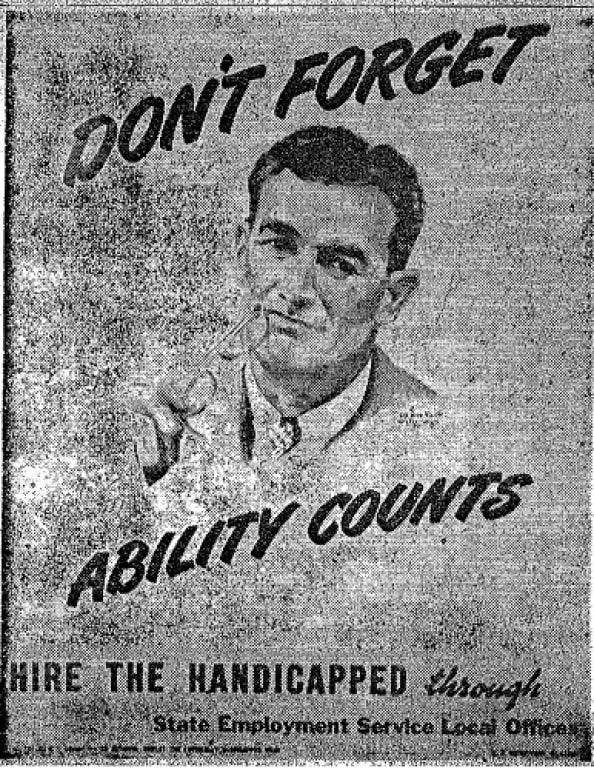
Charlestown, you were so ahead of the curve on all of these issues! As early as the 1940s, your Navy Yard had inclusive employment policies in place, collaborating with the Veterans Administration to provide equal employment opportunities for men and women who were injured during World War II. Rebecca recently showed me an article about this from the Boston Naval Shipyard News. Dated October 9, 1950, the article boldly states, “It’s ABILITY, not disability, that counts…1090 out of 8041 Shipyard workers have some form of disability…not only are well-placed handicapped persons able to meet the expected demands of the job, but frequently…their productive output is much greater than the average.”
I still can’t decide which aspect of this story amazes me more – the fact that the Navy Yard had such a policy in place 60 years ago, OR that someone felt proud enough to publish an article about inclusion in the workforce – in 1950, for Pete’s sake! Hats off to you, Charlestown.
As the Navy Yard’s newest resident, Spaulding is committed to rekindling this strong local tradition of access to employment. One of the best tools at our disposal is the Working Partners Program, a groundbreaking public/private partnership developed by Spaulding in collaboration with the Mass Rehabilitation Commission. Five years in the making, Working Partners combines vocational rehabilitation with job training to help program participants succeed in the workforce. To date, Working Partners has staffed 26 open positions in Massachusetts.
In this difficult economy, the national employment rate is currently 8 percent, and the rate for people with disabilities is more than 1.5 times higher, at 13.5 percent. This is a challenge that all sectors of our economy must face together. The Navy Yard’s history and the Working Partners Program both serve as vivid reminders that individuals with disabilities can make significant contributions to the workforce. Because we move through a world that was not designed to accommodate us, people with disabilities add an element of creativity to everything we do. Successful organizations, like Spaulding, and communities, like Charlestown, are always among the first to embrace this truth.