Community Corner
With election Tuesday, a look back at early Charlestown house party for Maura Healey
As general election approaches, a look back at an early Maura Healy campaign gathering at the Charlestown home of attorney Rich Johnston

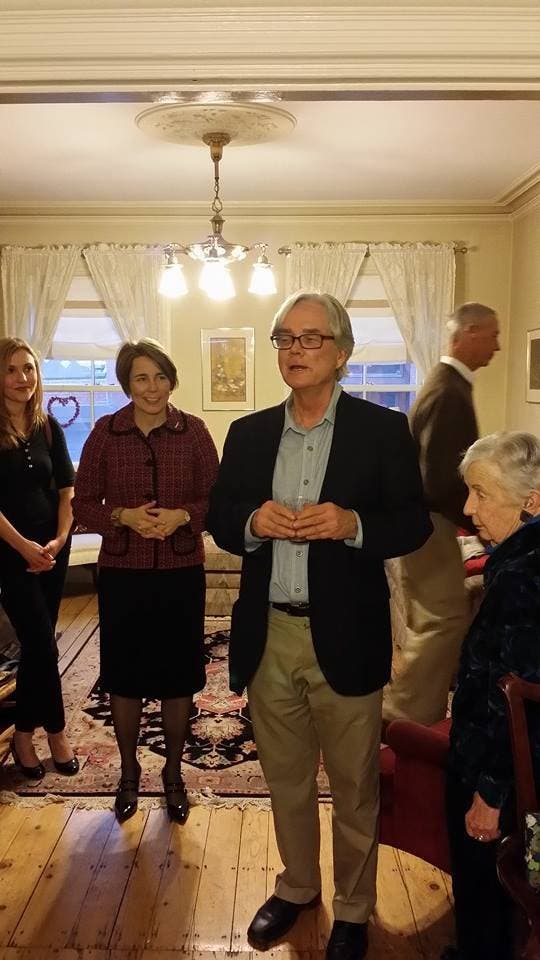
As general election approaches, a look back at a Charlestown
house gathering appearance early in the campaign of AG candidate Maura
Healey
A Monument Ave. early introduction to AG Candidate Healey
By Susie Davidson
On Feb. 1, with the Bunker Hill Monument as a backdrop and amid
community and comestibles, Charlestown resident and newly-announced
candidate for Attorney General Maura Healey outlined a stately
political platform based upon her values, commitment and experience.
It was an early stop on her nascent campaign, which had been announced
in October.
With a town caucus on the horizon, Healey addressed those who had
gathered at the Monument Avenue home of WilmerHale Senior Litigation
Partner Richard Johnston to find out more about this first-time
political candidate.
“I have known Maura professionally and personally for approximately 15
years,” wrote Johnston in the invitation to the meet and greet. “She
previously worked at the same law firm as me, and then moved to the
Attorney General’s Office, where she has fought on behalf of consumers
and civil rights. She has strong progressive values and will make an
outstanding Attorney General.”
Johnston, a 1976 Harvard Law School graduate, said that the two had
worked on cases together in the past.
“When she joined the Attorney General’s office, I knew the Attorney
General’s office was going to be better for it,” he said. “When she
moved to Charlestown, I knew that Charlestown was going to be better
for it. And now that she has become a candidate, this race will also
be better.”
Boston Globe columnist Scot Lehigh called Healey “just the kind of
person you want in politics” in his profile of the next day. He lauded
her “impeccable qualifications” before detailing the remarkable course
of her professional life, which began in New Hampshire and ascended
through Harvard, where she was captain of its basketball team, then to
a two-year stint playing professional basketball in Austria, back in
Boston to attend Northeastern University School of Law. Following a
federal judge clerkship, she served as a litigator for Hale and Dorr
(now WilmerHale), and, following the election of Martha Coakley, chief
of the Attorney General’s civil-rights division. There, she
distinguished herself by leading the challenge to and arguing the case
against the federal Defense of Marriage Act, and eventually, managing
two of the AG office’s five bureau divisions and approximately half of
the office’s staff.
Yet it was also apparent in Johnston’s living room that Healey also
notably possesses a down-home, New Hampshire warmth and genuine sense
of caring for those less privileged and the causes that affect them.
She was candid, personable, gregarious, and altogether very much like
the neighbor-next-door that she is.
“I have to admit that when I found out that she was running for
Attorney General, I was a little surprised, because she hadn’t always
seemed to be like a politician type, which was a compliment,” said
Johnston, who had been cited by Globe columnist Farah Stockman in a
Jan. 7 column on local impact investment efforts to improve social and
environmental climate in developing countries. Johnston was among a
pro bono team of lawyers sent to Freetown, Sierra Leone by WilmerHale
to help create a “special economic zone” that would encourage
manufacturers to relocate there. In September, he represented the firm
as its lead partner in a post-conviction DNA testing case that
reversed the wrongful conviction of Henry Lee McCollum, a North
Carolina death row inmate who had served a 30-year sentence.
“But when I thought about it for about 20 minutes or so,” Johnston
continued in his living room on Feb. 1, “I realized that it was a very
logical thing for her, because she had joined the Attorney General’s
office to do public service, she had risen within the office to become
Martha Coakley’s most trusted confidential aide, she had handled some
of the most important cases in that office, and most importantly, she
cares about so many important issues,” said Johnston. “And I think she
just understood that if she cared so much about them, why not get a
post where she could do something about what she cared about?” he
observed.
“I’m on the trail, out and about in a lot of places, and what a treat
it is to just walk a street over!” Healey began, as the hometown
assembled collectively beamed. After thanking her host for his “kind
introduction” and for holding her talk, she outlined her political
platform. As attendees soon realized, it was not only comprehensive,
but also engaging, rooted in character and strengthened by both
experience and conviction.
“I’m running for Attorney General because I think the role of the AG
has never been more critical,” she said, citing both the many
challenges to Massachusetts residents, families, and businesses, and
her unique ability to effect change. “I understand firsthand how that
office works, how we can get things done, and also, some of the
mistakes that we’ve made, and some of the roads we’ve gone down that
haven’t been as successful,” she said. “And I want to use my
experience and my vision for that office to be your next AG.”
She made a promise to the crowd. “No one is going to be more prepared
to lead, and no one one is going to work harder on Day One, so that
you have an office that is not only is the most effective, but is the
most forward-looking of all AG offices,” she vowed.
“I am new to campaigning, and I am new to politics, which Rich
mentioned,” she continued, recalling her background “before I so
happily landed five years ago on Winthrop Street.” Raised in Hampton
Falls, New Hampshire as the oldest of five children, she said that she
grew up in a home built in 1753. “So I’m a huge fan of Charlestown’s
preservation society, and all the efforts of this wonderful community
to restore and retain our history,” she said. Healey’s mother was a
school nurse, and her father taught high school history, and in
possible formative roles for his daughter, coached sports, and also
led the local teachers’ union. She worked her way through high school,
and during breaks while she studied government at Harvard College, by
waitressing in Hampton Beach.
Often chided for her basketball prowess in spite of her 5’4” height,
she called herself an “unlikely professional athlete in this race,”
but said that her athletic career had continuing benefit. “The
stamina, and some of the rigors of sport and discipline, I’m finding
to be pretty useful here on this journey,” she said. As Coakley’s
civil rights chief, she took the lead on cases in cases the office
brought against predatory Wall Street banks or mortgage brokers, she
explained. “I put together the teams and stood in court, holding those
entities accountable to make sure that families remained whole, and
that even cities and towns that had invested in some of those toxic
security products were able to recover hundreds of millions of
dollars,” she said, while adding that the had always viewed the role
of AG as more than lawsuits and subpoenas.
“I oversaw and designed a program that we’ve had in place over the
last couple of years that’s helped families stay in their homes,” she
said. “These are distressed borrowers who needed help getting a loan
modification of their mortgage.” Healey said she had worked directly
on their behalf with banks to get them into affordable loan payment
programs. “As a result, we kept thousands of families in their homes,
neighborhoods have been stabilized, and it ended up being a win for
the banks, too, because they had streams of payment,” she said. “It
was the right kind of constructive result. And that’s an example of
what Attorney General leadership can do.”
Healey also spearheaded the defense of access to reproductive health
care facilities in Massachusetts. She mentioned the previous month’s
Supreme Court hearings on buffer zones around Massachusetts abortion
clinics. “That was the first piece of legislation I worked on when I
got to the AG’s office,” she said. “And I knew that it was going to be
challenged, so the day that was passed, we started work on the
defense. I trained DA’s, I trained police on that law, and helped put
together the defense of that case. So I went down to the Supreme Court
to watch my former colleague argue it a couple of weeks ago.” She said
the issue will remain prominent both locally and nationally. “We
therefore need an Attorney General who’s going to be an advocate and a
leader in standing up for access to reproductive health care,” she
said, going into her successful challenge to the state’s the Defense
of Marriage Act. “Some of you may not be familiar with this law, but
basically it was a federal law that denied recognition of marriage to
gay married couples here in the state. In the eyes of the federal
government, because of this law, they weren’t actually married,” she
said.
Her three-pronged approach to the Attorney General’s office, she said,
was about “standing up for individuals...making sure that those who
are the most vulnerable among us have the voice and have the advocacy
that they need, and...safeguarding our communities, which means
working in partnership not just with members of law enforcement, but
working with city and town officials, working with community groups,
so that we’re doing the most to promote a healthy community for all of
us,” she said, adding, “And it’s about leading an office with my
values of fairness, accountability, and innovation - that’s what this
is about for me.”
Healey focuses on the concerns of the people of Massachusetts, be they
domestic, personal or fiscal. “It was a matter of unfairness, it was
also a matter of indignity,” she said in reference to the repeal of
DOMA. “But it was also a real pocketbook issue, because many were
paying several thousand dollars a year in taxes for health care
coverage for their spouse. They couldn’t get Social Security, they
couldn’t get Medicaid. They couldn’t get certain pension benefits that
other married spouses enjoy.” Her actions in assembling both the legal
case and its attendant strategy led to successful court arguments for
the defeat of the law. “And happily we saw that law defeated, and the
lawsuit that I was a part of resulted in the first court in the
country striking down that law,” she said, while reminding the
audience that it didn’t stop there. “The dominoes started to fall
around the country in the last year and a half, and most recently, the
Supreme Court decided that that law was dead,” she told them. “And to
me that’s an example of Attorney General leadership, and that’s the
kind of leadership we can bring to this.”
“She’s in it for the long haul,” said Johnston in his introduction,
explaining that Healey had left the attorney general’s office in order
to campaign full time, and get to know people around the state. “I
have been to other functions that she’s spoken at, and I know that the
passion is there,” Johnston continued, amid quips from the lively
assembled. “We could have a little one-on-one here today,” suggested a
female attendee at the mention of Healey’s basketball legacy, which
Johnston also termed indicative of the candidate’s drive and
perseverance.
“It gives you a sense of how competitive she is - and having worked on
cases with her, I also know how competitive she is,” he said. “But
it’s a competition that is infused with a sense of dignity and grace,
and knowing who she is. She grew up among the people, she’s not an
aristocrat, she’s not a snobbish person, she’s somebody who could
relate to just about anybody, and the issues that she cares about are
the issues that affect everybody,” he added.
According to Healey’s remarks, these cover all demographics, and all
ages. “I’m really concerned about student lending,” she said. “I see
some of the same unscrupulous lending practices going on in that
arena, and you couple unscrupulous lending with the increasingly high
cost of education, and families say they can’t do it,” she said.
“I want to be an Attorney General who tackles those issues. I want to
be an Attorney general who gets after for-profit colleges that are
promising veterans and service members and low-income folks,” she
declared, before moving on to privacy issues. “Not just regarding NSA
but companies like Target and Google,” she said. “I want to make sure
that consumers are protected.”
She pointed to a pin on her jacket in the shape of a lipstick tube.
“Lipstick is an organization out of Dorchester that works to prevent
gun violence,” she said. “You may remember Stephen Odom, who was
killed in 2007 by a stray bullet, just feet from his home. Lipstick
was started by his mother, Kim,” she said.
Lipstick (which stands for Ladies Involved in Putting a Stop to Inner
City Killing and is aimed at girls and women) sponsors training
sessions on the root causes of gun violence. “This is so that don’t
become straw buyers, who purchase guns for their boyfriends and male
associates,” said Healey, who also mentioned her work in the areas of
opioid and prescription drug abuse. “I have been horrified at the ages
of kids that get addicted to drugs,” she said. “I want to make sure
that we are on the front end of efforts to combat this situation.”
One audience member asked about programs that have helped mitigate
student disputes in the Boston Public School system. “Fund mediation
has provided crucial assistance in these problems of ‘he said, she
said,’” she said. “But the funding has unfortunately dried out.” She
asked Healey if she would have the opportunity to look into such
support.
“Mediation works among kids, among adults,” said Healey, who pledged
her commitment to such approaches.
“We still use settlement funds to support programming,” she said,
giving an example of monies recovered from sales of illegal drugs
going to support mental health programs. “We are using such revenue
for grant programs,” she said. “We passed an antibullying law in this
state. It was intended to raise the profile, and to have antibullying
programming in place,” she said.
“We should be training and working with kids regarding gun violence at
home. I will support the use of funds in that way. The concept is
something we ought to make use of,” she pledged.
Healey called the Attorney General’s office the “lifeblood of this
state” and told the group about a young boy she met years ago who
could not access the capabilities of iTunes because he was blind. “I
got on the phone to Apple to make sure they programmed accessibility
for the disabled into their products, and when the iPhone came out, it
was accessible,” she said. “The office exercises regulation authority
thoughtfully and effectively, in the most informed way,” she said.
“That vision shows some of what it takes to get results,” she said.
“It’s an example of the power and capacity of that office to do good.”
She stressed the comprehensive nature of its work.
“Agencies can be agents of change,” she said. “One responsibility of
the agency is to represent agencies as their lawyer. But it is also
the front end in areas that affect citizens. Prophylactically, we are
addressing issues before they go to litigation.”
Registered Democrats in Charlestown held a caucus at the Harvard-Kent
School at 50 Bunker Hill St. on February 11 at 6:30 p.m., where 13
delegates and three Alternates were elected to the 2014 Massachusetts
Democratic Convention held on June 13 and 14 at the DCU Center in
Worcester. At the convention, attendees cast votes to endorse
candidates for statewide office. (In order for a candidate to get onto
the state primary ballot, he/she must receive 15 percent of the vote
at the state convention.) In Worcester, Healey received 2,094 delegate
votes to her opponent former State Senator Warren Tolman’s 2,254, but
went on to defeat Tolman, who had the backing of Governor Deval
Patrick and Mayor Martin J. Walsh as well as other major local
political and labor officials, by a wide margin of 62.4 to 37.6
percent in the Sept. 9 Democratic primary for attorney general. In
Tuesday’s final runoff, she faces Winchester attorney John Miller in
this coming Tuesday’s general election.
Donna O’Brien, who described herself as a past Democratic campaign
volunteer, explained at Johnston’s gathering that caucus attendees can
fulfill many roles. “Some speak on behalf of the candidate, some sign
papers and perform other functions,” she said. “They help to build
some momentum going into the caucuses.”
“I want you to know who I am. I’m counting on Charlestown,” Healey
said in closing on Feb. 1.
“She is the candidate with the best experience been doing the job for
seven years,” said Francis Bingham of Cambridge, a classmate of
Johnston’s daughter at Boston College Law School, after the talk. “She
is not a career politician.” Bingham said that from listening to
Healey, he gained a broader understanding of the AG office. “I now see
the office as one that stands for protecting the vulnerable, and not
just an office to defend the state against lawsuits,” he said.
Classmate Gregory Bradford concurred. “The consumer protection aspect,
and especially student loan issues impressed me,” he said. “Students
across the state rely on these loans, and are affected for many years
thereafter,” he said.
“As a child psychologist, I was taken by Maura’s statements on
substance addiction in the very young,” said Barbara Daley, who is the
wife of one of Healey’s former Partners at WilmerHale. “The fact that
she is aware of it and committed to action is extraordinary,” she
said. “The breadth of her knowledge, and the emphasis that she is able
to place on so many different issues are quite impressive,” she said.
For more information, visit www.MauraHealey.com or visit her campaign
office at 89 Cambridge St. in Charlestown.